England
The English stick world: coppicing, hedge-laying, the British Stickmakers Guild, the Lake District hill-walking tradition, and single-stick — the largest working stick economy in the British Isles.
The English stick world is the largest working stick economy in the British Isles by volume of contemporary practice. The British Stickmakers Guild has its centre of gravity in England; the substantial majority of agricultural-show stick-making competitions happen at English venues; the Lake District hill-walking-stick economy and the Sussex/Kent hedge-laying tradition both sit within English territorial bounds; and the documented coppice tradition that produced most of the British Isles’ working stick-stock for the last three thousand years is principally an English tradition with related Welsh and Irish parallels.
For a journal whose centre of gravity is the Irish stick tradition, this is an important corrective. The Irish material is editorially central to this site (see Ireland); the English material is larger by volume and deserves treatment on its own terms.
This page is the entry point — orientation, reading-order suggestions, and a structural overview. The actual editorial content lives in the linked articles.
Coppicing — three thousand years and counting
The English coppice tradition is the oldest documented working-woodland practice in northern Europe, with archaeological evidence pushing the practice back into the early Neolithic. The most striking single piece of evidence is the Sweet Track in the Somerset Levels — a wooden trackway across boggy ground, dated by dendrochronology to 3807–3806 BC (the earliest precisely-dated wooden structure in northern Europe), constructed substantially from coppiced hazel and oak rods. The Sweet Track demonstrates that English coppice woodland management is at least 5,800 years old as a continuous practice; the technique’s extension into the Bronze Age and the long Iron Age is similarly well-documented.
Coppicing is the practice of cutting a hardwood tree close to the ground and allowing it to regenerate from the stump (the “stool”), producing multiple straight pole-stems suitable for working timber. The technique works particularly well for hazel, ash, sweet chestnut, and oak — all major English stick woods — and produces enormous yields of working stem-material from a relatively small woodland area on a sustainable cutting cycle (typically 7–25 years between cuts depending on species and use).
The English working-stick supply has, for most of the last three thousand years, drawn substantially on coppice products. A coppiced hazel rod at 7-year cutting age produces a straight, even-tapered, smooth-stemmed pole roughly perfect for a walking stick blank; coppiced ash at 15-year cutting age produces hill-walking-stave material; coppiced sweet chestnut at 12-year cutting age produces light and durable working stems for fences, hurdles, and walking sticks. The English stick maker working in coppice timber is operating within an inheritance of technique that runs back into the Neolithic.
For the canonical English coppice woods see Hazel, Ash, Chestnut, and Oak. Oliver Rackham’s History of the Countryside (1986) and Ancient Woodland (2003) are the canonical reference texts on English woodland history; both should be on the shelf of anyone seriously interested in the English working-stick tradition.
Hedge-laying
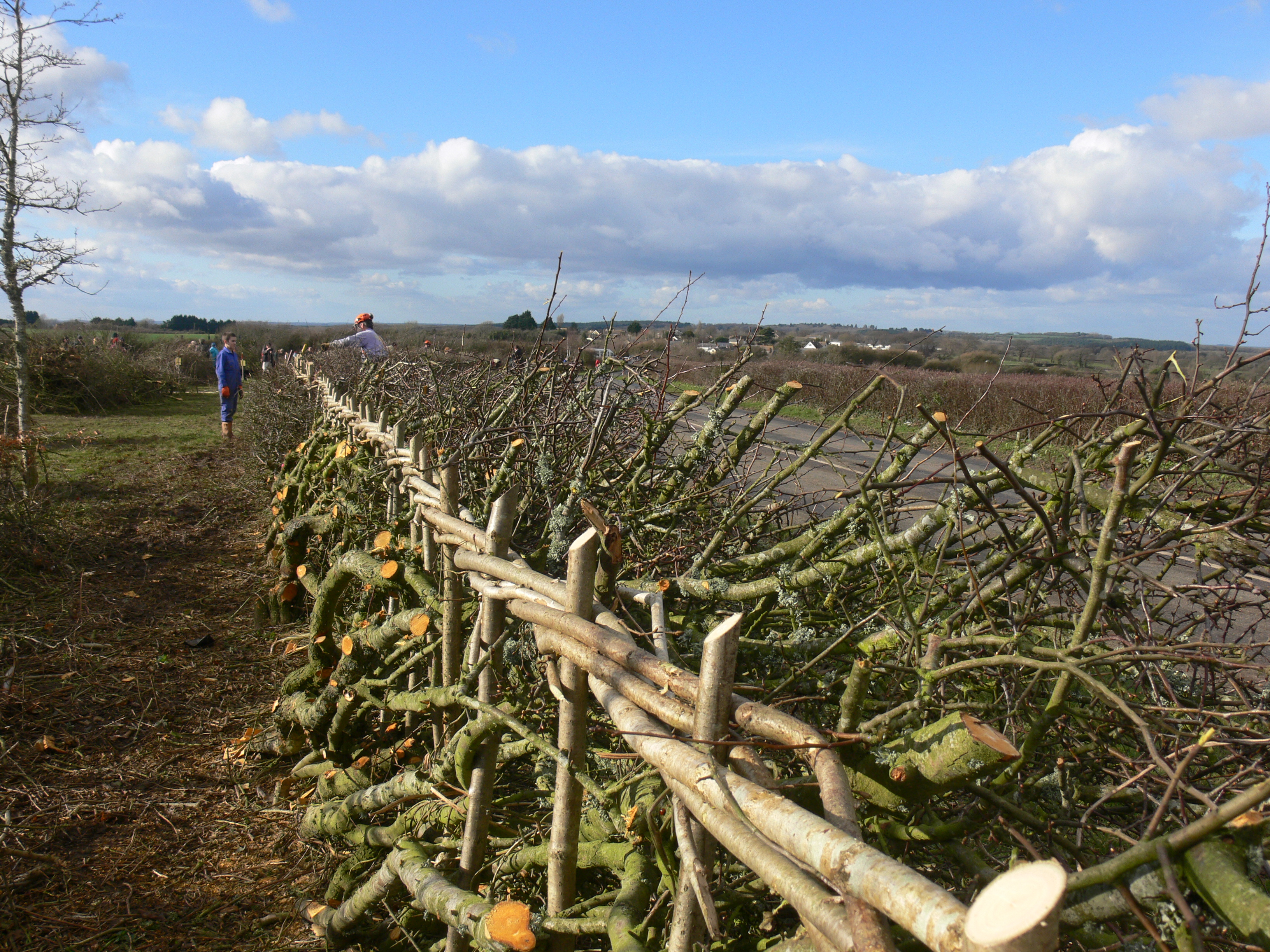
Closely related to coppicing but a distinct practice: hedge-laying is the rural craft of partially cutting and bending live hedge stems into a woven hedge that grows back into a stock-proof barrier. The practice produces, as a by-product, substantial quantities of working stem-material — shillelagh-quality blackthorn, hazel, ash, hawthorn, and field-maple stems all come, in significant volume, from the trimmings and “binders” generated by hedge-laying work.
The English regional styles are well-codified, with the National Hedgelaying Society maintaining recognised regional traditions:
Midland style — the canonical Leicestershire-and-Warwickshire tradition; tall, heavy, stockproof against cattle and sheep South of England style — lower, lighter, suited to sheep country in the southern counties Welsh-Border style — distinctive double-row construction; suited to the Welsh-English border country North Somerset style — short and stout, suited to the West Country grazing land Westmorland style — light, narrow, suited to the upland Cumbrian terrain Lancashire and Yorkshire style — heavier than Midland, with substantial regional variation
The annual National Hedgelaying Championships rotate between the major regional traditions, with substantial entries from working hedge-layers and a substantial spectator presence. The competition culture is closely linked to the broader rural-craft and county-show economy.
For the working-stick connection: most working English stick-makers either lay hedge themselves or have arrangements with local hedge-layers for first refusal on the year’s cuttings. A 7-cycle coppice woodland produces stick-stock; a working hedgerow with an experienced laying tradition produces a different and complementary stream of stick-stock, particularly the awkward-grown, gnarled, character-rich pieces that show-stick competition values most highly.

The British Stickmakers Guild
The British Stickmakers Guild (founded 1984) is the principal institutional body of the modern British and English working stick tradition. The Guild has approximately 800–1,000 members across the British Isles (with the substantial majority in England), maintains a journal and a working set of competition standards, and is the principal organiser of inter-club competition through its regional structure.
The Guild’s principal activities:
Competition standards and judging. The Guild has codified a set of competition categories (working sticks, fancy sticks, presentation sticks, market sticks, thumb sticks, shepherd’s crooks, novelty sticks, and others) with formal judging criteria, providing a consistent standard for the agricultural-show stick-competition culture.
Member education and information. The Guild runs workshops, demonstrations, and information events; it publishes a regular journal; and it maintains an active member community.
Professional development. The Guild operates a recognised hierarchy of member grades, with progressively more demanding qualification requirements; achievement of the higher grades is a meaningful credential within the working stick-making community.
International outreach. The Guild has corresponding members internationally and provides a recognised English-tradition entry-point for stick-makers in other countries who want to engage with the British and English standards.
The Guild’s regional clubs (with concentrations in the Midlands, the Yorkshire/Lancashire/Cumbria area, the South-West, and East Anglia) provide the day-to-day institutional life of the working stick-making community.
Agricultural-show competition
The English agricultural-show culture is the principal venue for working stick-making competition. The major shows include:
Royal Cornwall Show — the South-West’s principal agricultural exhibition, with a substantial stick-making category Royal Bath & West Show — Somerset’s major regional show, with strong stick-making participation Royal Highland Show — Scotland’s principal agricultural event, with the major Scottish stick-making competition (and substantial English participation) Great Yorkshire Show — Yorkshire’s principal show, with a developed stick-making category Royal Welsh Show — Wales’s principal agricultural exhibition, with the major Welsh stick-making competition (particularly strong on shepherd’s crooks) Various county shows across the English shires (Hampshire, Sussex, Kent, Devon, Norfolk, Lincolnshire, and others) with substantial stick-making participation
The competitions follow British Stickmakers Guild standards, with awards and prize money meaningful to the working community and substantial spectator interest. A serious working stick-maker in modern England plans her year around the show calendar; achievement at the major shows confers both income and professional standing.
The Lake District hill-walking-stick tradition
The English upland — particularly the Lake District in Cumbria but also the Yorkshire Dales, the North Pennines, and the Peak District — has a distinctive hill-walking-stick economy. The principal characteristics:
- Working sticks rather than presentation pieces — designed for hill-walking and sheep-work, with utility prioritised over decoration
- Ash and hazel dominance, with occasional rowan and (in modern decades) imported hickory
- Shorter and heavier than typical Welsh shepherd’s-crook tradition, suited to the Lakeland hill terrain
- The Lakeland horn-handle tradition — many working Lakeland sticks have horn handles (ram’s horn for working sticks, polished cattle horn for finer pieces) — a regionally-distinctive styling
- Substantial competitive presence at the regional agricultural shows, with the Lake District clubs of the British Stickmakers Guild concentrated here
The Lake District stick-economy is closely linked to the broader Herdwick sheep tradition — the indigenous Cumbrian sheep breed and the substantial working-shepherd culture that maintains it. A working Lakeland stick is, in many cases, a shepherd’s stick first and a walking stick second.
Single-stick — the lost English martial art
England’s principal contribution to European stick-arts is single-stick — the lost martial art of one-handed wooden-stick fencing, popular through the eighteenth and nineteenth centuries and substantially extinct as a continuous practice by 1914. See Single-stick for the full treatment.
The form’s relevance to the English regional cluster: single-stick was the canonical English contribution to the European fencing-stick world, sat alongside French canne de combat (see Canne de combat) and Irish bataireacht (see Bataireacht) as one of the three substantial nineteenth-century stick-arts traditions in Western Europe, and survives in modern HEMA reconstructive practice. England’s single-stick tradition is the historical-martial-arts cousin of England’s coppice-and-walking-stick tradition; a working Englishman in 1850 might well have used a single-stick at a country fair using a stick of the same wood that he carried for everyday walking.
Working forms — the English walking stick
The English working stick — the everyday walking aid carried by a working English man or woman through the eighteenth, nineteenth, and twentieth centuries — is recognisably its own form, distinct from the Welsh shepherd’s crook (see The shepherd’s crook) and the Scottish thumb-stick (see The thumb-stick).
The English working stick:
- Around 36–42 inches (91–107 cm) in length
- Typically ash, hazel, hawthorn, or hickory; occasionally chestnut, blackthorn, or yew
- Straight or with a modest crook handle
- Modest fittings — brass or steel ferrule, leather wrist-strap, simple horn or wooden head
- The user grips at the top with hand-over-head configuration
- Designed for walking and modest support rather than for ceremony, fashion, or martial use
The form is the workmanlike English answer to the Welsh and Scottish working sticks. Within the British Stickmakers Guild competition culture, the “market stick” category (a plain straight working stick suitable for everyday use) is closely identified with the English working tradition.
The walking cane (see The walking cane) is a different and distinctively urban-English tradition — the Victorian and Edwardian gentleman’s accessory, distinct in form, register, and material from the rural English working stick.
Reading order
For a reader new to the English stick tradition:
- Start with the wood pages — Hazel, Ash, Hawthorn, Oak, and Chestnut — for the material foundation
- The form pages — The shepherd’s crook, The thumb-stick, The walking cane — cover the principal English forms
- Single-stick and Swagger sticks cover the English martial-arts and ceremonial register
- Other woods of note covers the second-tier English stick woods (crab apple, wild cherry, beech, willow, dogwood, elder, yew)
- Irish vs Scottish vs Welsh sticks provides the regional-comparison context
A note on coverage
The English stick tradition is large enough that the journal’s current coverage is necessarily partial. The journal welcomes contributions from working English stick-makers, particularly Stickmakers Guild members and working hedge-layers, on:
- Specific named English makers and their working traditions
- Regional details on the various Lake District, South-West, East Anglian, and Yorkshire/Lancashire stick-making cultures
- Hedge-laying-to-stick-making working pipelines, which the journal has sketched in outline but not investigated in depth
- The competition history of the British Stickmakers Guild, which deserves substantially more detailed treatment
Working corrections and additions: [email protected].
Sources & further reading
- Rackham, O. (1986) — The History of the Countryside, J.M. Dent / WorldCat
- Rackham, O. (2003) — Ancient Woodland: Its History, Vegetation and Uses in England, Castlepoint Press / WorldCat
- British Stickmakers Guild, British Stickmakers Guild
- National Hedgelaying Society, National Hedgelaying Society
- The Sweet Track — Somerset Levels Project, Somerset Heritage
Related reading
- woodsIs Hazel a Hardwood?
The coppice wood par excellence — light, springy, abundant, and with the longest unbroken folk-tradition of any British or Irish tree.
- woodsAsh
The springy, impact-resistant wood of staves, tool handles, and the Irish hurling stick — and the species now in the middle of a Europe-wide health crisis.
- woodsOak
The other Irish stick wood — older, heavier, and the source of the original Wicklow shillelaghs.
- woodsHawthorn Wood: Hardness & Uses
Blackthorn's hedgerow companion: lighter in colour, no less dense, and the fairy tree of British and Irish folklore.