Chestnut
Sweet chestnut — the English coppice wood with the second-longest continuous working tradition in Europe, and a stick wood that competes honestly with oak at lower density.
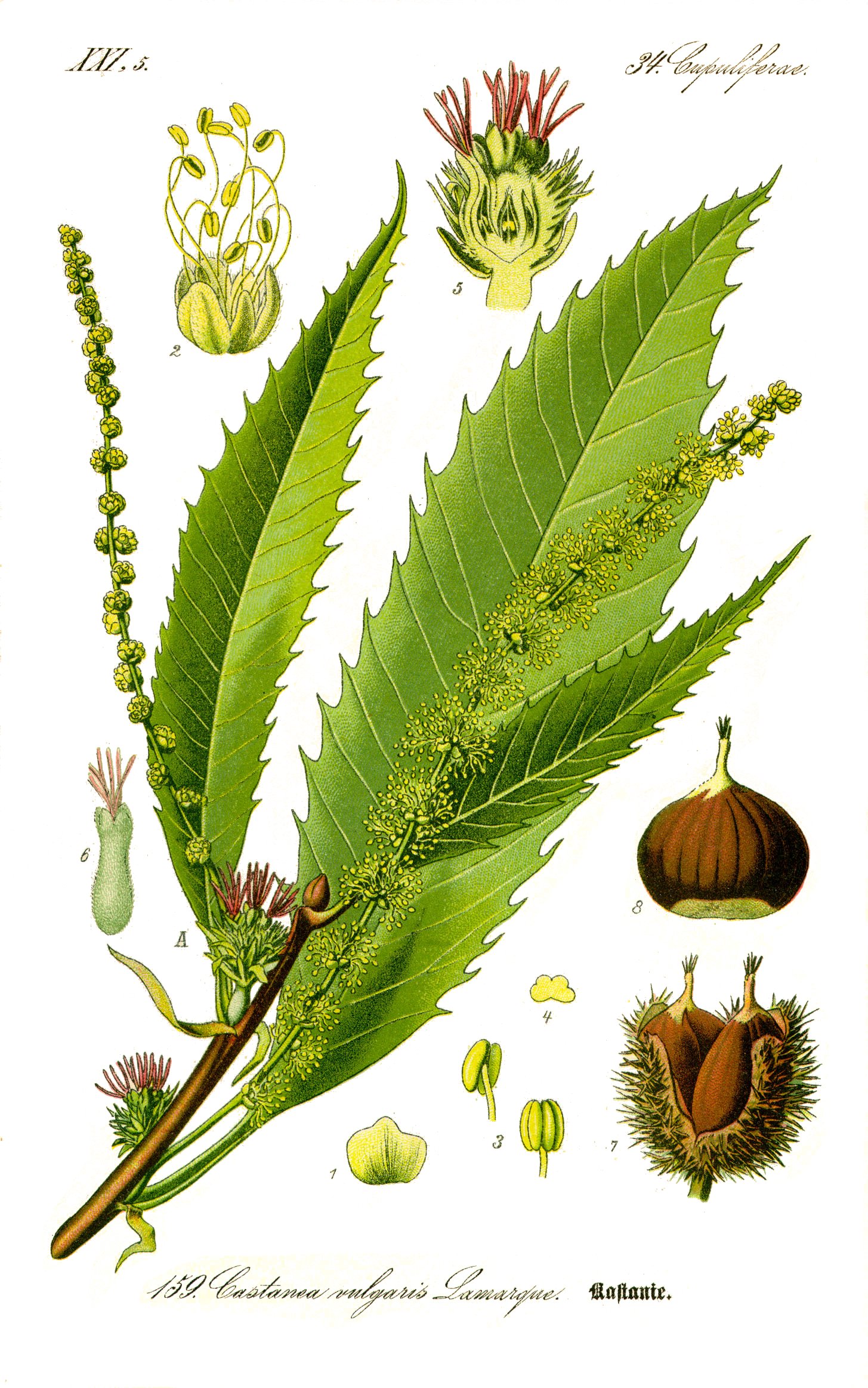
Sweet chestnut is the second-longest continuous working coppice wood of the British and Irish landscape — second only to hazel. The Romans introduced the species to Britain at some point in the first or second century AD, planted it widely in the south-east of England, and the resulting coppice woodlands have been continuously managed for sweet-chestnut pole-wood for at least eighteen hundred years. Kent, Sussex, and Surrey still hold large managed sweet-chestnut coppices that supply the working English fencing, hop-pole, and stick trades.
For a publication oriented toward Irish blackthorn, sweet chestnut sits at an interesting angle. It is not a native British or Irish tree; it is a Roman introduction. It is not dense — at ~550–600 kg/m³ it is lighter than oak and substantially lighter than blackthorn or hawthorn. But it has been worked into walking sticks across both England and southern Europe for centuries, and a sweet-chestnut walking stick from a serious coppice maker in Kent has its own quiet character. It is also the canonical wood of the French canne de combat (see /history/canne-de-combat/), which alone earns it a reference page.
This is the reference treatment.
Quick reference
| Common names | Sweet chestnut, Spanish chestnut, castaña (Spanish), châtaignier (French), castagno (Italian) |
| Binomial | Castanea sativa Mill. |
| Family | Fagaceae (beech and oak family) |
| Native range | Southern Europe — particularly the Mediterranean basin from Spain through Italy to the Balkans and into Turkey; introduced and naturalised in Britain by the Romans (~1st–2nd century AD); ancient introductions across temperate Europe |
| Habit | Large deciduous tree, 20–35 m at maturity; long-lived (500–700 years on the best sites); coppices vigorously |
| Bark | Smooth and grey on young trees; deeply spiral-fissured on mature trees, with a characteristic twisting that distinguishes sweet chestnut from oak at twenty paces |
| Leaves | Long lance-shaped, sharply serrated, 12–25 cm; deep glossy green |
| Flowers | Long pendulous yellow-green male catkins in late spring; small green female flowers at the base of catkin axes |
| Fruit | Chestnuts in spiny green husks that split open in autumn; one to three nuts per husk |
| Wood density | ~550–600 kg/m³ |
| Janka hardness | ~3,500–4,000 N — softer than European oak |
The plant
Sweet chestnut is in the Fagaceae — the same family as oak and beech — and shares with both the deeply-fissured mature bark, the tannin-rich heartwood, and the pattern of producing fruit (chestnuts in this case, acorns and beech-nuts in the relatives) that has been an important food source across European history.
The diagnostic features:
The long lance-shaped serrated leaves are unmistakable. At twelve to twenty-five centimetres long with sharply-pointed serrations along the entire margin, sweet chestnut leaves are visually unlike any other British or Irish tree leaf. Mature trees produce these leaves in dense canopy and the autumn turn — a clear yellow before browning and falling — is one of the more striking autumn-colour signals in the south-east-English countryside.
The spiny fruit husks are the second diagnostic. Each husk contains one to three nuts (in C. sativa; the related C. dentata of North America had similar fruit before the chestnut blight crisis), and the husks split open along four sutures in autumn to release the nuts. The husks are unmistakable on the ground beneath a fruiting chestnut and are sharp enough that experienced foragers wear gloves.
The spiral bark of mature trees is the third. Where oak fissures vertically, sweet chestnut develops a characteristic spiral pattern around the trunk — sometimes called “barber-pole” fissuring — that is, in older trees, dramatic enough to be diagnostic at distance.
The tree lives a long time. The Tortworth Chestnut in Gloucestershire, recorded as a notable specimen since the seventeenth century and probably planted before the Norman Conquest, is one of the oldest known British trees and has been continuously documented across nine centuries [VERIFY against Tortworth-specific historical records].
The English coppice tradition
Sweet chestnut’s place in the English landscape is, to a degree that surprises people who don’t know the south-east-English countryside, enormous. Roman-period plantings in Kent and Sussex produced woodlands that have been continuously coppiced for at least 1,500 years; the modern Kentish coppice industry runs in the same managed woodlands, on the same twelve-to-eighteen-year rotations, producing the same pole-wood for the same uses.
The dominant traditional uses for sweet-chestnut coppice pole-wood:
Fencing palings — the cleft-chestnut fencing that lines the South Downs and the Kent and Sussex countryside is the canonical English chestnut product. Pales are split radially from coppice poles, sharpened at one end, woven with wire to form the standard agricultural-and-domestic fencing. Hundreds of thousands of metres of cleft-chestnut fencing are made and installed annually in southern England.
Hop poles — the hop-growing industry of Kent and Sussex used sweet-chestnut poles extensively until the post-war shift to wirework. Much of the surviving Kentish chestnut coppice was originally established for hop-pole production.
Building — sweet chestnut is moderately durable, tannin-rich, and rot-resistant in contact with soil; it has been used historically for building cladding, joinery, and barn-frame work.
Walking sticks and other small-craft items — the secondary use after fencing and hops. Sweet-chestnut walking sticks are produced by a small number of working English coppice makers, particularly in Kent and the Weald.
Oliver Rackham’s The History of the Countryside (1986) is the standard reference for the English coppice tradition; sweet chestnut features extensively in his treatment of the south-eastern woodlands.
The wood
Sweet chestnut is ring-porous, like oak and ash, with the early-wood vessels prominent and the late-wood denser. The figure is similar to oak but with several differences:
- Lower density — ~550–600 kg/m³ versus oak’s ~700–760 kg/m³. Sweet chestnut is, at equivalent dimensions, about fifteen percent lighter than oak.
- Less interlocked grain — sweet chestnut tends to be straighter-grained than oak, with less of the figure-and-fleck character that gives quarter-sawn oak its visual distinction.
- Tannin-rich — sweet chestnut has very high tannin content, comparable to or above oak. This makes the wood rot-resistant in soil contact but also stains badly when in contact with iron (the tannin reacts with iron to produce dark blue-black streaks; iron fastenings are avoided in chestnut work).
The colour is pale to light brown when freshly worked, deepening to a soft honey with oil and age. Sapwood and heartwood are less strongly distinguished than in oak; a sweet-chestnut shaft often looks uniform along its length.
For walking-stick purposes, sweet chestnut produces a stick that is:
- Lighter than oak at equivalent dimensions — about fifteen percent less weight in the hand
- Springier under load than oak; closer to ash in flex behaviour
- Open-grained with visible ring-porous figure on the surface
- Pale to light tan, ageing to honey; visually distinct from blackthorn (much darker) and from holly (much paler)
- Available in clean lengths to about three feet typically; sweet chestnut’s coppice growth produces straight pole-wood reliably to walking-stick length
The wood’s working register is English coppice — closer to a working country-walking stick than to a formal show-stick. A sweet-chestnut stick from a Kent coppice maker is a piece of regional English material culture in a way that an oak or blackthorn stick from a different region would not be.
The French canne tradition
The other major sweet-chestnut stick tradition is French. The canne de combat — the French martial art of stick-fighting that developed in nineteenth-century Paris — uses a slender chestnut walking stick about ninety-five centimetres long with a rounded knob at one end. The wood is light enough for the rapid two-handed fencing-style techniques of the sport while being durable enough to take competitive impact.
Modern competition canne de combat sticks are still predominantly chestnut, with strict specifications maintained by the Fédération Française de Savate Boxe Française & DA. The full treatment is at /history/canne-de-combat/.
Cutting and seasoning
Sweet chestnut seasons more easily than oak. The wood:
- Dries quickly — typical seasoning runs six to eighteen months for stick-grade pieces, half the time of oak
- Resists checking — the relatively low density and even grain reduce surface checking risk
- Holds straight through seasoning if bound properly
- Takes oil deeply — sweet chestnut absorbs linseed and similar penetrating oils readily, and the surface darkens visibly with each application
Cutting is in winter for working coppice, with the cut shafts taken from selected stems of two-to-four-year regrowth. Older coppice (ten years and more) produces larger pieces suitable for fencing, joinery, and structural work; the stick-grade pole-wood is from the younger growth.
After seasoning, the wood is debarked (in most working tradition; some pieces retain bark for decorative effect), trimmed to length, fitted with handle and ferrule, and finished with linseed oil and beeswax.
A note on iron contact: any metal fitting (ferrule, nameplate, nail) that will be in contact with sweet chestnut should be brass, copper, stainless steel, or aluminium rather than ferrous. Iron fittings will produce blue-black tannin-iron stains in the wood within weeks of contact, particularly under any moisture exposure.
Chestnut blight and ink disease
The species’ modern decline has been substantial.
Chestnut blight (Cryphonectria parasitica) is the larger story, though primarily affecting North America. The fungus arrived in New York around 1904 from imported Asian chestnut nursery stock; over the following four decades it killed the great majority of mature American chestnut (Castanea dentata) trees across the eastern United States. The American chestnut, which was a dominant canopy tree in the eastern North American forest, was effectively eliminated as a mature-timber species by 1950. The European C. sativa is less susceptible but not immune; chestnut blight reached Europe in the 1930s and has affected European chestnut populations modestly since [VERIFY current Forest Research figures on European Castanea sativa mortality].
Ink disease (Phytophthora cinnamomi and related species) attacks the roots of sweet chestnut, causing characteristic black “ink-stain” lesions and progressive decline. Ink disease is the more serious current threat to C. sativa in southern Europe (Italy, Portugal, France) and is gradually establishing in Britain.
The cumulative effect is that sweet chestnut, while still abundant in working English coppice and still actively managed, faces real long-term ecological pressure. The South-East-English coppice industry has so far managed to maintain working populations through careful management, but the trajectory is uncertain.
Sweet chestnut vs other stick woods
The summary, for a reader placing chestnut in the broader stick world:
vs oak: chestnut is lighter, springier, more open-grained, and easier to season; oak is denser, more uniform, and has the deeper cultural register in British and Irish stick-making. For a walking stick where weight matters, chestnut; for a show piece or formal stick, oak.
vs ash: similar weight class, similar working character; both ring-porous, both shock-resistant at moderate density. Sweet chestnut has more tannin (matters for fitting choice); ash has the dieback crisis (matters for supply). For a working hill-walker’s stick, either; for a hurling stick (camán), ash by tradition and rule.
vs blackthorn: completely different — chestnut is pale and light, blackthorn is dark and heavy. The two woods are answers to different questions; not directly substitutable.
vs French canne sticks specifically: chestnut is the canonical French canne wood and the Fédération Française specifications privilege chestnut. A non-chestnut wood (oak, ash, hickory) can be made into a canne but reads as nonstandard.
Beyond sticks
Sweet chestnut’s broader uses across British, Irish, and southern European material culture:
Fencing — the canonical Kent and Sussex chestnut paling fence Hop poles — declining but historically important Joinery — particularly cladding, weatherboarding, and exterior building work where the wood’s tannin-driven rot resistance matters The chestnut nut — sweet chestnuts are a substantial autumn food crop across southern Europe; roasted chestnuts remain a winter street-food across Italy, France, and parts of Spain Coopering — historically used for cask-staves where oak was expensive or unavailable, particularly in southern Europe Furniture — secondary use after oak; sweet chestnut furniture is recognisable by its slightly lighter colour and more open grain
This is the reference page for sweet chestnut as a stick wood. The English coppice tradition more broadly is at England; the French canne use at Canne de combat; the wood-side comparison among the British and Irish stick woods at Holly vs blackthorn vs oak vs ash. Corrections from working English coppice makers and from canne de combat practitioners are welcome at [email protected].
Sources & further reading
- Castanea sativa Mill. — Plants of the World Online, Plants of the World Online, Royal Botanic Gardens, Kew
- Sweet chestnut — A-Z of British Trees, Woodland Trust
- Sweet chestnut — wood properties, The Wood Database
- Forest Research — sweet chestnut blight (Cryphonectria parasitica), Forest Research, UK
- Oliver Rackham, The History of the Countryside (1986), Dent / WorldCat
Related reading
- woodsOak
The other Irish stick wood — older, heavier, and the source of the original Wicklow shillelaghs.
- woodsHawthorn Wood: Hardness & Uses
Blackthorn's hedgerow companion: lighter in colour, no less dense, and the fairy tree of British and Irish folklore.
- woodsAsh
The springy, impact-resistant wood of staves, tool handles, and the Irish hurling stick — and the species now in the middle of a Europe-wide health crisis.
- comparisonsHolly vs blackthorn vs oak vs ash
Four traditional stick woods, side by side: how they look, how they behave under the hand, and which one belongs in which kind of stick.