Hawthorn Wood: Hardness & Uses
Blackthorn's hedgerow companion: lighter in colour, no less dense, and the fairy tree of British and Irish folklore.
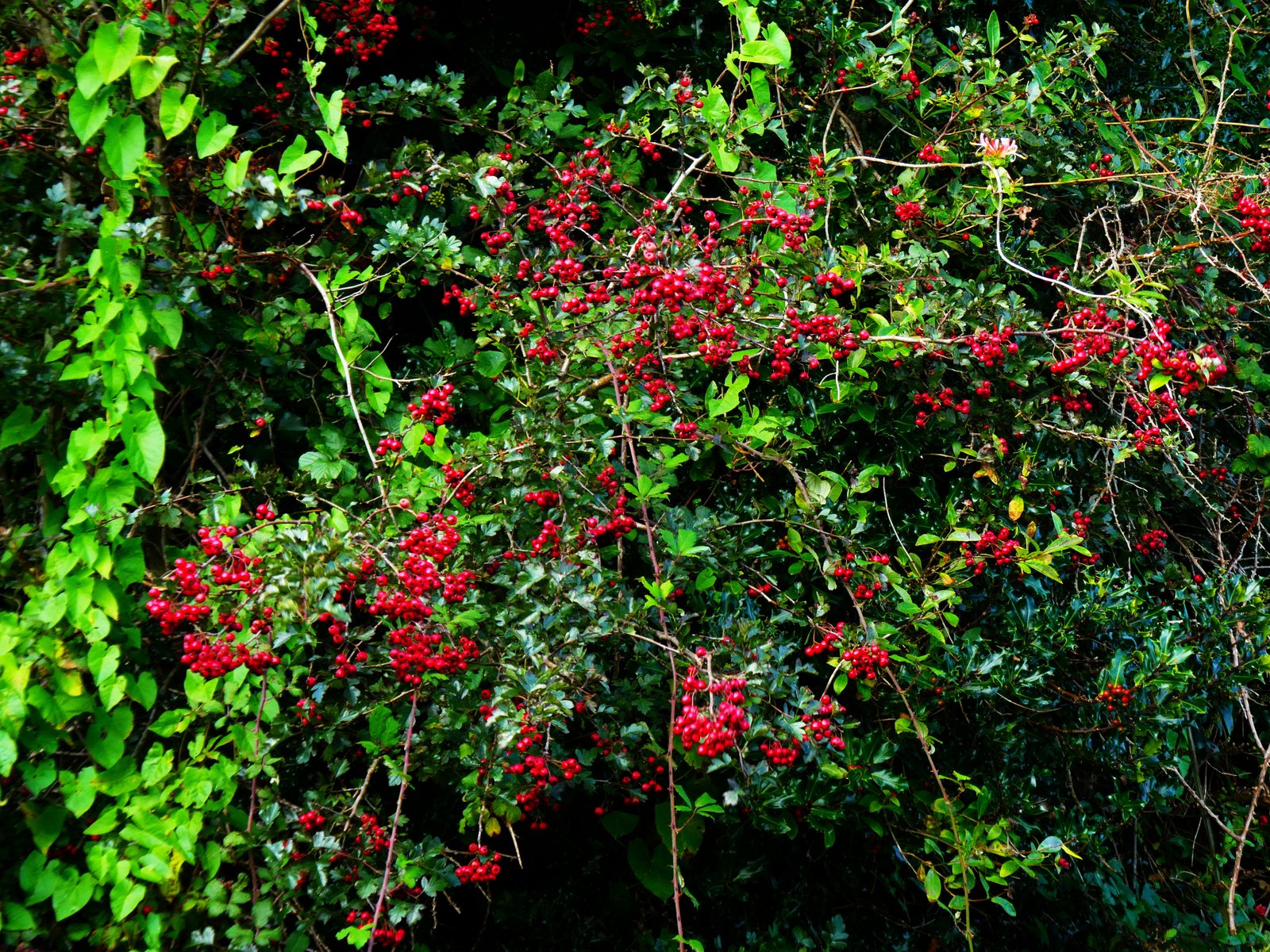
Hawthorn — sometimes spelled “hawthorne” — is the partner-tree of the British and Irish hedgerow. It grows beside blackthorn, in the same lanes and field margins, in the same kind of mixed-species hedge that has supplied stick-wood for at least three hundred years. Where blackthorn is the tree of March and winter and the Cailleach, hawthorn is the tree of May and summer and Bealtaine. The two are paired in the older folk-calendar; they are also paired, more practically, in the working life of any stick-maker who walks a hedge.
For a publication oriented toward the dark, dense, slow-seasoning blackthorn shillelagh, hawthorn deserves attention partly because it is the tree most often confused with blackthorn (and most often substituted for it in the cheap-stick trade) and partly because, when worked seriously, it produces a stick that is in some respects the finer of the two. The wood is pale instead of dark, but it is not less dense. The grain is tight, the polish is high, the working character is excellent. There are reasons it has been used for sticks across Britain and Ireland for as long as records exist.
This is what a stick-maker would tell a reader to know about it.
Quick reference
| Common names | Hawthorn, common hawthorn, May, whitethorn, quickthorn, sceach (Irish) |
| Binomial | Crataegus monogyna Jacq. |
| Family | Rosaceae (rose family — same as blackthorn, oak’s neighbour) |
| Native range | Most of Europe; into north-western Africa and western Asia; introduced and widely naturalised in temperate climates including parts of North America and Australia |
| Habit | Deciduous shrub or small tree, 5–15 m, often forming dense thickets in hedgerows |
| Bark | Grey-brown, smooth on young growth, fissured and scaly on mature stems |
| Thorns | Single, sharp, 1–2 cm, branching from twigs at right angles — fewer and shorter than blackthorn’s |
| Leaves | Deeply 3–7 lobed, 2–6 cm, dark green; among the most distinctive leaf-shapes in the British and Irish flora |
| Flowers | Small, white (occasionally pink), five-petalled, in dense clusters — late April to May |
| Fruit | Haws — small, round, deep red, single-seeded; ripen August through October |
| Wood density | ~750–820 kg/m³ [VERIFY] |
| Janka hardness | ~6,300 N — among the harder British and Irish native timbers |
The plant
Hawthorn belongs to the rose family and shares its long thorny lineage with blackthorn, its closer cousin. Where blackthorn is Prunus spinosa — a member of the same genus as cherries and plums — hawthorn is Crataegus, a separate genus altogether, with its own distinctive leaf-shape, flowering period, and fruit type. The two trees can grow side by side in the same hedge for fifty years; an experienced eye tells them apart at twenty paces by the leaves alone.
The diagnostic features of hawthorn:
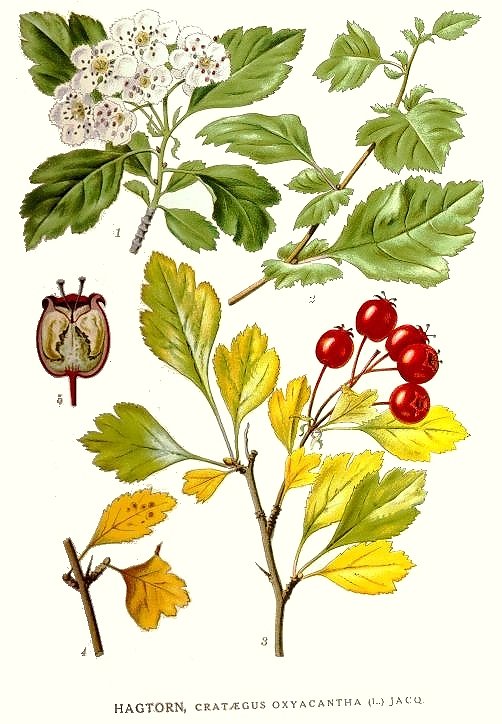
The deeply-lobed leaves. Hawthorn leaves are 3–7 lobed, sometimes deeply enough that they read at first glance as compound. The shape is unmistakable; nothing else in the British and Irish hedgerow flora produces a leaf quite like it.
The white May blossom. Hawthorn flowers in late April or early May, in clusters of 5–25 small white flowers (occasionally pink, especially on cultivated forms). The bloom is the visual signature of the British and Irish countryside in early summer; the older English name May tree dates from this association, and the festival of Bealtaine / Beltane on the first of May is the day the bloom is supposed to mark.
The red haws. The fruit is round, hard, and deep red — sometimes orange-red — and ripens through late summer and into autumn. Each haw contains a single hard seed (in C. monogyna — C. laevigata, the close relative, has two). Birds strip the haws through autumn and into early winter; what remains is the most reliable autumn identifier of the species.
The fewer, shorter thorns. Hawthorn does have thorns, but they are both fewer in number and shorter than blackthorn’s — typically 1–2 cm versus blackthorn’s 2–3 cm — and they emerge from the twig nodes rather than spaced along the length. A blackthorn hedge has a dense forest of thorns; a hawthorn hedge has occasional sharp ones at the joints. The practical effect for a hedge-cutter is that hawthorn is easier to work without injury, which is part of why it is the dominant wood for British hedge-laying (see Beyond sticks).

The seasonal year
The year of a hawthorn divides cleanly into four parts, mirrored against blackthorn’s earlier rhythm.
In late April and through May, the tree comes into full bloom. The white flowers are dense, fragrant (notoriously, with a faintly fleshy smell that older accounts attribute to compounds also found in plague-victim corpses — a folk-association that contributed to the proscription against bringing hawthorn blossom indoors), and visually striking enough that a hawthorn hedge in flower remains one of the most photographed features of the British and Irish countryside.
In June and through summer, the white drops away and the leaves come into full size. The hedge becomes a green wall again. This is the easiest period of the year to walk past a hawthorn without specifically registering it; experienced hedge-cutters use late spring (when the leaves are out but still small) for identification purposes.
In late August and into autumn, the haws ripen. The fruit is technically edible but underwhelming raw — too dry, too astringent, the seed too dominant. It has been used in haw jelly, in country wines, in some traditional tisanes for cardiac use [VERIFY: hawthorn’s medicinal-cardiac reputation is real but should be cited carefully]. Birds eat the haws in volume from late August through into December.
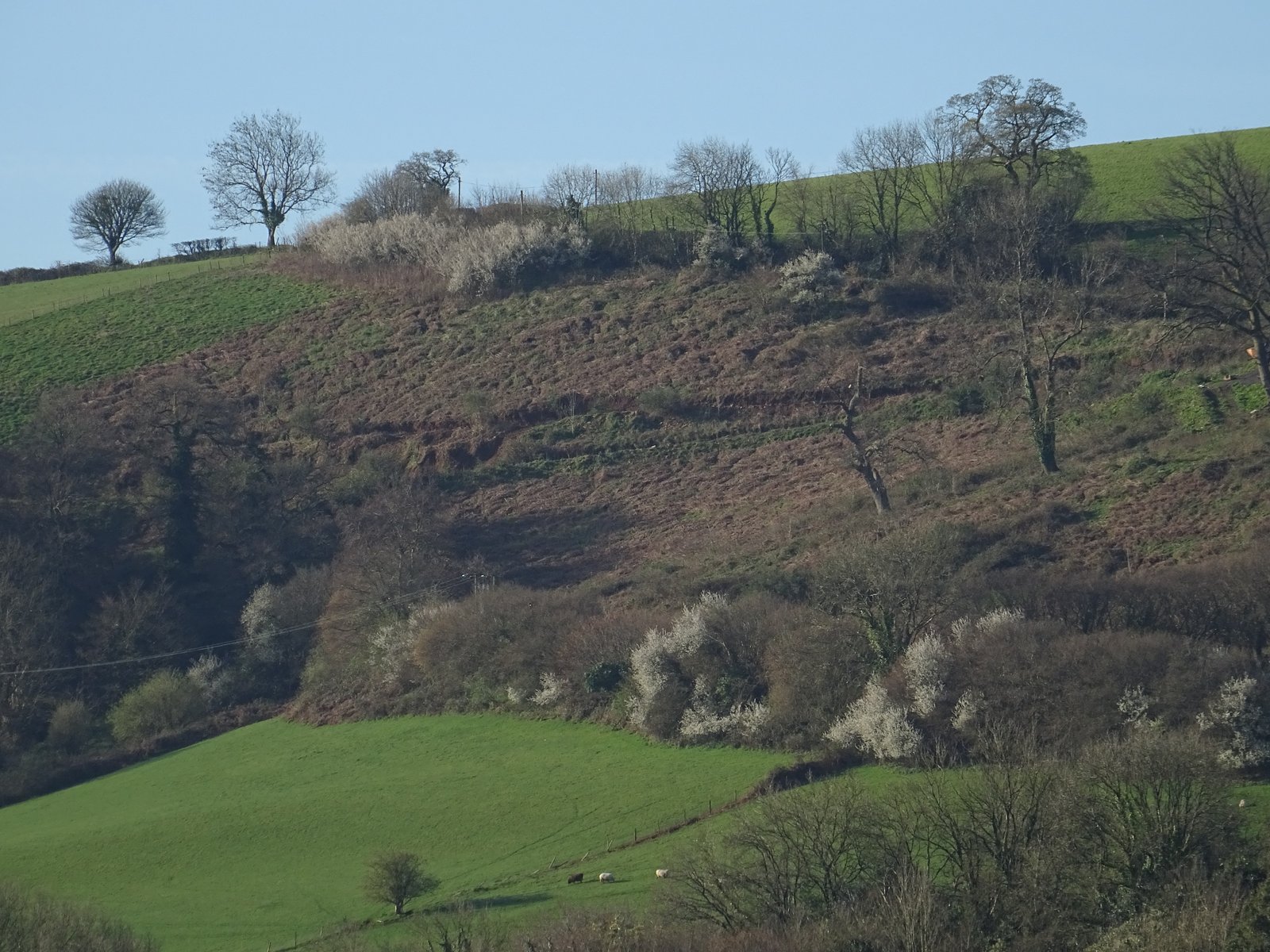
In winter, the leaves go and the structure becomes legible. Bare hawthorn against a winter sky is one of the quieter pleasures of the British and Irish hedgerow landscape — the dark twisted trunks, the irregular crowns, the fewer thorns visible against the bark — and is also when the stick-cutter’s work begins.
.jpg)
Folklore: the fairy tree and the May proscriptions
The folklore of hawthorn in Ireland and Britain is, in some respects, even larger than blackthorn’s, and considerably better preserved in active modern observance.
The lone fairy thorn
The proscription against felling a lone hawthorn — a solitary tree growing apart from a hedge, often in the middle of a field — is the single most durable element of Irish folk-belief surviving into the twenty-first century. The taboo applies to both hawthorn and blackthorn (see /history/fairy-thorn-taboo/ for the full treatment), but it attaches more strongly and more persistently to hawthorn. The famous 1999 re-routing of the M18 motorway around a lone fairy thorn at Latoon, County Clare — led by storyteller Eddie Lenihan — was a hawthorn case. So are most of the parallel cases that have surfaced since.
For the stick-maker, the practical effect is straightforward: lone hawthorns are not cut for sticks. Hedge-grown hawthorns are. The cultural framework that has produced the tradition’s working knowledge has carried the taboo forward without difficulty, because the everyday harvest from hedgerows never required the lone trees in the first place.
The May Day proscription against bringing it indoors
A second persistent folk-belief: hawthorn blossom should not be brought into the house, particularly in the month of May. The proscription survives in active observance among older British and Irish populations to this day [VERIFY current observance figures]. The stated reason — that the smell of hawthorn flowers carries the scent of corpses, or carries plague — has a real chemical basis. Hawthorn flowers contain trimethylamine, the compound that gives decomposing animal flesh its characteristic smell, and the association is olfactory before it is supernatural. Whether the underlying belief is observed for plague-related reasons or for fairy-related ones, the behavioural rule is: hawthorn stays outside.
For a stick-maker, this is irrelevant — the wood, once seasoned, has lost the bloom and the smell — but it is part of the cultural surround that makes hawthorn a more carefully-handled tree in the British and Irish folk-tradition than its botanical character alone would suggest.
The May bush
Hawthorn is the canonical wood of the May bush (Crann Bealtaine in Irish) — the branch decorated with ribbons, eggshells, and wildflowers, set up at a doorway or in a public place at Bealtaine (1 May) to mark the start of summer. The full treatment is at /history/may-bush-tradition/. The hawthorn used for the May bush is cut from a hedge, never from a lone tree, and the cut is taken at sunset on Bealtaine Eve or at sunrise on Bealtaine itself.
Pairing with blackthorn
The two thorn-trees of the Irish hedgerow appear in folk-tradition as a structural pair: blackthorn is winter (March bloom, the Cailleach’s staff), hawthorn is summer (May bloom, the May bush). The pairing is consistent enough across Irish, Scottish, and parts of English folk-tradition to read as deliberate cultural structure rather than coincidence; the trees flower at the right moments, in the right colours (both white), with the right thorns, and the folk-imagination did with them what folk-imagination tends to do with any salient pair.
The wood
Hawthorn produces one of the harder timbers in the British and Irish small-tree flora. The Wood Database lists Janka hardness at around 6,300 N [VERIFY], which puts it above blackthorn in some readings and well above oak — placing hawthorn in the same hardness band as European hornbeam and the harder American hardwoods. Density runs around 750–820 kg/m³ at standard moisture content, broadly comparable to blackthorn.
The colour is the wood’s most distinctive feature. Where blackthorn is near-black and ash is pale cream, hawthorn sits in between: a pale cream to soft pinkish-brown when freshly worked, deepening with oil and time to a warm honey or light tan. The sapwood and heartwood are not strongly distinguished, which is unusual for a temperate hardwood and means that hawthorn sticks tend to look uniform along their length — closer in this respect to ash than to blackthorn.
The grain is tight, fine, often interlocked at the base of older trunks, and takes an exceptionally high polish. Hawthorn was used historically for engraving blocks (alternative to boxwood), for fine cabinetwork, and for tool handles where dimensional stability and density were both wanted. The wood is harder to find in long pieces than ash or oak — the tree rarely produces a clean five-foot length of straight trunk wood — but for stick-length pieces (under three and a half feet) hawthorn is reliable.
For walking-stick purposes, hawthorn produces a stick that is:
- Heavier than its size suggests, like blackthorn — the density is real
- Pale rather than dark, which makes it visually distinct and suits a buyer who wants a brighter-finished piece
- Smoother in surface character than blackthorn, because hawthorn lacks the dense thorn-stub pattern that gives blackthorn its irregular face
- Well-suited to fitted handles, because the wood polishes cleanly and accepts a horn or carved-wood handle without difficulty
- Easier to work than blackthorn, in the workshop sense — the grain runs straighter, the wood is less interlocked through the shaft, and a hand-tool moves through it more predictably
The visual result is a stick that reads as refined rather than rustic — closer in cultural register to a Scottish show-stick than to an Irish hedgerow shillelagh.
Cutting and seasoning
Hawthorn seasons more like blackthorn than like ash. The wood is dense, the grain is tight, and the moisture loss has to be slow to avoid surface checking and the long longitudinal cracks that affect any high-density slow-grown timber dried in a hurry. The working figure is one to three years of air-drying, with the same traditional methods used for blackthorn (chimney burying, cold shed storage, periodic oiling, twine-binding to prevent warping).
The cutting is in winter, in dormancy, when the sap is down. Hawthorn is selected for the same qualities as blackthorn: a clean run of straight trunk wood, undamaged bark, no large knots. The thorn-density is lower than blackthorn’s, so the trimming work is less intensive — but the grain at the base is often tightly interlocked, and a maker selecting for a shillelagh-type piece will look for a decent root burl in the same way as for blackthorn.
After seasoning, the bark is left or removed depending on the piece. Barked hawthorn keeps a darker, more textured surface; debarked hawthorn reveals the pale heartwood and is the preferred form for show-sticks and presentation pieces. Finishing is conventional: linseed oil and beeswax, sometimes a thin shellac for the highest-finish work.
From cut to stick
A finished hawthorn stick is, in the working tradition, less common than a finished blackthorn stick — partly because the cultural identity of the Irish stick is so strongly tied to blackthorn’s name and dark colour, and partly because the tourist trade has driven blackthorn-imitation rather than hawthorn-celebration. But hawthorn sticks exist, are made by careful makers, and have their own quiet following.
The forms hawthorn most often takes:
Long walking sticks, 32–43 inches, debarked and finished pale. The pale colour and uniform grain produce a stick that reads as gentlemanly rather than rural — a different visual register from a blackthorn shillelagh, suited to formal dress or presentation use.
Show-sticks, with carved or fitted horn handles, often entered at British and Welsh agricultural shows. The wood polishes well, accepts inlay cleanly, and provides a pleasing visual contrast against horn or stag-antler handles.
Shorter walking-aid sticks for older users who want the heritage character of a thorn-tree stick without the visual heaviness of dark blackthorn. The hawthorn here reads as lighter both literally and visually.
The visual signature that says hawthorn rather than blackthorn, on close inspection: the lighter pinkish-cream colour of the wood beneath any finish; the absence of densely-clustered thorn-stubs along the shaft (hawthorn has scattered, fewer thorn-points rather than blackthorn’s dense pattern); and the slightly less interlocked grain, visible in fine surface markings under low-angle light.
Beyond sticks
Hawthorn earns its keep across British and Irish rural life in several specific ways, most of which involve the live tree rather than the cut wood.
Hedge-laying is the largest practical use. Hawthorn is the dominant species in working British and Irish hedgerows, and the traditional craft of hedge-laying — cutting partway through a vertical stem at the base, bending it down, and weaving it into the existing hedge — works exceptionally well with hawthorn. The result is a stockproof barrier that is denser, lower, and longer-lived than any unmaintained hedge. Modern conservation grants in Britain and Ireland incentivise the practice for biodiversity reasons (hawthorn supports more invertebrate species than any other British native tree apart from oak [VERIFY]) and for the visual character it gives the landscape. A maker walking a working hedge for stick wood is almost always walking a hedge that has been laid at some point in its life.
Rootstock for cultivated pears, apples, and medlars. The hawthorn root system is unusually robust, and grafting cultivated rosaceous fruit varieties onto hawthorn rootstock is a traditional practice in some Mediterranean and Middle Eastern grafting traditions [VERIFY current commercial practice].
Cardiac medicine. Hawthorn extracts (from the leaves, flowers, and haws) have been used for centuries in European folk-medicine for cardiovascular conditions, and a substantial pharmacological literature documents their flavonoid content and hypotensive effects. Standardised hawthorn extracts are sold as over-the-counter cardiac tonics in continental Europe and are recognised by the European Medicines Agency in the Herbal Medicinal Products Committee monographs [VERIFY current EMA status].
Country wines and preserves. Haw jelly, hawthorn-blossom wine, and various traditional infusions feature in the older British and Irish country-cookery tradition. None are commercial-scale.
Engraving blocks and small turnery. Historically a substitute for boxwood in fine engraving and small precision-turning work. The tradition is largely gone but the wood retains the qualities that supported it.
Hawthorn vs blackthorn for sticks
The summary, for a reader trying to choose between the two thorn-tree sticks of the British and Irish hedgerow tradition:
Blackthorn is darker, more iconic, more strongly associated with the Irish-stick cultural register. The trimmed thorn-stubs are visible across the surface; the colour is near-black; the cultural weight is enormous. For a shillelagh specifically, or for a stick meant to read as unambiguously Irish, blackthorn is the answer.
Hawthorn is paler, smoother, slightly less heavy at equivalent dimensions, with a different cultural register. It works particularly well in the Welsh and Scottish show-stick traditions, in finer-finished pieces with fitted horn handles, and for users who want a thorn-tree stick that does not visually announce itself as iconically rural-Irish. The wood is harder than oak, comparable to or above blackthorn in density, and produces a finished piece that is at minimum the equal of blackthorn for actual carrying use.
The two are not interchangeable. They are alternative answers to the same question, and a maker who works carefully will know how to bring out the strengths of each.
The four-wood comparison, including holly and oak, is at Holly vs blackthorn vs oak vs ash. The folklore of hawthorn proper, in fuller detail than this page allows, is in the linked history pieces below.
This is a reference page. The May Day folklore is treated more thoroughly in The May bush; the lone-thorn taboo in The fairy-thorn taboo; the seasonal-counterpart relationship to blackthorn in The Cailleach and Blackthorn in Irish mythology. Corrections from readers — particularly on the EMA status of hawthorn cardiac extracts, and on regional Welsh and Scottish hawthorn-stick traditions — are welcome.
Sources & further reading
- Crataegus monogyna Jacq., Plants of the World Online, Royal Botanic Gardens, Kew
- Hawthorn — A-Z of British Trees, Woodland Trust
- BSBI Plant Atlas: Crataegus monogyna, Botanical Society of Britain and Ireland
- Niall Mac Coitir, Irish Trees: Myths, Legends & Folklore (2003), Collins Press
- Hawthorn — wood properties, The Wood Database
Related reading
- woodsBlackthorn Tree Wood: Curing
The hedgerow tree behind most Irish sticks: dense, dark, slow-growing, and beloved of hedge-witches.
- woodsOak
The other Irish stick wood — older, heavier, and the source of the original Wicklow shillelaghs.
- woodsHolly
The pale-wooded thumb-stick tree of Scotland and Wales — and the harder-than-oak hedgerow shrub that sometimes turns up in Irish work too.
- historyThe Cailleach
The hag of winter, of the high places, of the storm, and of the blackthorn staff that keeps the cold in the ground.