Blackthorn Wood: Seasoning, Uses
The hedgerow tree behind most Irish sticks: dense, dark, slow-growing, and beloved of hedge-witches.

Most of what makes an Irish walking stick what it is happens before any cutting tool is involved. The wood is the work; the maker’s job is to find a stick that is already nearly the right shape, and to draw it out without breaking it. The wood that does this for the Irish tradition more often than any other is blackthorn wood — Prunus spinosa — a thorny hedgerow shrub that produces, almost incidentally, a small quantity of one of the longer-seasoning timbers in the British and Irish flora.
This is a reference page. What follows is what a stick-maker would want a reader to know about the tree: how to recognise it, when in the year to look at it, what the wood is like, why it has to be seasoned for years before it is touched with a knife, and the older meanings the tree carries in the cultures that have made things from it.
Quick reference
| Common names | Blackthorn, sloe, sloe-thorn |
| Binomial | Prunus spinosa L. |
| Family | Rosaceae (rose family) |
| Native range | Most of Europe; into western Asia; introduced and naturalised more widely |
| Habit | Suckering deciduous shrub or small tree, 2–6 metres |
| Bark | Dark, often near-black on older wood; smoother on young growth |
| Flowers | Small, white, five-petalled, March–April, before the leaves |
| Fruit | Sloes — small, dark, plum-like, very tart, ripening from late August |
| Wood density | No reliable published figure found |
| Janka hardness | No reliable published figure found |
The plant
Blackthorn belongs to the rose family and shares its genus, Prunus, with cherries, plums, peaches, almonds, and apricots. It is the wild ancestor of one strand of the cultivated plums and contributes — through hybridisation — to the parentage of others. None of which is much help in the field. What you see when you walk past a blackthorn in summer is a low, dense, twisted shrub with stiff dark twigs, rigid grey-green leaves, and a forest of thorns.
The thorns are the diagnostic feature. They are sharp, often two to three centimetres long, set roughly at right angles to the twig, and as hard as small nails. They go in deep when they catch you, and have a reputation — earned — for taking days to come back out. Old hedgers will tell you to remove a blackthorn thorn promptly, because it tends to break off cleanly under the skin and to suppurate; whether the wound is genuinely septic or just behaves like one is debated.
A mature blackthorn rarely exceeds six metres. More often it forms a thicket, suckering at the roots and spreading laterally; in old British and Irish hedgerows it can occupy whole stretches by itself. The dense, stockproof character of these thickets is half the reason it ended up planted along boundaries in the first place.
The seasonal year
The year of a blackthorn divides cleanly into four parts.
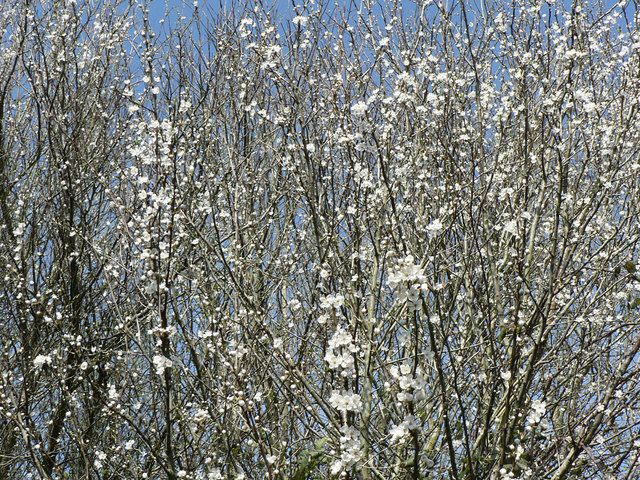
In March, sometimes earlier, the tree comes into bloom. The flowers are small and white and so densely packed on the twigs that, from a distance, a blackthorn in flower looks like a hedgerow has had snow blown onto it. The bloom is conspicuous because it happens before the leaves; while everything else is still bare, the blackthorn is already in white. A folk-belief once attached to this period still survives in the phrase blackthorn winter — a cold snap that often coincides with the bloom, sometimes severe enough to do for the early-flowering cherries and plums.
In April and May, the leaves come out — small, oval, finely toothed, dark green — and the white drops away. By midsummer the shrub is just a green wall with thorns; this is the easiest time of the year to walk past one without registering it.
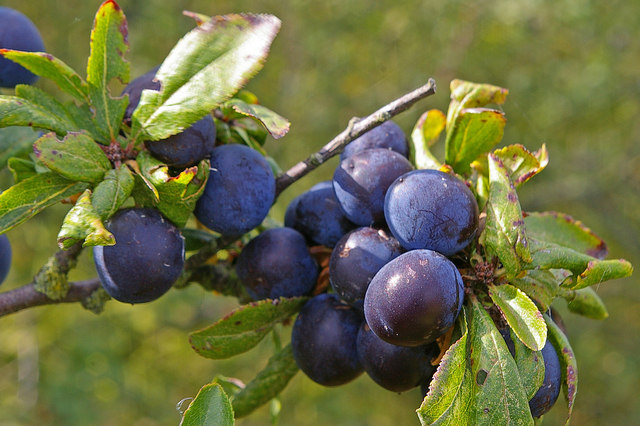
In late August and through autumn, the fruit ripens. Sloes are small, round, dark-blue or near-black, with a heavy bloom of natural wax on the skin. They are too tart and too astringent to eat raw. Their use is in sloe gin — fruit, sugar, and gin, left in a jar from the first frost (or the freezer) until Christmas — and in the English and Irish country wines of an older generation. The astringency is not a defect; it is the reason the fruit is interesting.
In winter, the leaves go and the structure of the bush becomes legible: black bark on the young growth, paler grey on older wood, the thorns clearly visible against the sky, and — for a stick-maker — the straight-enough lengths of trunk and root visible to the eye for the first time since the spring.
Folklore
The blackthorn has, over time, accumulated more folklore than almost any other tree in the British and Irish countryside, and a fair amount of it is grim. The thorns themselves — long, dark, apt to fester — attracted the kinds of attention that make for stories: blackthorn is the wood of witches’ staves in some traditions, the gallows-tree in others, and the Cailleach’s — the Hag of winter’s — staff in Gaelic Scotland and Ireland, the stick she strikes the ground with to keep the cold in.
The tree is sometimes counted among the fairy trees of Ireland: a lone blackthorn, particularly one growing apart from a hedge or in the middle of a field, is a tree it is unlucky to fell. (The same belief attaches more strongly to the lone hawthorn, although that has not always stopped roads being routed around it.) Pairs of blackthorn and hawthorn — the two most common hedge-thorns of these islands — figure in May Day and Beltane customs as winter-and-spring opposites: the hawthorn’s bloom in May is the moment of summer arriving; the blackthorn’s bloom in March, when the cold snap returns, is winter’s last word.
The folklore slips in and out of the language. Sloe-eyed, used since at least Chaucer, describes dark eyes in terms of the dark fruit. Blackthorn winter survives, as noted, in regional British weather-talk. And the most famous Irish loan into English — shillelagh — depends, on one of two competing etymologies, on the work the tree was put to entirely.
For the folklore taken in full rather than in passing, the standalone history piece is the better place; see Blackthorn in Irish mythology.
The wood as material
The heartwood is dark — variously described as “near-black”, “dark chocolate”, or “purplish-brown” depending on the cut and the polish — and it darkens further as the wood ages and is handled. The sapwood is much paler, almost cream, and is normally thin enough to be debarked away or sanded back to nothing. The grain is tight, sometimes interlocked, and the wood takes a polish well; it holds its shape against the friction of the hand and resists splitting under a sideways impact. The journal has not found a reliable published density figure for blackthorn, which is not listed in the Wood Database, so it does not quote one.
Two features of the live tree end up doing most of the work for stick-making.
The first is the root burl. Blackthorn suckers from the roots, and the junction between the trunk and the root-stock often forms a swollen, dense, gnarled bulb. Cut a few inches above and a few inches below this junction, and you have a stick with a natural knob at one end and a straight shaft at the other — a shillelagh, in effect, before any shaping happens. There is no reliable way to fake this with glue and a lathe.
The second is the thorns. Removed carefully, they leave the small pin-prick scars that give a finished blackthorn stick its characteristic surface — slightly bumpy, slightly irregular, alive in the hand. A turned-and-stained dowel is smooth in a way that a real blackthorn shaft never is. On any properly-finished piece the scars are visible at arm’s length.
The seasoning
A freshly-cut blackthorn stick is mostly water. Put it on a bench and start working it, and within a week it will have curled, split along the grain, or cracked from the knob down through the shaft — sometimes all three at once. Every Irish stick-making tradition that survives in the workshop sense includes a ritualised, time-consuming seasoning stage, and the rituals all amount to the same thing: dry the wood slowly, in low humidity, over a long enough period that the moisture leaves without splitting the wood as it goes.
The traditional methods include burying the cut sticks in the chimney of an old turf fire (warm, dry, smoky — ideal); storing them in a cool shed off the ground; oiling them periodically with linseed oil to slow the surface-drying; and binding them straight with hemp twine to prevent warping. Roots — the part that becomes the knob — are denser and slower to dry than shafts, and need the longer end of the seasoning range. One to three years is the working figure; some old makers prefer five.
Production sticks bypass much of this with kiln-drying. The result is faster, cheaper, and noticeably worse. A kiln-dried stick will work, but it is more brittle, prone to surface checking, and more likely to develop the long longitudinal cracks that show, eventually, on cheap “blackthorn” walking sticks from tourist shops. There is no substitute for time.
From cut to stick
The cutting itself is done in winter, in dormancy, when the sap is down. Live cuts in summer bleed and rarely season cleanly. The cuts are selective: a stick-maker walks a stretch of hedge looking for the rare combination of straightness, length, root-burl, and undamaged bark — and then takes one piece per visit, leaving the rest of the hedge to grow. (This is one of the reasons real blackthorn sticks are not a high-volume product.)
After seasoning, the bark is left or removed depending on the piece. A debarked stick shows the dark heartwood and the thorn-scars more clearly; a barked stick keeps a darker, more textured appearance. The wood is finished with linseed oil, beeswax, or a thin shellac — never a thick varnish, which obscures the surface the wood was chosen for in the first place. A leather wrist strap is fitted through a small drilled hole below the knob. A metal ferrule is sometimes added at the foot.
The result is a stick that is heavier than its size suggests, dark, slightly irregular, and — to anyone who has handled the cheap kind — unmistakably the real thing.
Buying blackthorn sticks and canes
Blackthorn wood appears in several buyer categories: full blackthorn walking sticks, short shillelagh clubs, blackthorn walking canes, and wooden handles fitted to hazel, ash, or oak shafts. The same material is not right for every form. A substantial root-burl blank makes a natural shillelagh handle or knob; a straighter, cleaner length of shaft is better for a regular walking stick; a thinner, lighter piece may work as a cane only if it has seasoned without hidden checking.
If you buy blackthorn now, match the form to the use. A daily walking stick needs the right height, a comfortable handle, a sound ferrule, and a shaft that feels alive rather than brittle. A ceremonial shillelagh can be shorter and heavier. A vintage blackthorn cane may have wonderful surface character, but check the foot, handle junction, and old cracks before trusting it for weight-bearing use. Real blackthorn sticks should feel dense for their size; very light “blackthorn” canes are often another wood, stained dark and sold under the brand of Irishness rather than the material itself.
Delivery language on shop pages can also mislead. “Free delivery” or fast shipping says nothing about seasoning quality, and a product category called “blackthorn walking sticks” can contain handmade pieces, imported souvenir sticks, and machine-finished wooden canes side by side. Before ordering, search the seller’s own description for the facts that matter: where the wood was cut, how long it was seasoned, whether the knob is natural root or fitted handle, whether the listed stick is ready for delivery, and whether the maker will trim or advise on height.
Beyond sticks
Blackthorn earns its keep elsewhere too. In agricultural use, the stockproof thicket has been the working livestock barrier of the British and Irish countryside for as long as there have been cattle to keep in. The traditional craft of hedge-laying — cutting partway through a vertical stem at the base, bending it down, and weaving it into the existing hedge — works particularly well with blackthorn, and the resulting laid hedge is denser, lower, and more thorn-rich than an untouched one. Modern conservation grants in Britain and Ireland both incentivise the practice, partly for biodiversity reasons (blackthorn supports moth and butterfly larvae and is heavily used by hedgerow birds) and partly for the visual character it gives the landscape.
The wood also turns up in walking-stick handles for non-blackthorn sticks (the dense, dark grain makes a striking contrast against a hazel or ash shaft), in occasional small pieces of decorative turnery, and — once in a while — in tool handles for items like billhooks where a heavy, grain-resistant timber is wanted at small scale.
But the centre of the wood’s use, in the British and Irish countryside, has been the same for at least three hundred years: a stick to walk with, a stick to lean on, and — in a darker register — a stick that could, if it had to, do other work too.
This is a reference page. If you spot an error here, please write to the editor. The history piece Blackthorn in Irish mythology handles the folklore in full; the comparison page Holly vs blackthorn vs oak vs ash sets the wood against its peers.
Sources & further reading
- Prunus spinosa L., Plants of the World Online, Royal Botanic Gardens, Kew
- Blackthorn — A-Z of British Trees, Woodland Trust
- BSBI Plant Atlas: Prunus spinosa, Botanical Society of Britain and Ireland
- Niall Mac Coitir, Irish Trees: Myths, Legends & Folklore (2003), Collins Press
- UK Hedgerows — habitat & condition, Joint Nature Conservation Committee
Related reading
- guidesShillelagh: Meaning, History & How to Spot a Real One
An Irish blackthorn club, a contested word, and a heritage object that has outlived its job description.
- historyBlackthorn in Irish mythology
The fairy tree, the Cailleach's staff, and the dark twin of the May hawthorn — what the older tradition actually says about the wood.
- historyBataireacht
Irish stick-fighting — once everywhere in rural Ireland, suppressed for over a century, taught now by a small number of teachers and clans.
- comparisonsHolly vs blackthorn vs oak vs ash
Four traditional stick woods, side by side: how they look, how they behave under the hand, and which one belongs in which kind of stick.