Shillelagh: Meaning, History & How to Spot a Real One
An Irish blackthorn club, a contested word, and a heritage object that has outlived its job description.

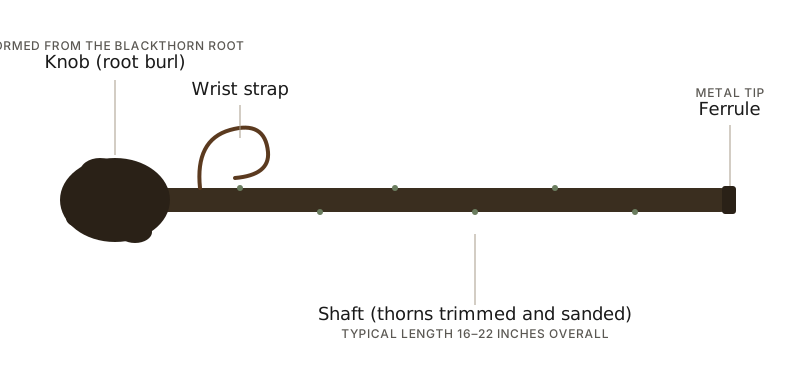
A shillelagh is a short Irish club or walking stick, traditionally sixteen to twenty-two inches long, cut from blackthorn with the wood’s natural root burl left on one end as a knobbed striking head. That is the simplest accurate definition, and it is worth keeping in mind, because almost everything else about the word — its spelling, its pronunciation, its etymology, its place in Irish life — is contested.
It is heavier than a walking stick and shorter than a staff. It might once have been a weapon. It might still serve as a walking aid. More often, in 2026, it is a heritage object — given as a gift, displayed on a wall, carried on St Patrick’s Day, sometimes mistaken for a club in airport security. Each of these uses pulls at the word a little differently.
Key facts
- Length: 16–22 inches, typically
- Wood: blackthorn (Prunus spinosa) most often; oak historically, holly and ash more rarely
- Head: the tree’s natural root burl, not a fitted or glued-on knob
- Pronunciation: /ʃɪˈleɪli/, “shil-AY-lee” (OED)
- First recorded in English: 1785, in Francis Grose’s Classical Dictionary of the Vulgar Tongue
How do you pronounce shillelagh?
The most common pronunciation in English is /ʃɪˈleɪli/ — written phonetically as shil-AY-lee. The stress sits on the second syllable; the gh is silent; the final vowel is a long e. This is the form most often heard from Irish speakers in Munster and from non-Irish speakers in the United States, where the word entered popular usage through emigration.
A regional variant — heard occasionally in older Hiberno-English and in the village from which the word may take its name — places the stress on the first syllable: SHIL-uh-lay. The Oxford English Dictionary lists the second-syllable form as primary, with the alternative noted. Either is recognised; the first will rarely raise an eyebrow outside of Ireland.
Where does the word “shillelagh” come from?
The word reached print in English in the late eighteenth century — the OED’s earliest cited example is in Francis Grose’s 1785 Classical Dictionary of the Vulgar Tongue, where it is glossed as “an oaken sapling, or cudgel” — and arguments about where it came from have been running ever since. Two main theories are still in circulation.
The first traces it to the Irish phrase sail éille — sail meaning a willow rod, éille meaning a thong or strap, the compound roughly “a stick with a thong”. This is the etymology preferred by some Irish-language scholars, and there is a clear logic to it: the leather wrist strap is among the most distinctive features of a finished shillelagh, and it makes more sense to name the stick by what is on it than by where it came from.
The second theory locates the word in the village and barony of Shillelagh, County Wicklow, in the south-east of Ireland — itself derived from the Irish Síol Éalaigh, “descendants of Éalach”. The Wicklow forests of Shillelagh were renowned for their oak, and the story goes that oak cudgels from the area were known by the place name long enough that the word followed the object into general use. The village derivation was promoted in the nineteenth century by Anna Maria Hall and Patrick Weston Joyce, both of whom wrote on Irish language and place-names; it is also the one most strongly disputed by twentieth-century lexicographers, who point out that the spelling and stress patterns don’t quite line up.
The OED, the standard reference for English-language etymology, presents both possibilities and treats the question as unresolved. So does the Foclóir Gaeilge–Béarla on the Irish-language side. Anyone who tells you the answer is settled is probably selling something.

A short history
What can be said with reasonable confidence is that sticks of this kind — short, weighted, hard-wood clubs — have been in Irish use for as long as records exist. They are mentioned, by various names, in early-modern Irish texts, and they appear in eighteenth- and nineteenth-century travel accounts written by visitors to Ireland with such consistency that it is harder to find a contemporary account without a stick in it than one with.
The era in which the shillelagh became inseparable from a particular kind of public life was the long century between the 1730s and the 1840s. This is the period of faction-fighting: organised, ritualised group brawls between rival clans, parishes, or factions, fought at fairs, weddings, funerals, and pattern-day gatherings, with sticks as the weapon of choice. Faction-fighting was suppressed, prosecuted, sentimentalised, and finally extinguished as the Famine emptied the countryside; the National Museum of Ireland holds period sticks and contemporary illustrations that show how seriously it was taken at the time.
Out of faction-fighting, and partly distinct from it, grew bataireacht — Irish stick-fighting as a more or less codified martial practice. Bata is simply the Irish for “stick”; bataireacht is the activity of using one. Several lineages say they survived in attenuated form into the twentieth century, most notably the Doyle family system, which by Glen Doyle’s own published accounts has been taught more widely since the 1990s (the journal has not been able to cross-check these details independently). The Antrim Bata school presents a separate living tradition, which it traces to the Ramsey family of County Antrim. The shillelagh figures in both as the short-stick form, distinct from the longer staff used in some other lineages.
By the late nineteenth century the shillelagh had begun the migration that defines its modern life: out of daily Irish use and into the symbolic register. The Gaelic Athletic Association, founded in 1884, codified hurling and football. Hurling, once associated with violent brawls, was formalised by the new association, which helped replace earlier unruly gatherings with organised sport. Mass emigration carried the object to America, where it survives in pub décor, parade kit, the iconography of Notre Dame’s Fighting Irish, and the gift shops of the Irish-American diaspora.
What wood is a shillelagh made from?
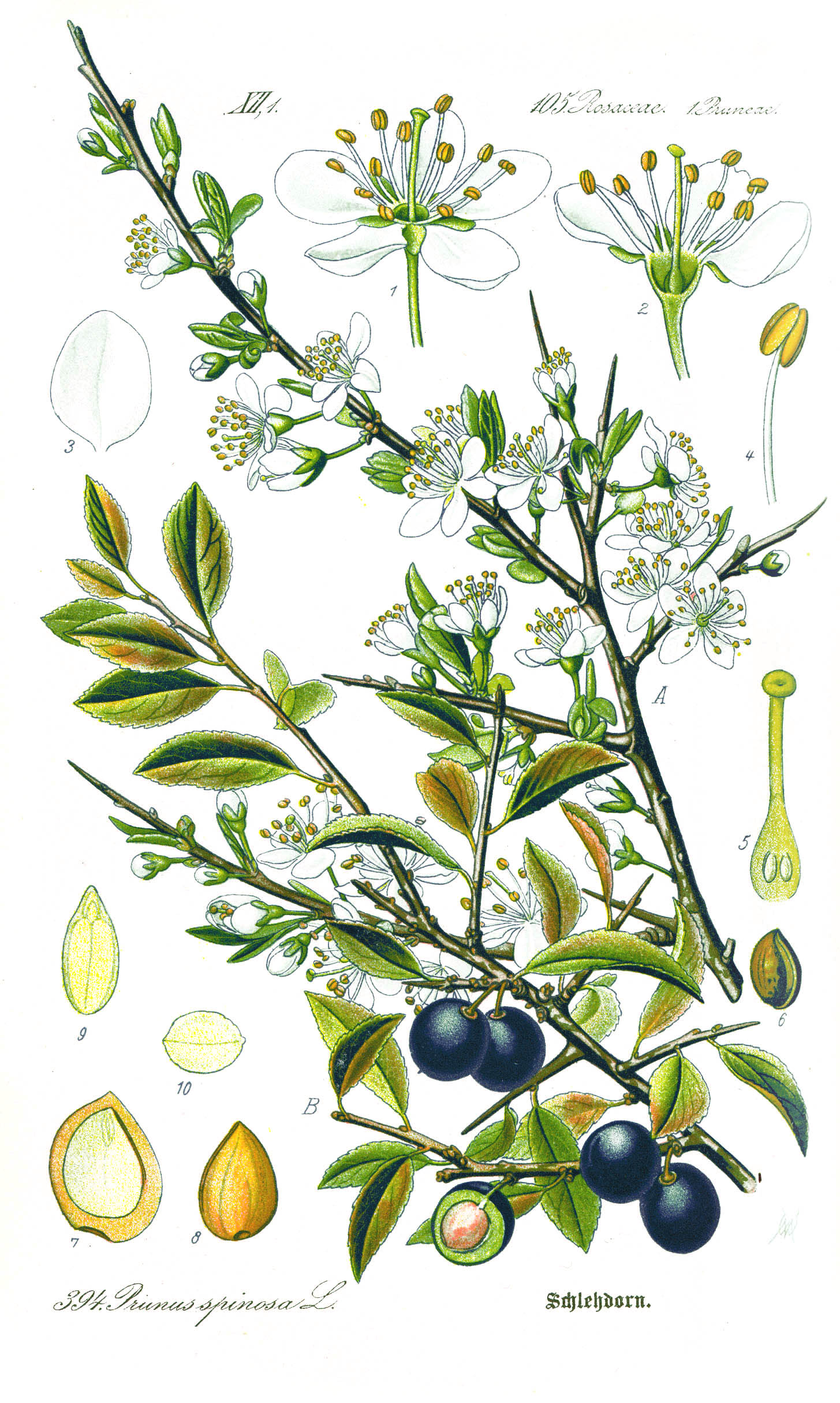
A shillelagh’s character begins before any cutting tool is involved. The traditional wood is blackthorn (Prunus spinosa), a dense, slow-growing, thorny shrub native to most of Europe and well-suited to the hedgerows and untended margins of Irish farmland. Blackthorn produces a wood that is unusually hard and dense for a small tree, with a tight grain, dark heartwood, and small thorns along the trunk that, after seasoning, leave neat pin-prick scars when removed. The result is a stick that is heavier than its size suggests and resistant to splitting under impact — which is, one assumes, why it found its niche.
Oak was the other historical wood, particularly in the south-east, and the term “original shillelagh” is sometimes reserved by makers for an oak example, in deference to the village-of-Shillelagh etymology. Holly and ash appear less often. A modern stick made by a careful maker will name its wood; a tourist-shop stick is more often “blackthorn” in marketing and something else in fact.
Cutting blackthorn is the easy part. The skill is in the seasoning: a freshly-cut stick is full of water and will crack as it dries, sometimes catastrophically. Traditional makers slow the drying with one of several methods — burying in chimneys, storing in cold sheds, occasional oiling — over a period of one to several years before any shaping happens. A proper handmade blackthorn shillelagh is, in this sense, a kind of slow agriculture as much as a craft. (The wood guide goes deeper on this; see /woods/blackthorn/.)
Cultural weight
It is hard to think of another piece of folk material culture that has done as much symbolic work for as small a country. The shillelagh is on St Patrick’s Day cards, leprechaun cartoons, GAA souvenirs, military presentation cabinets, Notre Dame fight banners, and the wall of every Irish theme pub from Boston to Bangkok. It has been the subject of music-hall songs, the prop of countless stage Irishmen, and — depending on which historian you trust — a gift exchanged between heads of state when one of them visits Ireland.
Among the more durable anecdotes is the claim that John F. Kennedy received a shillelagh during his 1963 visit to Ireland, and that it sat on his desk in the White House thereafter. The journal has not been able to confirm either detail from archival records, so it treats the story as unverified.
What the symbolism mostly elides is the violence the object once carried. The shillelagh in 2026 is a friendly thing: a gift, a wall hanging, a walking aid for an older relative. The shillelagh of 1820 was none of those — it was the kind of object you would not want to be on the wrong end of at a fair-day faction fight. Both are real. The history is not improved by sanding it down.
Shillelagh, walking stick, blackthorn stick
The three terms are not interchangeable, even though they often are in casual use.
A shillelagh is short — sixteen to twenty-two inches is the usual range — heavy in the head, and weighted for impact. It is held low on the shaft, near the foot, with the knob clear of the hand. It is a club.
A walking stick in the Irish tradition is longer (commonly thirty-four to forty-three inches, sized to the user), more even in balance, and gripped at the top by the handle or the curve. It is designed to take weight on flat ground or hill walking, not to swing. Many are made from blackthorn; many are not.
A blackthorn stick is any stick made of blackthorn, regardless of length or function. The phrase says something about the wood, not the form. A long blackthorn stick is a walking stick made of blackthorn; a short one is a shillelagh.
A fourth object is sometimes mixed in with these three but shouldn’t be: the swagger stick, a short, straight British officer’s stick with a fitted metal head and no wrist strap, carried as a mark of rank rather than as a weapon or a walking aid.
Tourist-shop stock often confuses all three, sometimes deliberately. A maker who knows the work will not.

How is a shillelagh used today?
The honest answer is: rarely, in the original sense. Bataireacht has practitioners, but they are few, and most carry their own training sticks rather than a finished shillelagh. The shillelagh’s daily life now is in roles the eighteenth century would not have recognised.
It is a gift, presented at retirements, ordinations, naturalisation ceremonies, civic honours. It is a prop, in some forms of Irish step-dancing and in the Notre Dame leprechaun mascot’s kit. It is a walking aid, especially in the longer sizes that blur into walking-stick territory, used by people who appreciate the heft and the heritage. It is a piece of folk-art, hung above mantelpieces and photographed for travel albums. The good ones — the ones cut, seasoned, and finished by hand — are also functional objects, made to a standard that has not changed in two hundred years. The poor ones are stained dowels with a wooden ball glued on top.
Telling them apart is mostly a matter of looking carefully at the head — does the knob flow naturally out of the shaft, or has it been added? — and at the surface of the wood, which on a real piece will show the trimmed thorn-nubs and the irregular grain that no machine quite reproduces.
Where to find an authentic shillelagh today
Authentic Irish stick-makers are not many. The list below is short by design: each maker still works largely by hand, sources blackthorn (or oak) from Irish hedgerows, and seasons the wood for years before shaping. Inclusion is editorial; we don’t take affiliate fees, and we don’t get paid for placement. If you know of a maker we should be considering, please write in.
McCaffrey Crafts — Killorglin, County Kerry
The most prominent Irish maker still working at scale, the McCaffrey workshop produces a wide range of pieces — short shillelaghs in the eighteen-to-twenty-inch range, hiking sticks in the mid-thirties, and longer walking sticks past forty inches — almost all from cut-and-seasoned blackthorn, with a smaller line in oak and a darker scorched finish for some pieces.
What sets the work apart is consistency: the shafts are cleanly debarked or carefully retained where retention serves the design; the knobs are formed from the actual root burl rather than glued additions; the leather wrist straps are real leather; and the finishing is restrained, with no varnish gloss attempting to disguise the wood. Lead times are real — handmade pieces take time, and demand is steady — and shipping outside Ireland and the EU is workable but adds days. The price reflects the craft; expect to pay considerably more than a souvenir shop, and considerably less than the inflated “premium” tier that markets to American buyers.
McCaffrey produces some of the photography on this site, used by editorial permission. We have no commercial relationship with them.
What to avoid
The Irish tourist trade is full of “blackthorn” sticks that are turned dowels stained dark, with a knob lathed separately and glued on. They are inexpensive, they look the part from a distance, and they have nothing in common with a real shillelagh except the wall they end up on. If a stick is finished with a high-gloss varnish, has a perfectly symmetrical knob, or sells for less than the price of a paperback book, it is almost certainly the manufactured kind.
A real one is heavier than it looks, slightly irregular, and feels — when you pick it up — like a piece of a tree that someone has been thinking about for a very long time.
If you spot an error in this piece, please write to the editor.
Sources & further reading
- shillelagh, n., Oxford English Dictionary
- Foclóir Gaeilge–Béarla (de Bhaldraithe), Teanglann.ie / Foras na Gaeilge
- Bata: an introduction to Irish stick fighting, Antrim Bata
- Faction Fighting in 19th-Century Ireland, National Museum of Ireland
- Prunus spinosa — blackthorn, Royal Botanic Gardens, Kew
- Faction fighting — decline and legacy, Wikipedia
Related reading
- woodsBlackthorn Wood: Seasoning, Uses
The hedgerow tree behind most Irish sticks: dense, dark, slow-growing, and beloved of hedge-witches.
- historyBataireacht
Irish stick-fighting — once everywhere in rural Ireland, suppressed for over a century, taught now by a small number of teachers and clans.
- comparisonsShillelagh vs walking stick vs blackthorn stick
Three terms that are used interchangeably in tourist shops but mean different things in the workshop. Here's what each one actually refers to.
- historyBlackthorn in Irish mythology
The fairy tree, the Cailleach's staff, and the dark twin of the May hawthorn — what the older tradition actually says about the wood.