Bataireacht
Irish stick-fighting — once everywhere in rural Ireland, suppressed for over a century, taught now by a small number of teachers and clans.
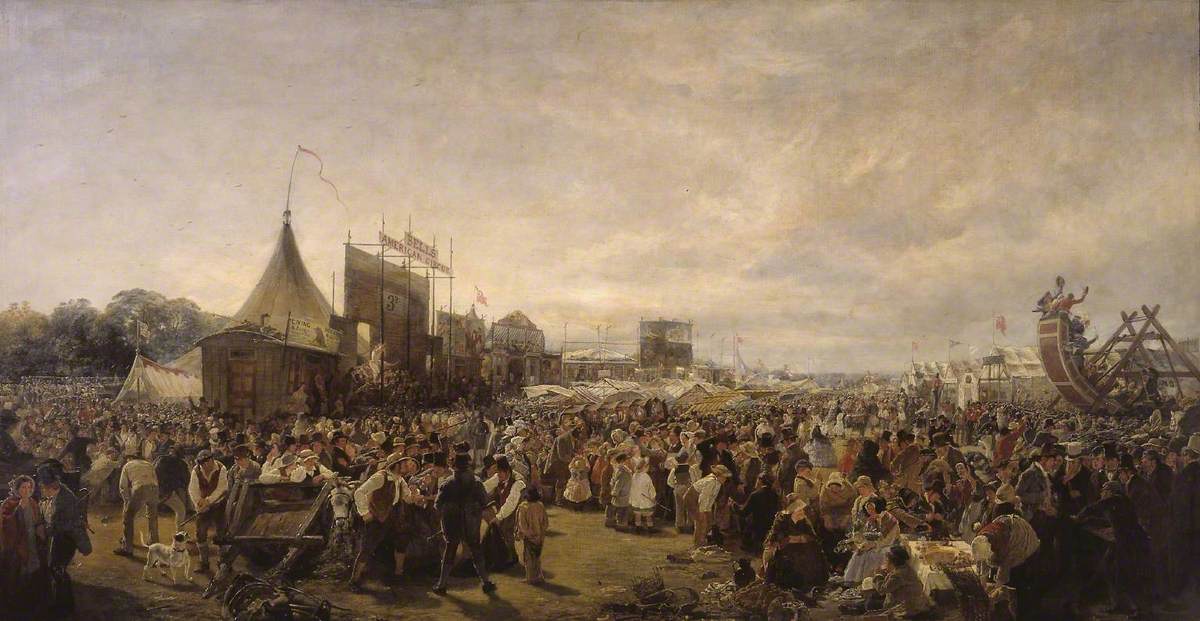
Bataireacht is the Irish word for stick-fighting. Bata is a stick; bataireacht is the practice of using one in a way that is closer to a martial art than a brawl. For most of the eighteenth and nineteenth centuries it was the everyday combat-craft of rural Ireland — taught father to son, contested at fairs and pattern days, refined into recognisable styles, suppressed when it became inconvenient — and for most of the twentieth century it was thought of as essentially extinct. It is not extinct. A small number of teachers, a handful of family lineages, and a slowly-growing international student body have kept enough of it alive that the word still has a present tense.
This is the long version of the story.
Where it came from
Stick-fighting is older than Ireland’s records of it. Heavy hardwood clubs are mentioned in early Irish texts; the bata in some form is a constant in the Irish countryside from at least the medieval period. What gave the practice a distinct shape in the modern sense was the social structure of eighteenth-century rural Ireland: rival clans, parishes, and trades that organised themselves into recognisable factions, met at fairs and patron-saint gatherings, and settled disputes — sometimes with grim seriousness, sometimes ritually, often both at once — in collective stick-fights.
The era from roughly 1730 to 1850 is when this culture was at its peak. Faction names from the period have survived in folklore and police records: the Caravats and Shanavests in Tipperary, the Three-Year-Olds and Four-Year-Olds in Limerick, the Cooleens and Lawlor-Black-Mulvihills in Kerry. Some factions had memberships in the thousands. Their disputes had real political and economic causes — land, tenancy, religion, family rivalry — but the contests themselves were shaped by ritual: a place and time agreed in advance, an opening verbal challenge, a structured series of rounds. Donnybrook Fair, in what was then a Dublin suburb, became the most famous of the venues, and the term donnybrook entered English to mean a noisy public fight.
The contemporary record is uneven. Travellers’ accounts veered between scandalised and sentimental. Resident magistrates wrote alarmed reports to Dublin Castle. Newspaper coverage played up the picturesque. Patrick D. O’Donnell’s 1975 study The Irish Faction Fighters of the 19th Century (Anvil Books) is a book-length account of the era.
What it actually looked like
It is easy, especially from a distance, to picture faction-fighting as untrained chaos. The sources do not bear that out. The fighting was structured around recognisable techniques, taught by recognisable teachers, with recognisable equipment.
The stick was usually a short, weighted hardwood — most often blackthorn, sometimes oak or holly — between roughly two and three feet long, with the natural root burl serving as a knob. Many fighters carried two: a longer one for defence, a shorter one for offence. The grip was characteristically held about a third of the way up the shaft, leaving the long end as a striking surface and the short end as a guard or a hooking tool. This is unlike most European stick-fighting traditions, which grip near one end. The Irish grip placed weight on both sides of the hand at once.
A practiced fighter could deliver — at speed and with the body, not the arm — a strike that broke bone through a wool overcoat. Defence was largely structural: the short end of the stick acted as a parrying brace against incoming blows, and the body moved off-line rather than back. Wrestling and grappling were folded in. Footwork was specific.
What this practice was called by its practitioners varied. Bataireacht is the surviving Irish-language term; in Hiberno-English the activity was variously stick-fighting, bata, sticking, or just fighting depending on the parish. Different lineages used different vocabularies. The standardisation that comes with a documented martial-arts curriculum did not arrive until very late.

The slow disappearance
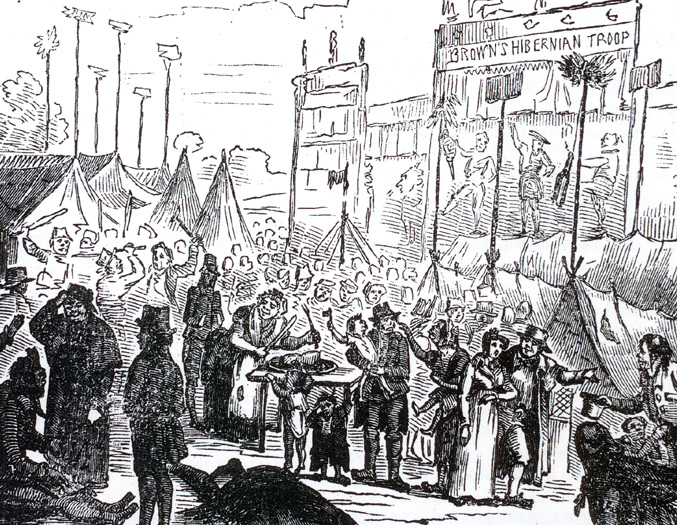
By the 1840s the public taste, the legal climate, and the demography of rural Ireland had all turned. Public faction-fighting was being prosecuted more aggressively. The Great Famine (1845–1852) hollowed out the rural population most associated with it. Mass emigration carried both the practice and its practitioners overseas, where the diaspora — especially in the United States, Britain, and Australia — adapted what they knew to new contexts that did not, for the most part, want it.
Three institutional pressures squeezed what remained. The Catholic Church, recovering its public footing in the post-Emancipation decades, discouraged faction-fighting as a cultural embarrassment. The Royal Irish Constabulary prosecuted gatherings. And the Gaelic Athletic Association, founded in 1884 to revive Gaelic sports, formalised hurling — once associated with violent brawls — which helped replace earlier unruly gatherings with organised sport. Donnybrook Fair was suppressed in 1855. The remaining public contests dwindled across the second half of the nineteenth century until, by the early twentieth, they were unusual enough to make the newspapers when they happened.
What is striking, and what the standard narrative often misses, is that the practice itself did not disappear when the public expression of it did. Stick-fighting techniques continued to be passed within families — not as a sport, not as a martial art with belts and dojos, but as a kind of inherited household knowledge, held quietly and passed selectively. Several lineages survived into the twentieth century in this way, in Ireland and in the diaspora.
The Doyle Clan System and the slow revival
One of the surviving lineages is the Doyle family system. As Glen Doyle’s own published accounts tell it, the Doyles, originally from County Wexford, carried a stick-fighting curriculum through several generations and eventually to Newfoundland, and Glen Doyle, a martial artist and historian based in Canada, opened the family system to public teaching from the 1990s onward. The journal has not been able to cross-check these details against independent sources, and the dates and the exact line of transmission rest on those accounts alone.
The Doyles are not the only lineage to surface. The Antrim Bata school, in Northern Ireland, presents a related tradition with its own distinct curriculum and lineage claims; the school’s own website says its techniques were handed down the Ramsey family of County Antrim from at least the mid-nineteenth century. Other family lines have come forward more recently. International seminars, video instruction, and a growing literature — mostly self-published, some academic — have made the practice more visible than at any time since the 1840s.
What students learn now is not exactly what a Tipperary faction-fighter would have known in 1830. Some of the social context is gone. Some techniques have been reconstructed rather than preserved. But the core material — the grip, the structural defence, the use of the short and long ends of the stick, the integration of wrestling — is consistent enough across lineages, and consistent enough with the historical record, that it is reasonable to call what is taught today a continuation rather than an invention.
Where it sits now
Bataireacht in 2026 is a small, scattered, internationally-distributed practice. There are formal schools in Ireland, the United Kingdom, and the United States; informal study groups in continental Europe and Australia; a steady trickle of YouTube instruction; an active conversation among lineages about authenticity, attribution, and what it means to teach a tradition that was not, until recently, taught in this way.
There is no formal census of practitioners, and the journal knows of no reliable estimate of how many people train in bataireacht. The Antrim Bata school dates a movement to repopularize the art from the early 2000s.
For a reader new to the subject, the simplest way in is to find a lineage that suits — Doyle, Antrim, or one of the smaller systems — and to commit to one teacher rather than sampling several. The Antrim Bata school’s introductory material is freely available online. A short blackthorn or oak stick of the kind described in What is a shillelagh? is the right starting equipment. The wood, in this small subculture, has not changed in three hundred years.
Why it matters
It is a fair question to ask why this matters now. The practical case is thin: bataireacht is unlikely to be useful in a contemporary self-defence context, and it is not an Olympic discipline, and there is no money in it. The honest answer is that it matters in the way that a lot of small surviving folk traditions matter — not because it is necessary but because, having been thought lost and not actually been lost, it offers a working test of how much of any other rural Irish practice could still be there if someone went looking for it. The social structures that held bataireacht in place are gone. The skill survived. That is interesting on its own terms, and it is the closest thing the Irish have to a living link with one of the most-discussed and least-understood elements of their pre-Famine cultural life.
A walking stick from County Kerry is not a fighting tool. But it is the same wood, cut from the same hedgerows, and held — even if no longer for combat — in roughly the same way.
If you train in a lineage we should be aware of, or know of a teacher’s published work that should be cited here, please write to the editor.
Sources & further reading
- Bataireacht: an introduction, Antrim Bata
- Patrick D. O'Donnell, The Irish Faction Fighters of the 19th Century (1975), Anvil Books / WorldCat
- Glen Doyle, Bataireacht: The Doyle Clan System (book listing), WorldCat
- Patrick D. O'Donnell, faction-fighting collections, National Museum of Ireland
- Faction Fighting in Pre-Famine Ireland, History Ireland
- Faction fighting — decline and legacy, Wikipedia
Related reading
- guidesShillelagh: Meaning, History & How to Spot a Real One
An Irish blackthorn club, a contested word, and a heritage object that has outlived its job description.
- woodsBlackthorn Wood: Seasoning, Uses
The hedgerow tree behind most Irish sticks: dense, dark, slow-growing, and beloved of hedge-witches.
- guidesA short history of the Irish walking stick
Three centuries of an everyday object — from faction-fight weapon to emigrant gift to the heritage piece a small handful of makers still cut by hand.
- historyBlackthorn in Irish mythology
The fairy tree, the Cailleach's staff, and the dark twin of the May hawthorn — what the older tradition actually says about the wood.