Holly vs blackthorn vs oak vs ash
Four traditional stick woods, side by side: how they look, how they behave under the hand, and which one belongs in which kind of stick.

The four traditional stick woods of the British and Irish countryside are blackthorn, oak, holly, and ash. Each one ended up in the tradition for a particular set of reasons; each one produces a recognisably different finished object; and most stick-makers working today will use all four at different times, depending on what the client is asking for.
This is the side-by-side. The long-form notes on each wood are linked from the relevant section.
At a glance
| Blackthorn | Oak | Holly | Ash | |
|---|---|---|---|---|
| Binomial | Prunus spinosa | Quercus robur / petraea | Ilex aquifolium | Fraxinus excelsior |
| Density | No reliable published figure | ~675–710 kg/m³ | ~650 kg/m³ | ~680 kg/m³ |
| Janka hardness | Not standard-tested | ~4,980–4,990 N | ~4,510 N | ~6,580 N |
| Colour | Near-black heartwood, reddish-brown | Light brown, ages to honey | Almost white | Pale cream to light brown |
| Grain | Tight, sometimes interlocked | Open, prominent ray fleck | Very fine, even, often featureless | Open, ring-porous, distinct figure |
| Typical length | 16–48 in (limited by shrub size) | Any | 30–60 in (slow-growing trees) | Any |
| Seasoning | 1–3 years (more for roots) | 1–2 years | 1–2 years (debark early) | 1 year |
| Iconic form | Shillelagh; short walking stick | Long walking stick; staff | Thumb-stick; show-stick | Staff; tool-handle |
| Strongest tradition | Ireland | Ireland (Wicklow); England | Scotland; Wales | Across all four countries |
Density and Janka figures are the Wood Database averages for English and sessile oak, English holly, and European ash, at 12% moisture content. The Wood Database has no entry for blackthorn, so the journal quotes no figure for it.
Blackthorn
Full reference: /woods/blackthorn/.
Blackthorn is the iconic Irish stick wood. Dark, dense, slow-seasoning, irregular in form, and limited in length by the size of the shrub itself, it is the wood of the shillelagh — short, knobbed, weighted at the head — and of the shorter Irish walking stick. The defining visual feature of a blackthorn shaft is the trimmed thorn-nubs that remain after the live thorns are removed; the defining tactile feature is the natural root burl that becomes the knob.
Best for: shillelaghs; short walking sticks where the dark, irregular character of the wood is the point; pieces where the maker wants the stick to be visibly Irish without elaboration.
Worse for: long staves (the wood doesn’t reliably grow that long); ceremonial or formal sticks where evenness is desired; pieces where a pale colour is wanted.
Oak
Oak is the older Irish stick wood, the one carried by the place-name etymology of shillelagh itself. It is mid-toned (light brown when freshly worked, deepening to honey with oil and age), open-grained with the famous ray-fleck on quarter-sawn pieces, and available in any length the maker can find. Where blackthorn is the wood of the hedge, oak is the wood of the larger wood: the formal walking stick, the long staff, the ceremonial piece.
Best for: long walking sticks; staves; presentation and ceremonial pieces; sticks where dimensional consistency and clean grain are wanted; the Wicklow oak tradition specifically.
Worse for: short shillelaghs (without a root burl, the natural knob is harder to come by); pieces where the maker wants the stick to read as small-batch and rural rather than crafted and formal.
Holly
Full reference: /woods/holly/.
Holly is the wood of the Scottish and Welsh upland stick traditions — the thumb-stick, the show-stick, the gillie’s stick. It is the palest of the four woods (almost white when fresh, ageing to a soft cream), and one of the slowest-growing. The grain is fine and even, almost featureless, with the visual quality of polished bone. A holly stick is brighter in colour than anything else native to the region, and — at length — strikingly different from any other British or Irish stick.
Best for: thumb-sticks; long, fork-handled walking sticks; show-sticks where pale colour is the visual point; pieces where the wood is meant to read as crafted rather than rustic.
Worse for: shillelaghs (the colour is wrong; the form is wrong); sticks where the maker wants visible character in the surface.

Ash
There is no dedicated reference page for ash on the journal yet, so this section is slightly longer than the others.
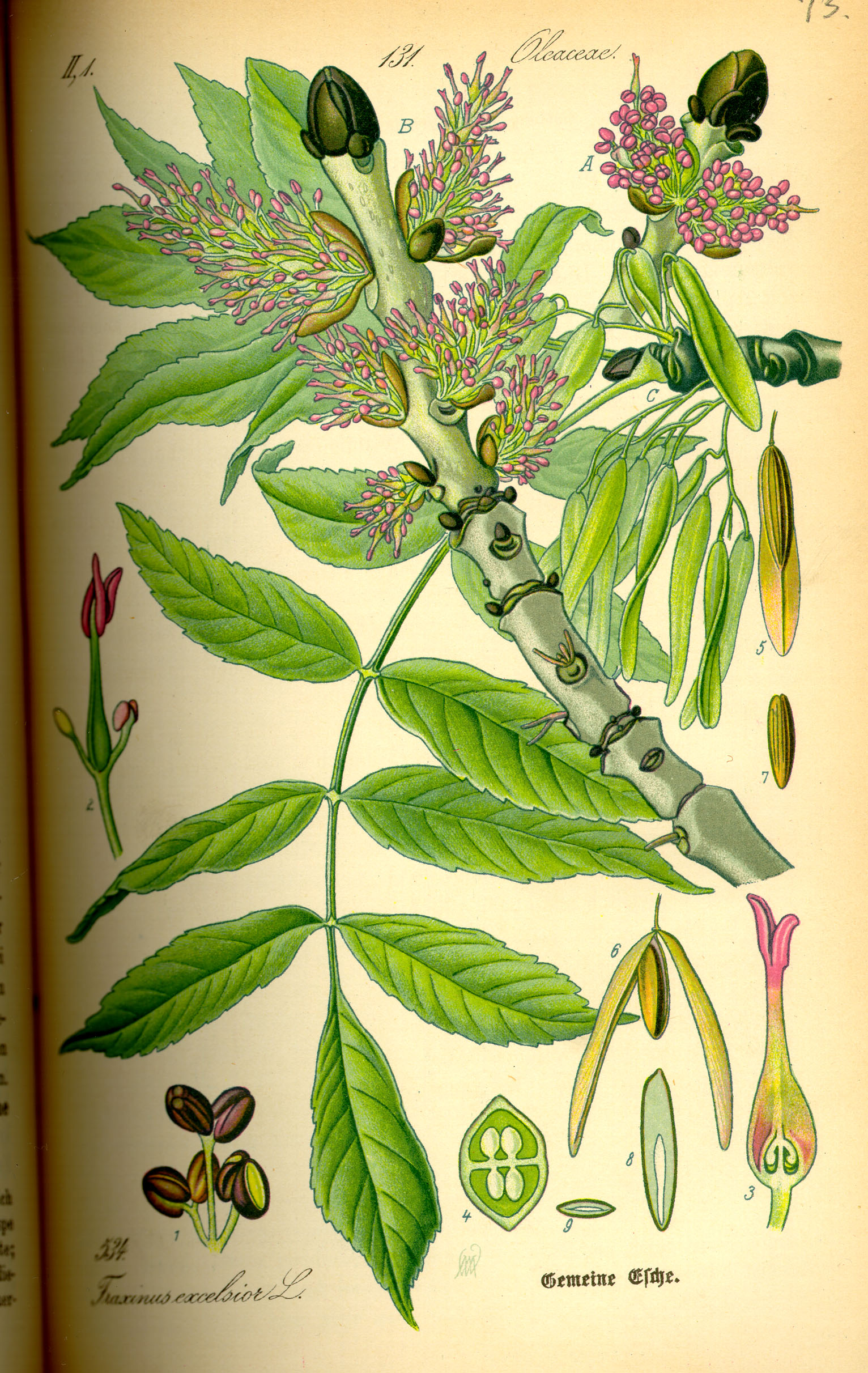
Common ash (Fraxinus excelsior) is a common large deciduous tree of the British and Irish countryside, native across most of Europe, with distinctive opposite-paired pinnate leaves, prominent black winter buds, and the recognisable winged seeds (the “ash keys”) that hang in clusters through the autumn. Mature trees reach 25–35 metres; the wood is harvested both from coppiced pole-wood and from larger felled trunks.
The wood is pale to light brown, with sapwood often indistinguishable from heartwood; ring-porous, with the spring-wood pores very large and the late-wood almost solid, giving it a clearer figure than any other common British timber. Density runs around 680 kg/m³, close to English oak (about 675 kg/m³); Janka hardness is around 6,580 N, higher than oak (about 4,980 N).
What ash is celebrated for, in the working-craft tradition, is shock resistance. The grain structure makes ash extraordinarily good at absorbing impact without fracturing; this is why ash has historically been the wood of choice for tool handles (axes, hammers, billhooks), for the longbow (where yew was the preferred wood but ash was the substitute), and — most relevant to this site — for the camán, the hurling stick of Irish national sport, which is typically made of ash.
For walking sticks specifically, ash is the wood of the staff rather than the shillelagh. A long ash stick is light for its size, springy under load, and durable in a way that the harder but more brittle woods are not. The traditional shepherd’s crook of upland England and Wales is often ash with a horn handle. The Highland walking stick used by the older generation of stalkers and gillies is often ash. The Wexford and Tipperary hurling tradition keeps the wood in active use at scale; what does not go into camáns goes into farm-tool handles and a small but steady output of plain working walking sticks.
Best for: long walking sticks; staves; shepherd’s crooks; sticks where the wood needs to take impact without breaking.
Worse for: shillelaghs (wrong character — too pale, too straight, no natural knob); pieces where dark colour is wanted.
A note that is necessary in 2026: European ash is in the middle of a population-level health crisis from ash dieback (Hymenoscyphus fraxineus), a fungal disease introduced into Europe in the 1990s and now established across Britain and Ireland. Mature ash continues to die at scale; the long-term picture for the species in these islands is uncertain. Ash from sustainably-managed dieback-tolerant stock is now the rarer commercial product. A stick-maker working in ash today is, in part, working against a disappearing material.
Which to choose
For the buyer or the new maker trying to decide, this is the simplest version:
-
A short Irish stick — a shillelagh, a club, a presentation gift in the Irish tradition — is blackthorn, full stop. Use one of the other woods only if you have a specific reason to, and be prepared for the result not to read as iconically Irish.
-
A long walking stick to use on roads and gentle hills, in the Irish or English tradition — is most often oak or ash, with oak the more formal choice and ash the more practical one. Either is correct. Blackthorn at this length is unusual and harder to source.
-
A long thumb-stick or fork-handled walking stick, in the Scottish or Welsh tradition — is holly, by tradition, with the natural Y-fork at the top. Blackthorn does not produce this form reliably; oak and ash can but rarely do.
-
A staff — five feet or more, for serious hill-walking — is ash, in almost every case. The shock-resistance and the springy character of the wood under load are the reasons.
-
A working tool handle, an axe haft, a hurley — is ash. None of the other woods reach the same combination of strength and impact-resistance.
The four woods are not interchangeable, and a maker who tries to use the wrong wood for the wrong form is, almost always, fighting the material rather than working with it. The tradition has been in place for long enough — three hundred years for blackthorn and oak, longer for ash and holly — that the matches between wood and form are not arbitrary. They reflect what each tree actually is.
A reader who is comparing real handmade pieces from a maker should expect to see the wood named, and to see the wood match the form. A maker who labels a stick as blackthorn and produces something pale, straight, and uniform is — at best — using the wood imprecisely, and probably using a different one.
This piece pairs with What is a shillelagh? on the form side, and with the individual wood reference pages on the material side: blackthorn, oak, holly, and (in preparation) ash.
Sources & further reading
- European oak — wood properties, The Wood Database
- Ash (European) — wood properties, The Wood Database
- Holly — wood properties, The Wood Database
- Ash dieback (Hymenoscyphus fraxineus), Forest Research, UK
Related reading
- woodsBlackthorn Wood: Seasoning, Uses
The hedgerow tree behind most Irish sticks: dense, dark, slow-growing, and beloved of hedge-witches.
- woodsOak
The other Irish stick wood — older, heavier, and the source of the original Wicklow shillelaghs.
- woodsHolly
The pale-wooded thumb-stick tree of Scotland and Wales — and the hedgerow shrub that sometimes turns up in Irish work too.
- woodsAsh
The springy, impact-resistant wood of staves, tool handles, and the Irish hurling stick — and the species now in the middle of a Europe-wide health crisis.