Oak
The other Irish stick wood — older, heavier, and the source of the original Wicklow shillelaghs.

If blackthorn is the wood of the modern Irish stick, oak is the wood of the older one. The shillelagh takes its name, on one of the two competing etymologies, from the village and barony of Shillelagh in County Wicklow — and what the village was famous for, before it gave its name to a stick, was its oak forests. The original shillelaghs, in the Wicklow tradition that is preserved in the place-name etymology, are oak.
The pair makes sense once you see them next to each other. Blackthorn is small, dark, dense, and rare in any one piece longer than three feet. Oak is large, mid-toned, and available in any length you want. A blackthorn stick is what comes out of a hedgerow; an oak stick is what comes out of a wood. Both have been used in Ireland for at least three hundred years. Both, in the right hands, finish to something that lasts a lifetime.
This is what a maker would tell a reader to know about oak.
Quick reference
| Common names | Pedunculate oak (English oak), sessile oak (durmast oak) |
| Binomial | Quercus robur L.; Quercus petraea (Matt.) Liebl. |
| Family | Fagaceae (beech family) |
| Native range | Most of Europe; widespread across Britain and Ireland |
| Habit | Large deciduous tree, 20–40 m at maturity, long-lived (300–800 years not uncommon) |
| Bark | Grey-brown, deeply fissured on mature trees; smoother on young growth |
| Leaves | Lobed, 7–14 cm long; robur has short stalks (almost sessile) but stalked acorns; petraea has stalked leaves but sessile acorns |
| Acorns | 2–4 cm long, in shallow cups; September–November |
| Wood density | ~675–710 kg/m³ at 12% MC |
| Janka hardness | ~4,980 N (1,120 lbf) for English oak |
Two species
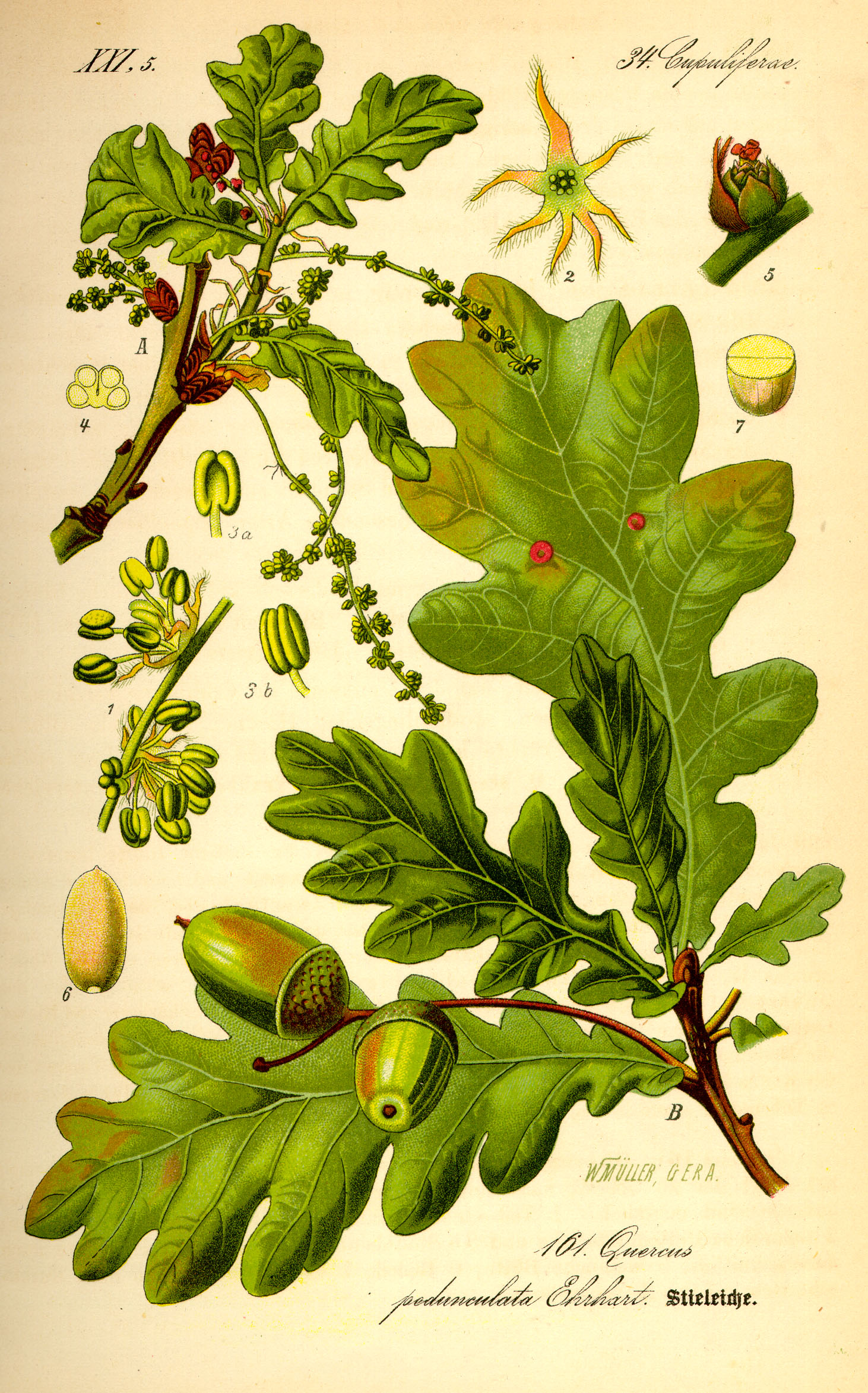
The British and Irish oak is, for practical purposes, two species that hybridise where they meet. Pedunculate oak (Quercus robur) is the lowland tree of heavy clay and lower-altitude woods; sessile oak (Quercus petraea) is the upland tree of thinner soils and higher ground. They are very close cousins — the wood of the two is essentially indistinguishable in the workshop — and both are found across Ireland.
The diagnostic between them is back-to-front. Robur has acorns on long stalks (“peduncles”) but leaves with almost no stalk; petraea has acorns sitting tight to the twig but leaves on long stalks. In the field, looking at acorns is faster than looking at leaves.
For the purposes of this site, “oak” means either species, with the species-specific differences flagged where they matter for the wood.

The Wicklow connection
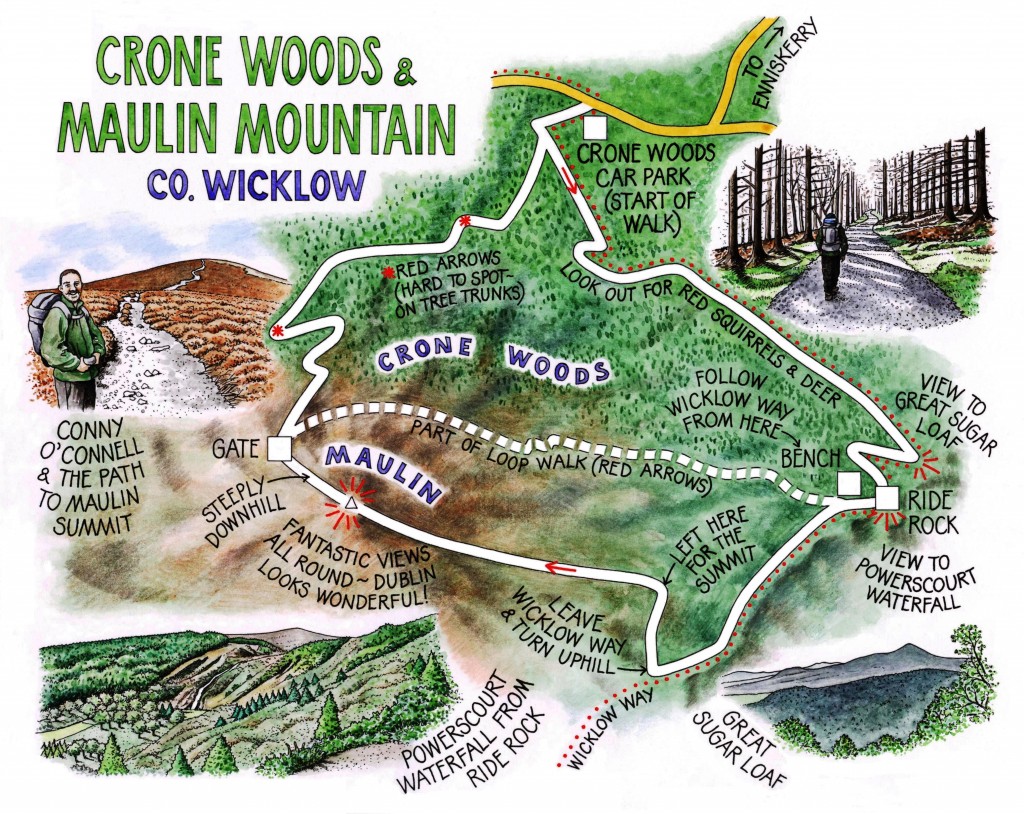
The stretch of County Wicklow now associated with the village of Shillelagh and the wider Slaney valley was, until the seventeenth century, the largest continuous oak forest in Ireland. The wood from these forests was a strategic resource long before it was a folk one: oak from the south-east supplied the timber for the medieval and early-modern Irish economy, the late-Tudor and Stuart shipbuilding programmes, and the great houses of the Anglo-Irish ascendancy.
The forests were, by the same token, a strategic vulnerability for a colonial power that did not control them, and the systematic clearance of Irish woodland through the seventeenth century — accelerated under Cromwell, completed by the 1690s — was as much a political project as a commercial one. By the time the eighteenth century picked up the place-name shillelagh as a generic for an oak stick from the area, the forests that produced the wood were largely gone. The wood survived; the woods did not.
A few fragments remain. Coolattin Oak Wood, on the western edge of the historical Shillelagh estate, is a surviving fragment of the old south-eastern oak forest; the Irish government bought it with the support of An Taisce. The forest is much smaller than it was three centuries ago; the trees themselves are descendants, in the unbroken sense, of the forests that gave the stick its name.

The wood
Oak is the standard against which the harder hardwoods of European tradition are measured. It is not the densest of them — that distinction belongs in Europe to a few outliers like cornel and box, and even among the common timbers ash (~680 kg/m³) and beech (~710 kg/m³) are both denser than English oak (~675 kg/m³) — but it is the most commonly worked wood in the British and Irish craft tradition. Density runs at around 675–710 kg/m³ at standard moisture content (English and sessile oak); Janka hardness sits around 4,980 N (about 1,120 lbf).
The character of the wood is in its figure. Quarter-sawn oak shows the characteristic medullary rays as a flecking pattern that runs across the grain; flat-sawn oak shows the cathedral-arched flame figure that appears on most oak floors. The colour, when freshly worked, is light biscuit-brown. With oil and time it deepens; an oak stick that has been carried for a generation is closer to a dark honey or a near-black, and shows the cumulative effect of every hand that has held it.
For sticks specifically, oak does several things blackthorn cannot.
The first is length. A blackthorn stick is limited by the size of the shrub; anything past about three and a half feet of straight-grained shaft is rare. An oak stick can be any length the maker chooses, and longer staff-sized pieces — five feet and up — are mostly oak or ash, never blackthorn.
The second is predictability. A blackthorn shaft is irregular by nature; the maker is working with what the hedge has given. An oak shaft, cut from the larger trunk wood, can be made straight, even, and to specification. This makes oak the right wood for the more formal walking stick — the kind given as a presentation piece, the kind used by stage actors and ceremonial officers — where blackthorn’s irregular character would read as wrong.
The third, in some hands, is sound. An oak stick, struck against another oak stick, gives a different note from blackthorn against blackthorn — sharper, drier, less of a thud. Stick-fighting practitioners know this; collectors usually do not. It is the kind of detail that survives in a tradition without anyone making a point of it.
Cutting and seasoning
Oak does not need the same theatrical seasoning as blackthorn. The wood is structurally more forgiving — less prone to surface checking, less likely to warp dramatically — and a properly-stored oak shaft will be ready to work in roughly half the time of an equivalent blackthorn piece. One year, sometimes two, is the working figure. Some makers go longer for the densest heartwood pieces.
Cutting is in winter, as for any timber. Selection is straighter — what the maker is looking for is a clean grain run with no large knots — and the cuts can come from coppiced pole-wood, from windfall branches, or from larger felled trunk wood split out to size. Oak responds well to air-drying in a covered shed; the surface losses to checking and weathering are minimal compared to most hardwoods, and the resulting wood is stable.
Finishing is more variable. Oak takes oil deeply, takes wax over oil well, and takes shellac and natural varnishes without the obvious filming that blackthorn rejects. Many oak sticks are finished darker than the natural wood — by smoking, scorching, or staining — to bring them closer in tone to blackthorn or to the older “shillelagh-black” finish associated with traditional pieces. A scorched-and-oiled oak shillelagh is among the more striking forms of the stick the wood produces.
Beyond sticks
The list of things oak has been used for in Ireland and Britain is functionally the list of things hardwood has been used for. Shipbuilding, until the wood ran out. Furniture, especially in the seventeenth and eighteenth centuries. Coopering: oak is the wood of the barrels in which wine, sherry, brandy, and Scotch whisky are aged. Beams and roof timbers in domestic and ecclesiastical building, where surviving oak from the medieval period is among the longest-lived timber in any European structure.
The folklore of oak is also large. The tree is the king of the wood in Indo-European tradition; it is the druid’s tree in the popular imagination of the post-Romantic Celtic Revival; it is the seat of the bile, the sacred tree of pre-Christian Ireland that marked tribal centres and inauguration sites. The folklore piece these references belong in is its own article and not this one.
Oak vs blackthorn for sticks
A reader trying to choose between an oak stick and a blackthorn one is mostly choosing between two registers of the same tradition.
Blackthorn is the modern emblematic choice, the wood that says “Irish stick” without elaboration. It is dark, dense, irregular, and — done well — heavier than it looks. It is the wood of the hedge, of the small farm, of the rural countryside.
Oak is the older and the more formal choice, the wood that returns the object to its place-name origin in Wicklow. It is lighter in colour (before finishing), more even in grain, available in longer lengths, and noticeably more workable for the maker. It is the wood of the wood, of the larger estate, of the timber-frame and the great house.
A short shillelagh is most often blackthorn now, but a long walking stick — particularly one made for ceremony or display — is more often oak. Both are correct.
The fuller side-by-side, including holly and ash, is in Holly vs blackthorn vs oak vs ash.
This is a reference page. If you spot an error here, please write to the editor.
Sources & further reading
- Quercus robur L., Plants of the World Online, Royal Botanic Gardens, Kew
- Oak — A-Z of British Trees, Woodland Trust
- An Taisce — purchase of Coolattin Wood, Wikipedia
- Oliver Rackham, Trees and Woodland in the British Landscape (1990), Phoenix Press / WorldCat
- English oak — wood properties, The Wood Database
- Sessile oak — wood properties, The Wood Database
- Oak — barrels for wine and spirits, Wikipedia
Related reading
- woodsBlackthorn Wood: Seasoning, Uses
The hedgerow tree behind most Irish sticks: dense, dark, slow-growing, and beloved of hedge-witches.
- guidesShillelagh: Meaning, History & How to Spot a Real One
An Irish blackthorn club, a contested word, and a heritage object that has outlived its job description.
- comparisonsHolly vs blackthorn vs oak vs ash
Four traditional stick woods, side by side: how they look, how they behave under the hand, and which one belongs in which kind of stick.
- guidesA short history of the Irish walking stick
Three centuries of an everyday object — from faction-fight weapon to emigrant gift to the heritage piece a small handful of makers still cut by hand.