Holly
The pale-wooded thumb-stick tree of Scotland and Wales — and the hedgerow shrub that sometimes turns up in Irish work too.
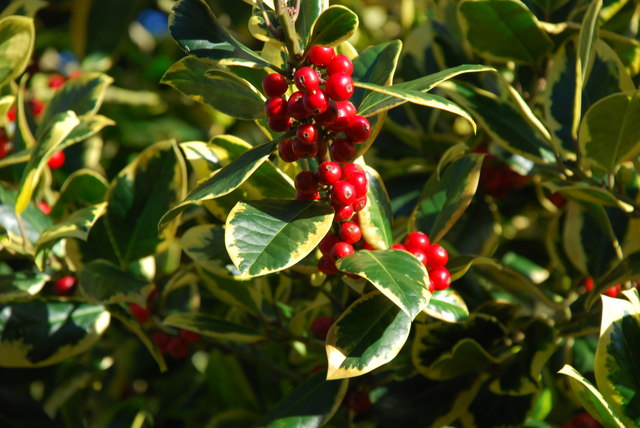
Holly is the third of the British and Irish stick-woods, and the one most readers will not have thought of. It is the pale-wood to blackthorn’s dark, the even-grain to oak’s open. It does not look like a stick wood until you’ve used one, at which point it does not particularly look like anything else.
It is also the wood most strongly associated with the Scottish and Welsh stick traditions — the thumb-stick of the upland walker, the crook of the shepherd, the show-stick of the Welsh sheep-dog handler — rather than with the Irish blackthorn-and-oak axis. The wood’s distinctive whiteness is the reason it survives in the British and Irish craft tradition at all: nothing else in the native flora looks remotely like it.
Quick reference
| Common names | Holly, English holly, European holly, celyn (Welsh), cuileann (Irish) |
| Binomial | Ilex aquifolium L. |
| Family | Aquifoliaceae |
| Native range | Western and southern Europe; into North Africa and southwest Asia |
| Habit | Evergreen shrub or small tree, 5–15 m, slow-growing |
| Bark | Smooth, pale grey, often with darker spots — distinctive at any age |
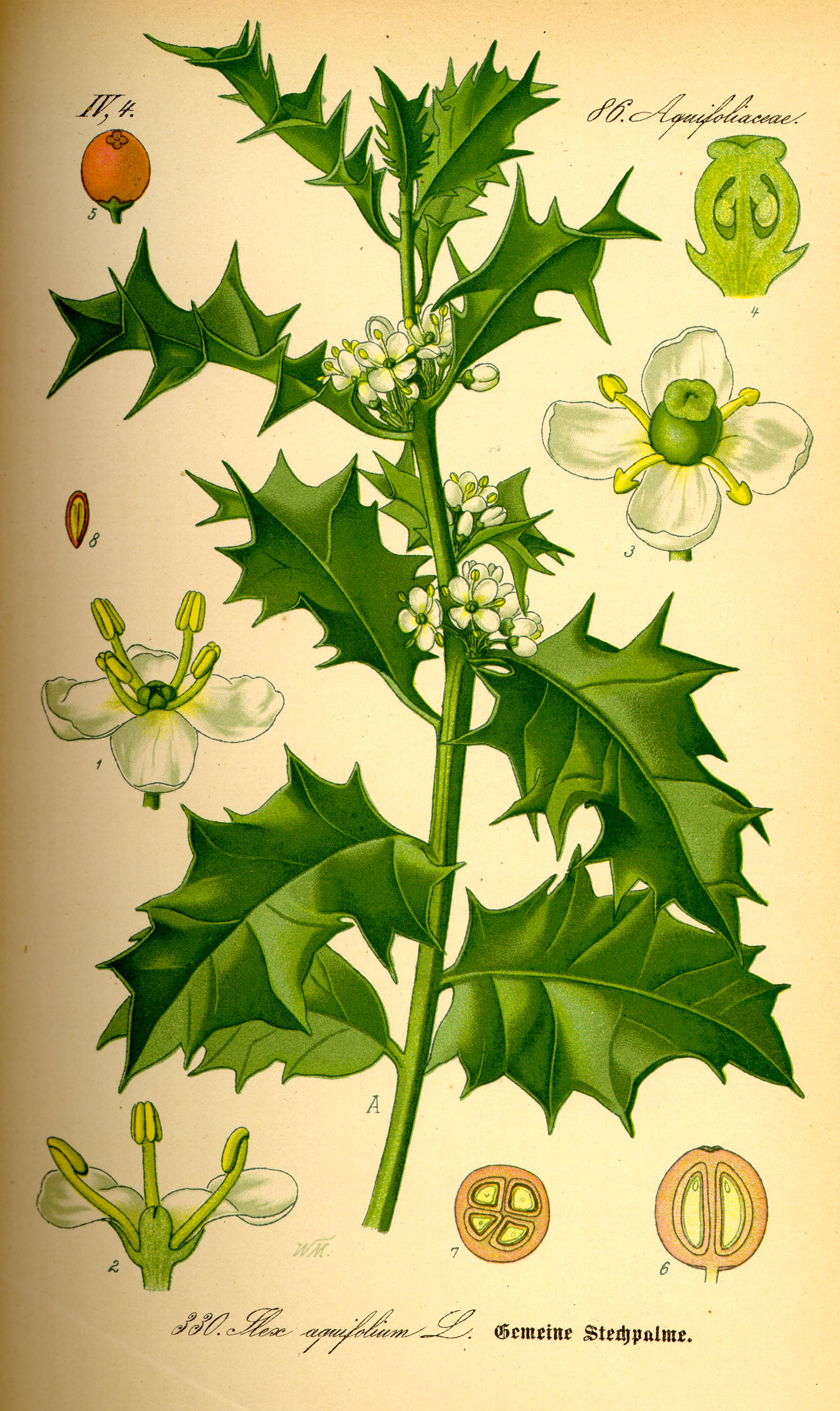
| Leaves | Glossy, dark green, evergreen; spined and wavy on lower branches, smoother and almost entire on upper branches |
| Flowers | Small, white, four-petalled, May; dioecious (separate male and female plants) |
| Fruit | Bright red berries on female trees, ripening in autumn and persisting through winter |
| Wood density | ~650 kg/m³ at 12% MC |
| Janka hardness | ~4,510 N — a little below English oak (~4,980 N) |
The plant
Holly is one of the few evergreen broadleaves native to Britain and Ireland, which alone makes it conspicuous in the winter hedgerow when most of the surrounding trees are bare. It grows slowly — a metre a decade is not unusual on a poor site — and the stems that get cut for sticks are typically thirty to sixty years old. The growth rings are tight and roughly circular, which is part of what gives the wood its remarkable evenness.
Two features of the live tree are diagnostic for anyone walking a hedge looking for stick wood.
The first is the leaf dimorphism: lower branches carry leaves with the famously sharp spines along their wavy edges; upper branches carry leaves that are almost smooth-edged and oval. Older trees, and those in shaded places, tend to have the most smooth-edged leaves, especially in their upper parts, so an old, well-grown holly may have spineless leaves at the height a stick-cutter is interested in.
The second is the bark. Holly bark is smooth and pale grey, with darker speckling, and is unlike any other native British or Irish tree bark at first glance. A holly stick that has been left barked retains this distinctive surface. A holly stick that has been debarked reveals the white wood beneath — and this is what makes the tree commercially interesting, because almost nothing else in the European native flora produces a wood this pale.

The wood
Holly is the whitest temperate hardwood of any commercial significance in Europe. Freshly worked, it ranges from off-white to a very pale ivory; with handling and time it ages to a soft cream, never to the dark browns of oak or the near-blacks of blackthorn. This pale colour is the reason the wood is, in industrial terms, used for veneer and inlay more than for structural work; furniture-makers prize holly for stringing lines and the small inset details that need a wood that won’t disappear into the surrounding pieces.
For sticks, the colour matters less than two other properties.
The first is the hardness. Holly is a dense, hard wood, but by Janka measure it is not harder than oak. The Wood Database lists English holly at about 4,510 N and English oak at about 4,980 N, with holly averaging about 650 kg/m³ against about 675 kg/m³ for oak.
The second is the grain. Holly grain is fine, even, almost featureless, and frequently very straight. There is none of the open ray-fleck of oak; none of the gnarled root-character of blackthorn. A finished holly shaft has the visual quality of polished bone or aged ivory — which is exactly the quality that makes it useful for thumb-sticks and crooks, where the wood is meant to read as clean rather than rustic.
The combination of the two — a dense wood and an extremely even grain — gives a holly stick a particular feel in the hand: less alive in surface character than blackthorn, but tighter and brighter. It is the connoisseur’s wood among the British and Irish stick timbers.
Cutting and seasoning
Holly is in some ways easier and in some ways harder to season than blackthorn or oak.
Easier, because the wood is structurally stable. Holly does not crack along the grain in the way blackthorn does; the surface checking that affects oak is rare. A holly shaft, properly stored, will reach working moisture without dramatic incidents.
Harder, because of the colour. Holly’s defining whiteness is fragile, and the wood will discolour quickly if it is allowed to absorb sap residues, dust, or moisture in the early stages of drying. Stick-makers working in the holly tradition often debark immediately after cutting and store the wood in clean, dry, well-ventilated conditions, sometimes in waxed paper, to preserve the white. A holly stick that has gone yellow or grey has lost something it cannot get back.
Standard seasoning runs one to two years for a finished stick, somewhat shorter than blackthorn because the wood is more stable. The cuts are taken in winter, as for any timber, and selection is for clean, straight, knot-free runs of stem. Holly’s slow growth means that a usable stick-length will often be the entire main stem of a small tree.
The Scottish and Welsh thumb-stick tradition
Where blackthorn is the iconic wood of the Irish stick, holly is the iconic wood of the upland British stick — particularly in the Scottish Highlands, the Lake District, and Wales. The form most associated with it is the thumb-stick: a long, lightly-curved walking stick with a Y-shaped fork at the top, into which the thumb settles when the stick is held at the user’s hip.
The Y-shape is a natural feature of the holly’s growth — the tree branches with regularity that lends itself to the form — and a holly thumb-stick is, in most cases, found in the hedge rather than shaped at the bench. The maker selects a stem with a usable Y, cuts the longer leg to walking-stick length, trims the shorter leg to the desired thumb-rest height, debarks if appropriate, seasons, and finishes. There is comparatively little carving involved.
The Welsh sheepdog trial tradition uses holly extensively; the show-sticks carried by Highland gillies and Lakeland fell-walkers are often holly with a stag-horn or carved-bone handle.
In the Irish tradition, holly is less common but not absent. In early Irish law, holly was one of the seven chieftain trees (airig fedo, “nobles of the wood”) of the Bretha Comaithchesa, alongside oak, Scots pine, hazel, ash, yew, and apple; its winter berries gave it a strong place in pre-Christian midwinter folklore that survives in the Christmas use of holly today. Its presence in finished Irish sticks is a matter of taste rather than strong tradition.
Beyond sticks
Holly’s whiteness has ensured its survival as a commercial timber far beyond the stick trade. Historically and into the modern period it has been used for:
- Inlay and veneer — the standard furniture inlay wood for centuries, particularly in stringing lines on the edges of cabinets and box-work
- Marquetry — figure-cutting work where contrast against darker grounds is the whole point
- Engraving blocks — once an alternative to boxwood for fine work, though largely superseded
- Piano keys and other small fittings — the Wood Database lists dyed-black piano keys among holly’s common uses, and the wood is occasionally substituted for ebony
- Mathematical instruments — slide rules, drawing tools, where dimensional stability matters
The folklore is also large. Holly’s evergreen character placed it at the centre of pre-Christian midwinter celebrations across northern Europe; the modern Christmas use of holly wreaths is, in this longer view, a continuation of that material rather than a Victorian invention.
Holly vs blackthorn vs oak
A short summary, with the comparison piece following the wood-by-wood references:
- Blackthorn is dark, dense, irregular, and short. It is the iconic wood of the Irish shillelagh.
- Oak is mid-toned, open-grained, and available in long, even pieces. It is the wood of the formal walking stick and the Wicklow tradition.
- Holly is pale, hard, even-grained, and slow-growing. It is the wood of the Scottish and Welsh thumb-stick.
For the side-by-side, including ash, see Holly vs blackthorn vs oak vs ash.
This is a reference page. If you spot an error here, please write to the editor.
Sources & further reading
- Ilex aquifolium L., Plants of the World Online, Royal Botanic Gardens, Kew
- Holly — A-Z of British Trees, Woodland Trust
- BSBI Plant Atlas: Ilex aquifolium, Botanical Society of Britain and Ireland
- Holly (European) — wood properties, The Wood Database
- Niall Mac Coitir, Irish Trees: Myths, Legends & Folklore (2003), Collins Press
- Ilex aquifolium — wood and uses, Wikipedia
- Brehon — the Bretha Comaithchesa and the seven chieftain trees, Wikipedia
Related reading
- woodsBlackthorn Wood: Seasoning, Uses
The hedgerow tree behind most Irish sticks: dense, dark, slow-growing, and beloved of hedge-witches.
- woodsOak
The other Irish stick wood — older, heavier, and the source of the original Wicklow shillelaghs.
- comparisonsHolly vs blackthorn vs oak vs ash
Four traditional stick woods, side by side: how they look, how they behave under the hand, and which one belongs in which kind of stick.
- guidesShillelagh: Meaning, History & How to Spot a Real One
An Irish blackthorn club, a contested word, and a heritage object that has outlived its job description.