Ash
The springy, impact-resistant wood of staves, tool handles, and the Irish hurling stick — and the species now in the middle of a Europe-wide health crisis.
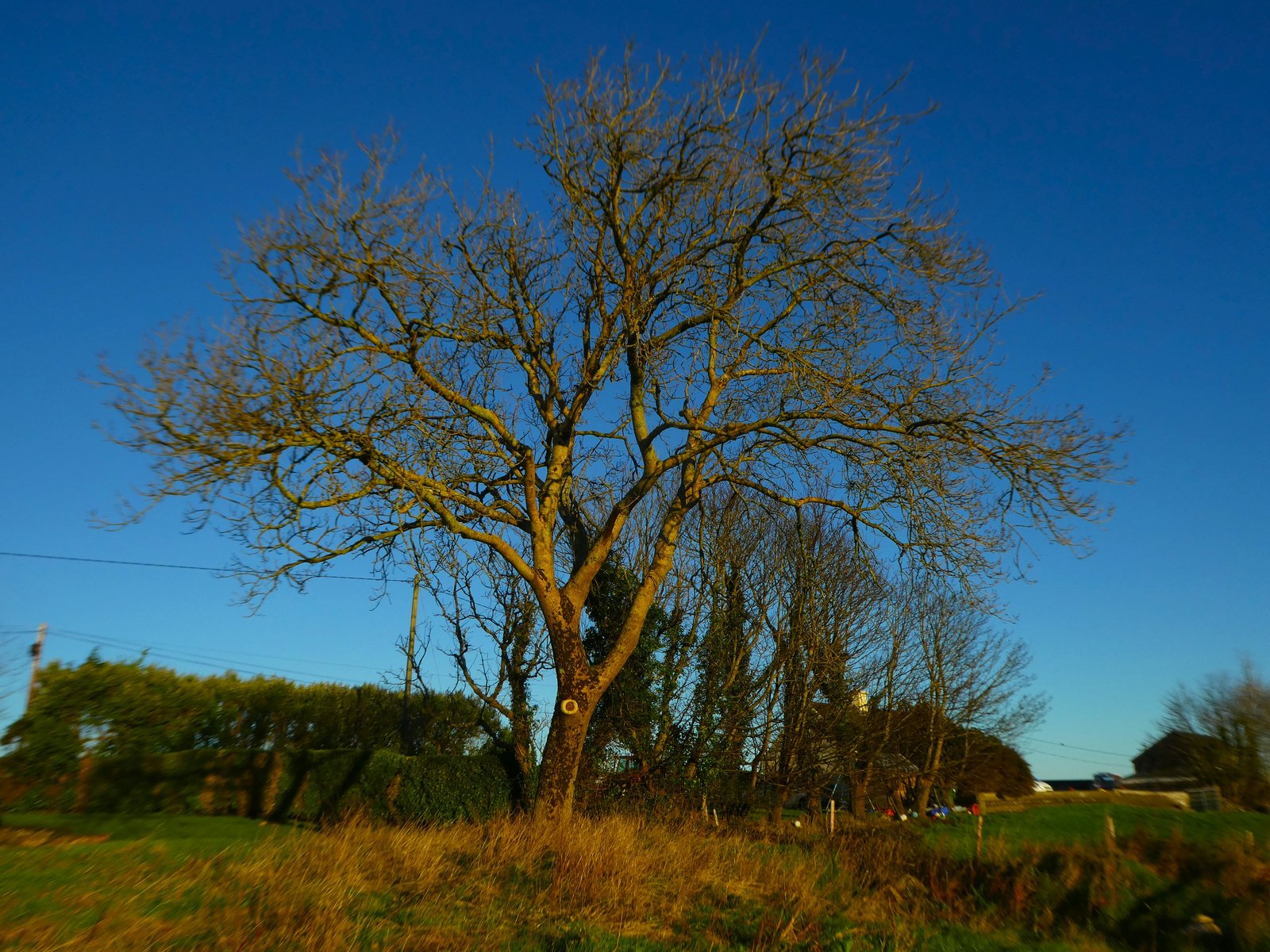
Ash is the wood of impact. It does what no other British or Irish hardwood does as well — absorbs sudden force without breaking — and the tradition has put it where that property matters: in tool handles, in shepherd’s crooks, in long staves, and most distinctively in the camán, the Irish hurling stick that is, by tradition and by competition rule, made of nothing else.
It is also the species in the middle of a Europe-wide health crisis. Ash dieback — a fungal disease that arrived from East Asia in the 1990s and is now established across the continent — is killing mature ash trees on a scale that threatens the species’ continuity in some landscapes. The wood will continue to be available for the foreseeable future. Whether the tree itself survives in its current ecological role is, as of 2026, an open question.
This is what a stick-maker would tell a reader to know about ash.
Quick reference
| Common names | Ash, common ash, European ash, fuinseog (Irish), onnen (Welsh) |
| Binomial | Fraxinus excelsior L. |
| Family | Oleaceae (olive family) |
| Native range | Most of Europe; into the Caucasus and northern Iran |
| Habit | Large deciduous tree, 25–35 m at maturity, fast-growing for a hardwood |
| Bark | Pale grey, smooth on young trees, fissured on mature ones |
| Buds | Distinctive black winter buds — diagnostic in any season |
| Leaves | Compound, opposite, pinnate, with 7–13 leaflets; among the last to leaf out in spring |
| Flowers | Small, dark purple, in clusters before the leaves; April |
| Fruit | Single-winged samaras (“ash keys”) in pendulous bunches; September–November |
| Wood density | ~680–720 kg/m³ at 12% MC |
| Janka hardness | ~5,000 N (~1,120 lbf) |
The plant
Ash is a large, fast-growing deciduous tree of the Oleaceae family — the same family as olive, lilac, and privet, which is sometimes surprising to people thinking of ash as a quintessentially Northern European wood. It is widespread across most of Europe and into western Asia, and it is one of the more productive timber trees of the British and Irish countryside, reaching commercial size in roughly half the time of oak.
Three features identify ash on sight, in any season.
The first is the black winter buds. Most British and Irish trees have buds in some shade of brown or grey-green. Ash buds are an unmistakable sooty black, set at opposite pairs along the twig. A bare ash twig in February is the easiest of all the native trees to identify.
The second is the opposite-paired pinnate leaves. Each leaf is a compound structure of seven to thirteen narrow leaflets along a central stalk, with the leaflets in pairs along the rachis. The arrangement is shared with elder and a handful of other species, but ash leaves are larger and more open in spacing than the alternatives.
The third is the ash keys — single-winged samaras hanging in dense clusters in autumn. The fruit is dispersed on the wind by the autumn equinox, and the keys themselves often persist on the tree well into winter, making the species easy to identify even after leaf-fall.
In Irish and Welsh folk-classification, ash was one of the noble trees — alongside oak and hazel — in the early Irish tree-list (the Auraicept na n-Éces and its variants), with associated rights, restrictions, and cultural status [VERIFY exact placement in the Auraicept]. The high cultural status reflected the practical importance of the wood across the agricultural and craft economy.
The wood
Ash is a ring-porous hardwood, meaning the early-wood vessels (formed in spring growth) are much larger than the late-wood vessels (formed later in the season). The result is a distinctive figure that is unmistakable on a sanded ash surface: alternating bands of porous and solid wood, running the length of the stick, with the porous bands often catching oil during finishing and standing out as slightly darker.
The colour is pale to light brown — a creamy biscuit when freshly worked, deepening with oil and time to a soft honey or light tan. There is little distinction between heartwood and sapwood on most pieces, which is unusual for a temperate hardwood and means that ash sticks tend to look uniform in colour from end to end (in contrast to blackthorn, where the dark heartwood and the pale sapwood give a finished stick its characteristic two-tone appearance).
Density runs at around 680–720 kg/m³ at standard moisture content — slightly less than oak, noticeably less than blackthorn. Janka hardness is around 5,000 N, comparable to European oak.
What sets ash apart, mechanically, is shock resistance. The ring-porous structure is unusually good at absorbing impact along the grain — under sudden force the wood flexes rather than fractures, and the energy is dispersed along the length rather than concentrated at the point of impact. This is the property that has, for as long as records exist, put ash where impact happens: tool handles for axes, hammers, billhooks, and adzes; shafts for the longbow; the shock-absorbing parts of carts and carriages; and the hurling stick.
For walking-stick purposes, the same property gives an ash stick a particular feel under load: slightly springy at length, less stiff than oak, more forgiving of a heavy plant on a hill or a slip on a wet path. It is not a fighting wood — for that you want the dead, dense weight of blackthorn — but it is the working hill-walker’s wood across both the British and Irish traditions.
The Irish camán
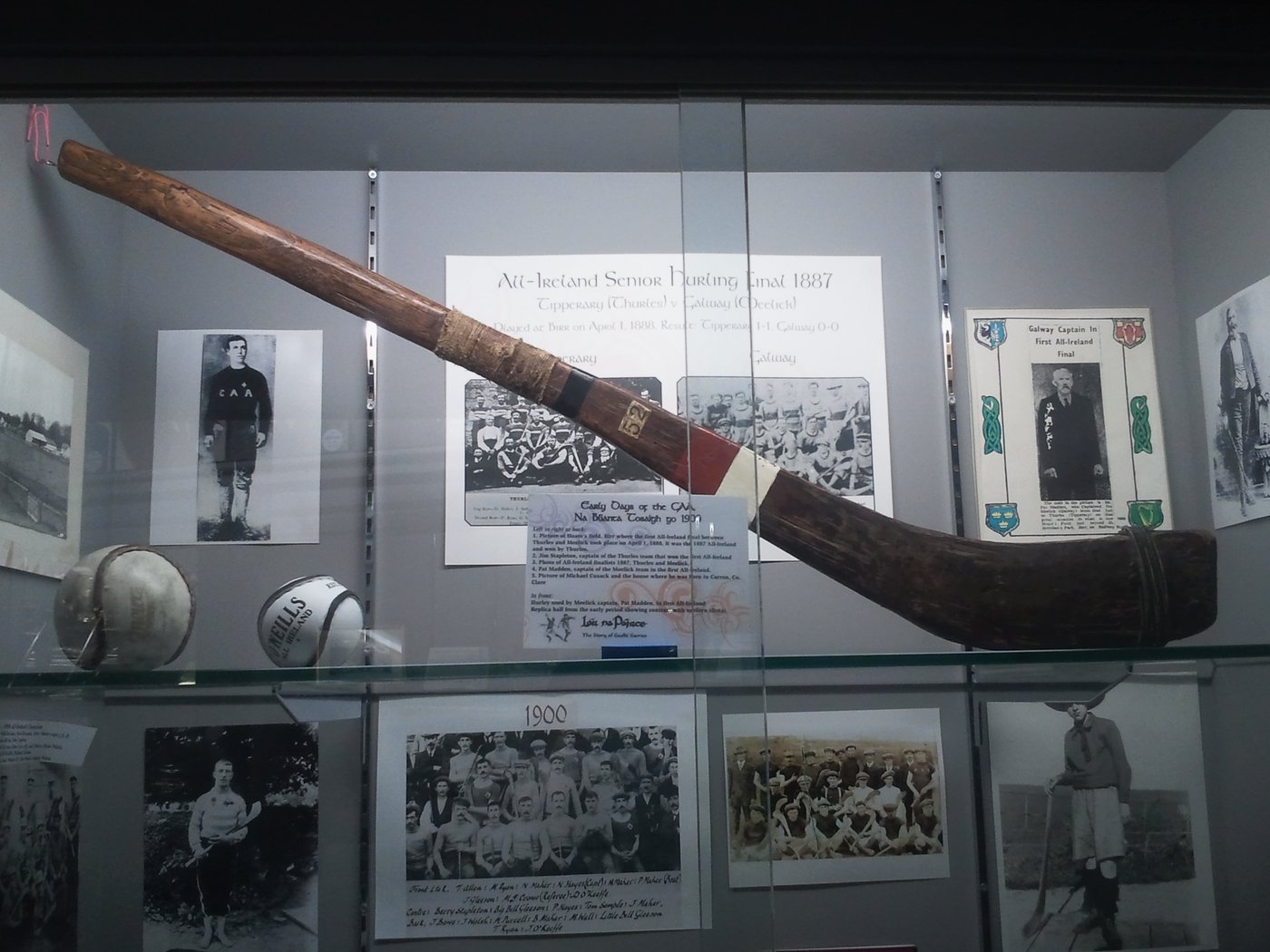
The most distinctive Irish use of ash is the camán — the hurling stick of Irish national sport. Hurling, codified by the Gaelic Athletic Association from 1884 onward, is one of the fastest field games in the world; the ball (the sliotar) is struck along the ground or in the air with a short, broad-bladed stick made of ash. The blade is wide and slightly curved; the handle is gripped two-handed; the wood absorbs the repeated, heavy impact of the contest in a way that no other available timber would survive.
GAA rules specify that the camán be made of ash by tradition and, in some interpretations, by formal regulation [VERIFY current GAA technical specifications]. The supply of suitable ash for camán production has been, since at least the 1980s, an active concern for the sport’s governing body and an active business for a small number of specialist makers, mostly concentrated in Wexford, Tipperary, and Galway. Camán-makers are a recognisable craft category in Ireland, distinct from but related to the broader stick-making tradition.
The wood for camán production has historically come from Irish-grown ash — straight-grained, knot-free, from coppiced or selected woodland — supplemented by imports as Irish supply has proved inadequate to demand. The dieback crisis (below) has put serious pressure on both the domestic and the imported supply.

The Welsh shepherd’s crook
The other major working use of ash for stick purposes is the shepherd’s crook of the Welsh and northern English upland sheep tradition. A working crook is typically four to five feet long, with a curved hook at the head designed to catch a sheep around the neck or the hind leg; the shaft is gripped at the upper third, and the crook is used in active flock-management as an extension of the shepherd’s reach.
Ash is the dominant wood for working crooks because it combines the necessary length (ash grows in straight pieces well in excess of five feet), the appropriate weight (light enough for an all-day working tool), and the impact-resistance (a crook that catches a moving sheep and is yanked sideways needs to flex rather than break). The curved head is heat-bent from the natural growth of the tree, with the bend set permanently by the seasoning process.
Welsh and Cumbrian crooks are still made by working makers, in working sheep country, for working shepherds. The show-stick variant — a finely-finished crook with a horn handle, made for competitive display at agricultural shows rather than active sheep-work — is a parallel tradition with its own competitive culture. Both are described in more detail in Irish vs Scottish vs Welsh sticks.
Tool handles, longbows, the working register
The list of things ash has been used for in Britain and Ireland is essentially the list of objects where wood has needed to take impact without breaking. The major working uses, in rough order of historical significance:
- Tool handles for axes, mauls, sledgehammers, billhooks, adzes, hoes, scythes, and rakes. Almost any wooden-handled striking or chopping tool of British or Irish manufacture, before the post-war shift to fibreglass and synthetic handles, was ash.
- Longbows. Yew was the preferred wood for the medieval English longbow, but ash was the standard substitute when yew was unavailable, and produced a serviceable bow.
- Cart and carriage parts, particularly the shafts, the spokes, and the parts subject to repeated stress. Pre-internal-combustion English and Irish road transport ran on ash.
- Aircraft frames in the early twentieth century — most early biplane airframes used ash for the structural elements where laminated bracing was needed.
- Sports equipment beyond hurling: tennis rackets (until the post-war switch to laminated woods and then synthetics), some hockey sticks, baseball bats in some periods.
For sticks, the practical lesson of all of this is that ash is the wood for functional, impact-bearing pieces rather than for ornamental display. A blackthorn shillelagh sits on a wall; an ash stave is what you take walking.
Cutting and seasoning
Ash is, by traditional stick-making standards, easy to season. The wood is structurally stable; it doesn’t case-harden the way oak can; it doesn’t develop the surface checking of blackthorn. One year of air-drying is normally enough for a working stick; some makers go to eighteen months for the larger crook pieces.
Cutting is in winter, as for any timber. Ash coppice — a managed woodland of stools cut on a 7–15 year rotation — produces particularly good stick wood, with straight grain runs that are nearly knot-free. The traditional Welsh and Irish coppice cycle for ash is 12–15 years; longer cycles produce larger pieces suitable for tool handles and crook shafts, shorter cycles produce thinner pole-wood for hurdles and walking sticks.
After seasoning, ash takes a clean debark with little fuss, and the wood underneath is the pale cream of any properly-finished ash piece. Finishing is conventional: linseed oil, beeswax, sometimes a thin shellac for the decorative pieces. The ring-porous figure shows clearly through any of these.
Ash dieback
Since the 1990s, European ash has been in the middle of an existential health crisis driven by the fungal disease ash dieback, caused by Hymenoscyphus fraxineus. The fungus was first observed killing ash in Poland in 1992, and was confirmed in the United Kingdom in February 2012 — though Forest Research notes evidence that the pathogen had entered Britain at some point before 2006. The fungus is native to East Asia, where the local ash species are largely tolerant; it is the European Fraxinus excelsior that has no inherited resistance to it.
The disease causes leaf wilt, crown decline, and eventually death of trees. Forest Research notes that the fungus “can kill young and coppiced ash trees quite quickly”, while older trees can resist it for some time until prolonged exposure or another pest or pathogen finishes them. The disease is now established across Britain and Ireland; mature ash death is a regular feature of British and Irish woodlands as of the mid-2020s. Some trees with apparent genetic tolerance survive in infected stands, providing the genetic basis for the breeding programmes that may eventually restore the species in working populations.
The implications for the stick-making and tool-handle trades are real but slow-moving. Existing stocks of ash timber will continue to be available for years to come, drawn down from felled mature trees; future supply depends on whether dieback-tolerant individuals can be identified, propagated, and planted in time to maintain a working population.
Camán production has already been affected. The GAA and several research bodies have invested in tolerant-ash breeding programmes [VERIFY specific programmes], and in increased imports from regions where dieback has not yet reached the same severity. The cost of ash for camán production has roughly doubled from 2010 to 2024 [VERIFY exact figures]. Whether Irish-grown ash will remain a viable economic source for the sport over the next twenty years is uncertain.
For walking-stick purposes, the disease is a real but less acute concern. A stick-maker uses small quantities of wood relative to the bat industry; the available supply is likely to outlast any individual maker’s career. But the ecological loss is significant. Ash has been one of the defining trees of the Irish and British countryside for a thousand years; the prospect of its absence is a substantial cultural and ecological change.
A reader buying an ash stick from a careful maker in 2026 should ask, simply, where the wood came from, and consider that wood from sustainably-managed dieback-tolerant stock is the more responsible choice in the current circumstances.
Ash vs other stick woods
The position of ash in the four-wood comparison:
- vs blackthorn: lighter, straighter, available in much longer pieces; less iconic; the wood for staves rather than for shillelaghs.
- vs oak: lighter, springier, more shock-resistant; oak is denser and more dimensionally stable; the choice between them depends on whether the stick will be used or displayed.
- vs holly: ash is much more easily available, in much longer pieces, but lacks holly’s distinctive pale colour and is not used in the Scottish thumb-stick tradition.
The full side-by-side is at Holly vs blackthorn vs oak vs ash.
This is the reference page for ash. The dieback situation is evolving and the figures here are working estimates as of mid-2026 — corrections from foresters or from the GAA’s technical staff are particularly welcome.
Sources & further reading
- Fraxinus excelsior L., Plants of the World Online, Royal Botanic Gardens, Kew
- Ash — A-Z of British Trees, Woodland Trust
- Ash dieback (Hymenoscyphus fraxineus), Forest Research, UK
- European ash — wood properties, The Wood Database
- GAA — hurling and the ash camán, Gaelic Athletic Association
Related reading
- woodsBlackthorn Tree Wood: Curing
The hedgerow tree behind most Irish sticks: dense, dark, slow-growing, and beloved of hedge-witches.
- woodsOak
The other Irish stick wood — older, heavier, and the source of the original Wicklow shillelaghs.
- woodsHolly
The pale-wooded thumb-stick tree of Scotland and Wales — and the harder-than-oak hedgerow shrub that sometimes turns up in Irish work too.
- comparisonsHolly vs blackthorn vs oak vs ash
Four traditional stick woods, side by side: how they look, how they behave under the hand, and which one belongs in which kind of stick.