Is Hazel a Hardwood?
The coppice wood par excellence — light, springy, abundant, and with the longest unbroken folk-tradition of any British or Irish tree.
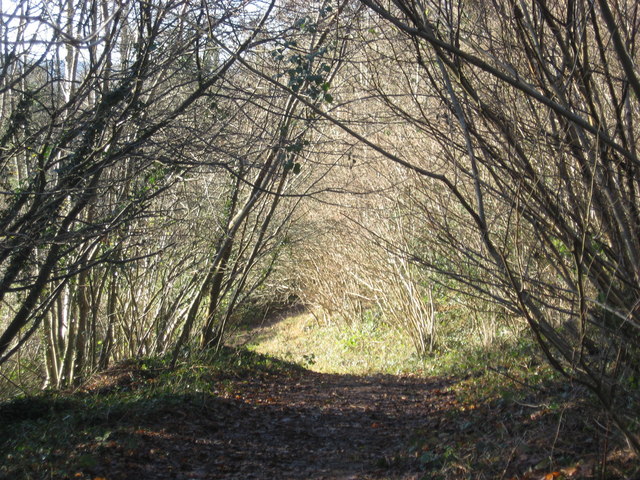
Is hazel a hardwood? Botanically, yes: hazel (Corylus avellana) is a broadleaf, flowering tree. In working terms it is one of the softer hardwoods used for sticks, with a Janka hardness of roughly 3,500–4,500 N — well below oak or blackthorn. Hazel does not produce the heaviest stick or the densest. What it produces is the most: more straight, knot-free, working-length stick wood than any other tree in the British and Irish countryside, and at a steady annual rate that no other native species comes close to matching. For three thousand years of recorded countryside use, hazel has been the wood that took the everyday work — the pole-walked walking sticks, the bean-poles, the woven hurdles, the divining rods, the wattle-and-daub fillings of the cob house — while the harder timbers were saved for harder duties.
It is also the wood with the longest continuous folk-tradition of any British or Irish tree. Hazel sits, alongside oak and ash, in the early Irish Auraicept na n-Éces tree-list as one of the noble trees of the wood; its name is in the etymology of place-names from Aughnacloy in Tyrone to Coleshill in Warwickshire; it is the source of the wand of divination, the salmon-shading nuts of the Tobar Segais, and a substantial chunk of what survives of pre-Christian Irish material culture. It is, in short, a tree worth knowing about.
This is the reference version.
Quick reference
| Common names | Hazel, common hazel, European hazel, coll (older Irish), cuilcheann (Irish), collen (Welsh) |
| Binomial | Corylus avellana L. |
| Family | Betulaceae (birch family) |
| Native range | Most of Europe; Caucasus and into western Asia |
| Habit | Multi-stemmed shrub or small tree, 3–8 m, suckering and forming thickets |
| Bark | Smooth, light grey-brown with horizontal lenticels; reddish on young growth |
| Catkins | Long pendulous yellow male catkins (“lambs’ tails”) in February–March, before the leaves |
| Leaves | Roughly heart-shaped, double-toothed, hairy, 5–10 cm |
| Fruit | Hazelnuts, in a leafy involucre, ripening September–October |
| Wood density | ~570–620 kg/m³ [VERIFY] |
| Janka hardness | ~3,500–4,500 N — among the softer working hardwoods of the region |
The plant
Hazel grows almost everywhere in Britain and Ireland. It is a multi-stemmed shrub rather than a single-trunk tree by natural inclination, and the multi-stemmed habit is part of what makes it the dominant coppice wood: cut a hazel down to its stool, and within a year or two it will have produced six to twelve new straight stems, each suitable for working. Repeat the cut every seven to fifteen years, and the same stool will produce stick wood for hundreds of years — there are recorded hazel stools in British woodlands estimated at over a thousand years old [VERIFY against Oliver Rackham’s surveys].
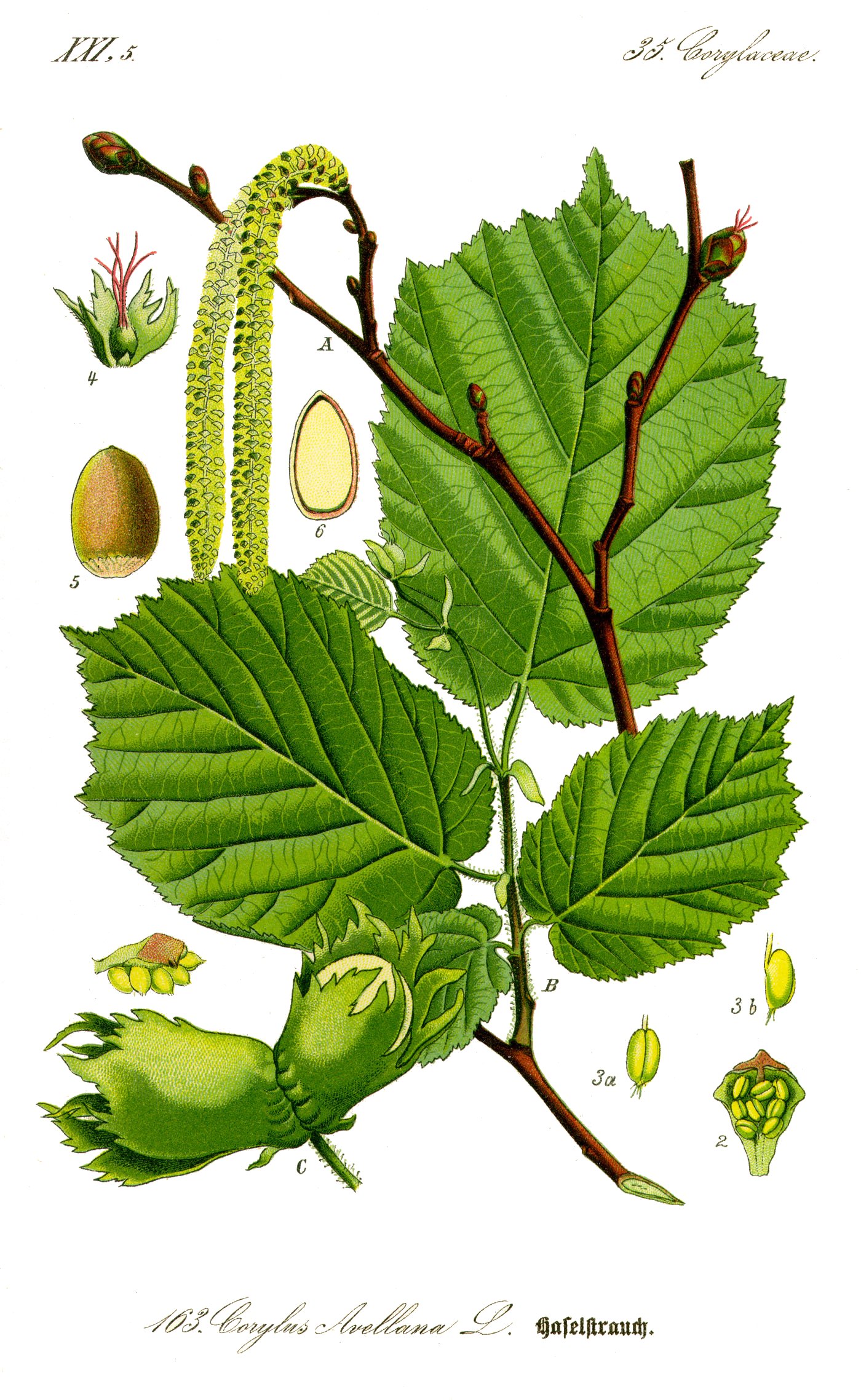
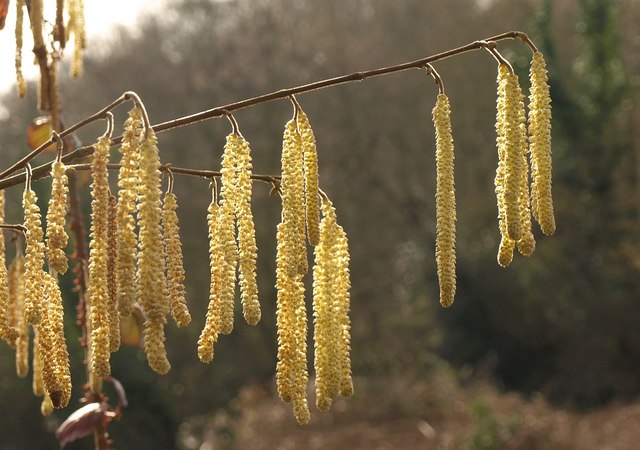
The leaves are unmistakable on close inspection — roughly heart-shaped, with the surface slightly fuzzy and the margins double-toothed. The catkins are diagnostic in late winter: long pendulous yellow strands (“lambs’ tails”) that release pollen onto the much smaller red female flowers on the same plant, weeks before the leaves emerge. The hazelnut itself, in its leafy involucre, is one of the more recognisable autumn fruits of the British and Irish countryside.
Hazel is light-demanding — it cannot grow in the deep shade of an established oak or beech canopy — and is therefore characteristic of woodland edges, scrub, and the understorey of more open mixed woodland. It has been planted, encouraged, and managed continuously across British and Irish woods for thousands of years, with the result that the modern distribution reflects human management almost as much as natural ecology.

The wood
Hazel wood is lighter, softer, and more flexible than any of the other major British and Irish stick woods. Density runs at around 570–620 kg/m³ — substantially less than blackthorn, oak, or holly, comparable to lime or willow at the lower end. Janka hardness is in the 3,500–4,500 N range, which is roughly two-thirds the hardness of oak.
This sounds, on paper, like a deficiency. In practice it is precisely what makes hazel useful. The wood:
- Bends without breaking to a degree that the harder hardwoods do not. This is the property that makes it the wood for woven hurdles, basketry, hedge-laying binders, and any application that involves working green wood into a curved form.
- Cuts cleanly with hand tools — the lower density and the fine grain mean that a billhook, a knife, or a small saw works through hazel quickly and predictably, in contrast to blackthorn (which dulls a blade) or oak (which fights a saw).
- Seasons quickly — a year of air-drying is plenty for a stick, and pole-wood for non-load-bearing applications can be used green if cut at the right time.
- Takes a clean finish — hazel sands evenly, takes oil deeply, and produces a soft pale-cream or light-honey surface that some users prefer to the darker character of the other woods.
The colour is pale to light brown — a creamy biscuit when freshly worked, often with a faint pinkish tinge in the heartwood, deepening to a soft honey with oil and age. Sapwood and heartwood are not strongly distinguished; hazel sticks tend to look uniform along their length.
For walking-stick purposes, the practical effect of all of this is that hazel produces a light, fast, springy stick — much less in the hand than a blackthorn or oak piece of equivalent dimensions, but more responsive on a long walk, and easier to carry hands-free over a shoulder. It is a walking wood rather than a leaning wood. For users who want a stick to gesture with rather than to bear weight on, hazel is often the better choice.
The coppice tradition
The most distinctive thing about hazel as a working wood is that it is, by historical standards, the product of an active management system rather than a wild-cut material. The system is coppicing: cutting the tree down to a low stool every seven to fifteen years, allowing the regrowth to produce multiple straight stems, and harvesting the resulting pole-wood as the basic raw material of British and Irish countryside craft.
Coppicing has been practised in these islands since at least the Bronze Age [VERIFY: archaeological evidence from the Sweet Track in Somerset and similar sites suggests structured coppice management by 4000 BC]. The system reaches its medieval and early-modern peak in the period from roughly 1100 to 1700, when most lowland British and Irish woodland was under some form of coppice rotation, providing a continuous output of pole-wood for fuel, fencing, building, and craft.
The traditional uses of hazel coppice are extensive:
- Wattle-and-daub building — woven hazel rods (the “wattle”) forming the structural panel of timber-framed walls, then plastered with daub (a mixture of mud, straw, and dung). The default building method of pre-modern British and Irish domestic construction.
- Hurdles — woven panels for sheep folds, garden enclosures, and temporary fencing. A working hurdle-maker (a “hurdler”) was a recognised rural trade until the mid-twentieth century.
- Hedge-laying binders — the longer, more flexible hazel rods that lock a freshly-laid hedge in place along its top.
- Bean-poles, pea-sticks, and garden supports — the standard British and Irish support material for climbing legumes.
- Faggots — bundles of small hazel rods for kindling, oven-fuel, and (historically) bread-baking.
- Thatching spars — the hazel rods (sometimes oak) split into pegs that hold thatch in place on roofs.
- Sticks for walking, herding, and general use.
Coppice use declined dramatically through the twentieth century, with the post-war shift to wire fencing, mass-produced building materials, and synthetic supports. From a position of near-universal practical importance in 1850, hazel coppice as a living working tradition was reduced by 1980 to a small specialist niche maintained by a few hundred craftspeople across Britain and Ireland.
A modest revival is now underway. The Small Woods Association and similar bodies in Britain have actively promoted coppicing both for its biodiversity benefits (managed coppice is one of the most species-rich woodland types in Europe) and for its craft outputs, and the number of working coppice operations has been gradually rising since around 2000 [VERIFY current figures].
For a stick-maker buying hazel, coppice-cut wood is the standard source. The maker selects straight, knot-free, two-to-three-year-old pole-wood from a well-managed coppice, cuts in winter, and seasons in the same way as any other stick wood (one year typically suffices). The supply chain is short and direct in a way that the supply chains for the harder, slower-growing woods are not.
The Scottish hazel stick
Hazel’s role in walking-stick making, specifically, is most strongly associated with the Scottish tradition — particularly the upland walking stick of the Highlands and the Lowland sporting estates. Hazel is one of the canonical Scottish stick woods, alongside holly; the two woods are sometimes used in combination, with a holly head fitted to a hazel shaft, in the more elaborate sporting pieces.
The Scottish hazel stick is typically a long walking stick (38–48 inches), with a natural curve preserved from the live wood, often with a horn or stag-antler handle. The shafts are debarked and finished with linseed oil; the surface character is very different from a Scottish holly stick — slightly warmer in colour, slightly more figured in grain, with the occasional small knot left as a feature.
Hazel thumb-sticks — with the natural Y-fork at the head — are also made in the Scottish tradition, though holly is more typical for that specific form.
In the Welsh tradition, hazel appears more often in the working sheep-handler’s stick than in the show-stick: a light, fast hazel stick is useful in active flock-management in a way that a heavier wood is not. The working Welsh sticks are often less photographed than the show-sticks but are the more numerous form in actual rural use.
In the Irish tradition, hazel is a recognised but secondary stick wood — used where it grows, sometimes preferred for the lighter walking sticks of the western counties, but never carrying the iconic status of blackthorn or oak. There is no specifically Irish hazel stick form in the way there is for blackthorn and oak.
Folklore: divination, the Salmon, and the wand of wisdom
The folklore of hazel is among the largest and oldest in the British and Irish tradition. The most durable elements:
The divining rod — the forked hazel wand used to locate underground water — is the single best-known folk-magical use of any tree in the European tradition. The practice (called “dowsing” in English, coltsfoot in some older Welsh sources [VERIFY]) involves walking with a Y-shaped hazel rod gripped lightly in both hands; the rod is held to twist downward when passing over an underground water source. Dowsing has been practised continuously in rural Britain and Ireland from at least the late medieval period, and is still occasionally used by farmers, well-drillers, and water-board engineers, with results that the scientific literature treats sceptically and the practitioners treat as obvious. Whatever one makes of the underlying claim, the wood for the rod is, by tradition and convention, hazel.
The Salmon of Knowledge — the bradán feasa of Irish mythology — is associated with hazel through the nine hazels (sometimes seven, sometimes nine, sometimes more) that grew over the Well of Wisdom (Tobar Segais), dropping their nuts into the water. The Salmon ate the nuts and acquired all knowledge; the salmon was caught and cooked by the boy Fionn mac Cumhaill, who burnt his thumb on the hot fish, sucked it, and inadvertently took the salmon’s knowledge into himself. The story is one of the most-told in Irish mythology, and the hazel — as the source of the nuts of wisdom — sits at the centre of it.
In the early Irish tree-list (the Auraicept na n-Éces and related material), hazel is one of the noble trees, alongside oak, ash, yew, and others, with formal status in early Irish law and culture. The exact placement varies between manuscript versions, but the high status is consistent across the recorded versions [VERIFY against Mac Coitir’s reading].
In Welsh folklore, hazel is associated with poetic inspiration through the bardic tradition; a hazel wand was, in some accounts, a symbol of the bard alongside the harp. The hazel-and-bard association is less archaeologically secure than the Irish wisdom connection but appears repeatedly in the medieval Welsh material [VERIFY against the Mabinogion and the bardic grammars].
A lone hazel does not, in the same way as a lone hawthorn or a lone blackthorn, attract a fairy-tree taboo. Hazel was sufficiently abundant in the British and Irish countryside that the folk-magical attention focused on rarer trees; the hazel was treated more as a resource than as a sacred object in everyday life.
Cutting and seasoning
Hazel is the easiest of the British and Irish stick woods to season. The wood:
- Loses moisture quickly — at standard temperatures and humidities, a debarked hazel shaft reaches working moisture content in three to nine months, well below the timescales for blackthorn or oak.
- Resists checking — the relatively low density and even grain mean that surface checking, while not impossible, is rare in hazel that has been dried at any reasonable rate.
- Holds straight — a piece of hazel that was straight when cut will remain straight through seasoning, with only minor adjustment needed at the bench.
Cutting is in winter, as for any timber, with the additional flexibility that small-diameter coppice wood (less than about 25 mm) can be cut and used at almost any time of year if it is not going to bear significant load. Stick-quality hazel is normally cut at two to four years of regrowth; older coppice produces wood that is too thick for typical walking-stick use.
After seasoning, hazel is debarked or left barked according to taste. Debarked hazel shows the pale heartwood; barked hazel keeps a darker, more textured surface. Heat-bending is straightforward — the wood is more flexible than blackthorn or oak — and the tradition of setting deliberate curves is more developed in hazel than in any other British or Irish stick wood. Finishing is conventional: linseed oil, beeswax, sometimes a thin shellac.
Hazel vs the harder woods
The summary, for a reader trying to decide between hazel and the alternatives:
- vs blackthorn: hazel is much lighter, softer, and easier to source in long pieces; lacks the iconic Irish character; not the wood for a fighting stick.
- vs oak: hazel is lighter, more flexible, faster to season; oak is denser and more structurally solid; for a long walking stick used over rough ground, hazel is often the better hands-on choice, oak the better visual/formal one.
- vs holly: hazel is comparable in working character but lacks holly’s distinctive whiteness; for a Scottish thumb-stick, both are correct, with the choice down to colour preference.
- vs ash: hazel is similarly light and springy; ash takes more impact; for a long staff or a working tool handle, ash is the right choice; for a walking stick, either is appropriate.
For a buyer who wants a light, working, comfortable walking stick without a strong preference for one of the iconic woods, hazel is often the most practical answer. It is also, in current circumstances, the most ecologically sustainable of the British and Irish stick woods: managed coppice is among the most renewable timber sources in the European temperate zone, and hazel is the dominant species in most British and Irish coppice systems.
Beyond sticks
The list of historical hazel uses is extensive and was outlined above. The contemporary uses, beyond stick-making, include:
- Hurdle-making for organic farms, gardens, and traditional events
- Hedge-laying binders in the conservation hedge-restoration trade
- Bean-poles and garden supports, sold by garden centres in increasing volumes since the 2000s
- Spar-making for thatching, which remains an active rural craft in parts of southern England
- Coppice-with-standards silviculture, where hazel is grown as the understorey beneath retained oak or ash, providing both timber and biodiversity benefit
The hazelnut trade is largely separate. Cultivated hazelnuts (filberts and cobnuts) are grown primarily in Turkey, Italy, and Oregon, with smaller commercial production in Kent and Devon; the wild hazel of the British and Irish countryside is rarely commercially harvested for the nuts.
This is the fifth and final wood reference page in the current set, completing blackthorn, oak, holly, ash, and hazel. The fuller folklore of the Tobar Segais and the Auraicept tradition is its own subject, and a dedicated piece on the early Irish tree-list is in preparation.
Sources & further reading
- Corylus avellana L., Plants of the World Online, Royal Botanic Gardens, Kew
- Hazel — A-Z of British Trees, Woodland Trust
- Oliver Rackham, The History of the Countryside (1986), Dent / WorldCat
- Niall Mac Coitir, Irish Trees: Myths, Legends & Folklore (2003), Collins Press
- Coppice woodland management, Small Woods Association
Related reading
- woodsBlackthorn Tree Wood: Curing
The hedgerow tree behind most Irish sticks: dense, dark, slow-growing, and beloved of hedge-witches.
- woodsOak
The other Irish stick wood — older, heavier, and the source of the original Wicklow shillelaghs.
- woodsHolly
The pale-wooded thumb-stick tree of Scotland and Wales — and the harder-than-oak hedgerow shrub that sometimes turns up in Irish work too.
- woodsAsh
The springy, impact-resistant wood of staves, tool handles, and the Irish hurling stick — and the species now in the middle of a Europe-wide health crisis.