Other woods of note
Crab apple, cherry, beech, willow, dogwood, elder, and yew — the second-tier stick woods that supplement rather than replace the canonical hardwoods.
The canonical British and Irish stick woods — blackthorn, oak, ash, hazel, holly, hawthorn — get individual reference pages because each has a substantial working tradition, distinctive material properties, and enough cultural register to merit standalone treatment. Below the canonical six sit a second tier: woods that have been worked into sticks across centuries of practice, that occasionally appear in named makers’ work, but that don’t have the volume of working tradition to justify a full page each.
Seven of these woods are worth knowing. Each is briefly described below.
Crab apple — Malus sylvestris
The native British and Irish wild apple, ancestor of the cultivated orchard apple. A small tree, rarely more than 8 m, often gnarled and dense-grown in old hedgerows, producing small hard astringent fruit in autumn.
As a stick wood: dense (~700–800 kg/m³), tight-grained, exceptionally fine in figure, takes a beautiful polish. The hardness sits comfortably in the upper range of the British natives — comparable to hawthorn or holly. The dimensional limitation is real: a working crab apple stem of suitable diameter and length for a walking stick is uncommon, and most working makers who use crab apple are obtaining it from felled hedgerow trees rather than from any standing supply.
Working tradition: occasional use in the Welsh and Lake District traditions, particularly for hand-sticks and short canes where the dimensional limit doesn’t bite. Some named British Stickmakers Guild makers (in the English Lakeland and the Welsh borders) have used crab apple deliberately for high-value gift-stick work, where the figured grain and the warm honey-pink colour of the polished wood add value over the more common natives.
Working character: crab apple seasons slowly and is prone to checking; allow 18–24 months for a stick blank to reach working moisture. Carves and turns cleanly once dry. Takes a fine oil or shellac finish. The pale-pink-honey colour deepens with handling and benefits from minimal finish.
The wood is in the rose family (Rosaceae), close kin to hawthorn (see Hawthorn) and to the cultivated apple. Crab apple in a fenced or specimen collection is a different timber from a wild hedgerow crab — the wild material, slow-grown in poor conditions, is the denser and more figured of the two.
Wild cherry — Prunus avium
The native British and Irish cherry, parent species of the cultivated sweet cherry, growing into a substantial tree (15–25 m) in mixed woodland and along old field-edges. The species is well-known to the timber trade as fruitwood — a fine cabinet-making and turnery wood — and the working stick tradition draws on the same material.
As a stick wood: medium density (~600–650 kg/m³), tight straight-grained, attractive figure with characteristic darker brown-red heartwood and pale sapwood. Janka hardness around 4,000 N — softer than oak, comparable to walnut. The principal virtue is the figure: cherry produces some of the most attractive turned-and-polished stick stock available in the British and Irish woods, with the heartwood deepening to a rich amber-brown over years of handling.
Working tradition: occasional use in show-sticks and presentation pieces, particularly within the British Stickmakers Guild competition culture. Wild cherry stick blanks are obtained from felled estate or woodland trees rather than from any dedicated supply; a working maker who has access to good cherry stock often holds it for a particularly fine commission rather than burning it through routine work.
Working character: seasons reasonably quickly for a fruit-wood (12–18 months), carves and turns cleanly, takes finishing materials beautifully. Tends to darken over time even without specific finishing — fresh cherry is a pale pinkish-tan; a 20-year-old cherry stick is a deep red-brown.
The wild cherry stick is the working maker’s “Sunday best” — not the everyday tool, but the wood reached for when the commission justifies it.
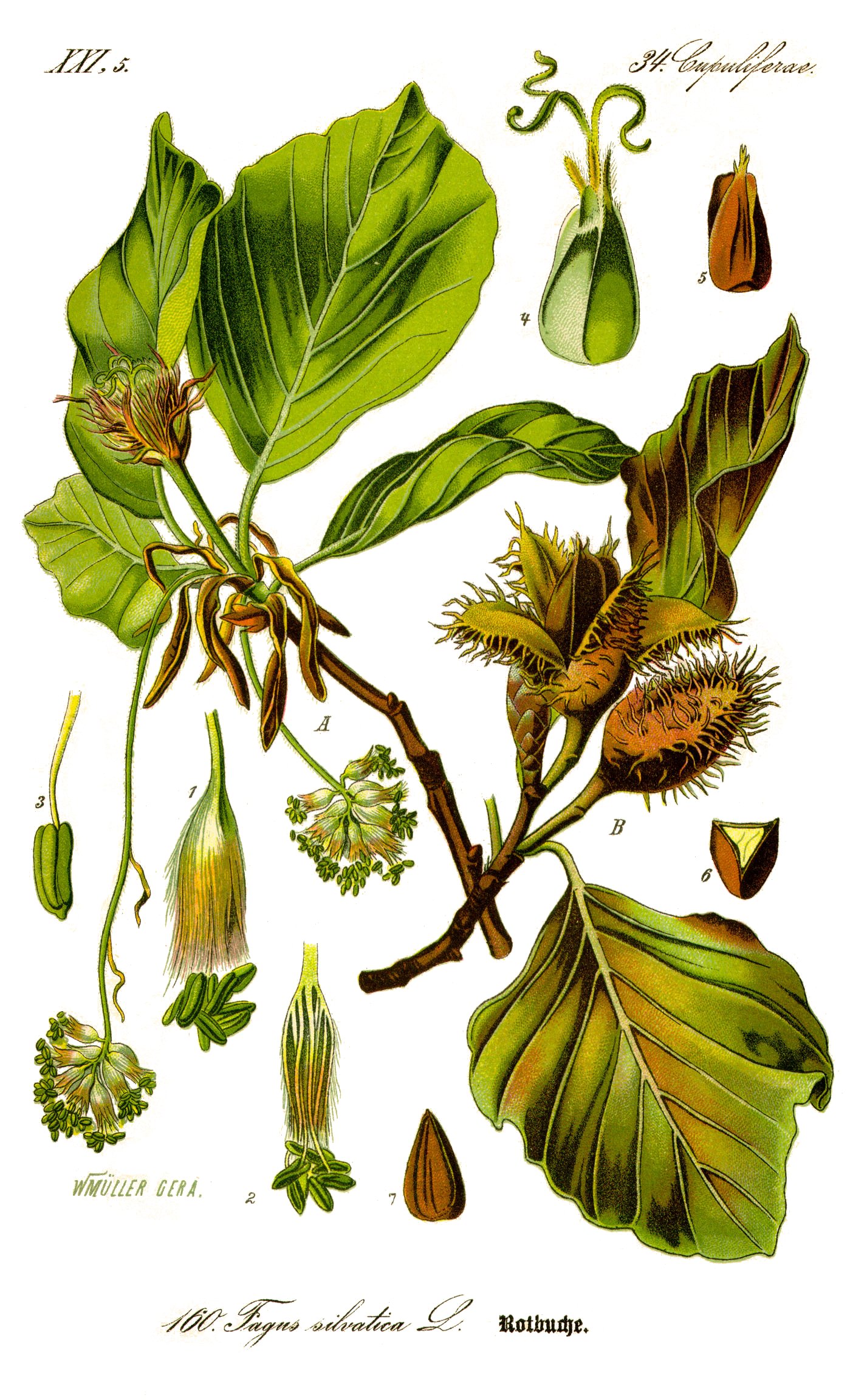
Beech — Fagus sylvatica
The European beech is one of the canonical timbers of the British and Continental hardwood tradition: a large tree (25–35 m) with smooth grey bark, oval wavy-edged leaves, and small triangular nuts in bristly husks. Beechwood is the workhorse of the European tool-handle, kitchenware, and turnery trades.
As a stick wood: medium density (~700 kg/m³), straight-grained, fine to medium texture, pale cream colour with little figure. Janka hardness around 6,500 N — moderately hard. The virtues are technical: beech machines, turns, and finishes cleanly; it is dimensionally stable once seasoned; and it accepts stains and dyes evenly. The defect is character: beech is a plain wood. It looks plain, ages plain, and does not develop the figure or the colour-deepening of the fruit-woods or the patina of oak.
Working tradition: rarely chosen as a first material by serious stick-makers. Where beech appears in the British and Irish stick trade, it is often as a substitute — a beech stick stained dark to imitate blackthorn, or a beech walking-cane in a cheap retail-grade product. Honest makers working in beech tend to leave it unstained and let the pale colour speak for itself; the result is workmanlike rather than beautiful, but practical and durable.
Working character: seasons reliably and predictably. Takes machine work as well as any temperate hardwood. Accepts varnish, oil, and lacquer evenly. The plain pale appearance benefits from minimal finish; heavy varnish makes beech look cheaper than it is.
For the European working tradition, beech is the timber that turns stair-spindles, kitchen utensils, and the handles of every tool a craftsman touches. Its place in stick-making is real but not central.
Willow — Salix spp., particularly white willow S. alba
The willow family is enormously varied. The species relevant to stick-making in Britain and Ireland is principally white willow (S. alba) and its hybrid with crack willow (Salix × fragilis) — both lowland riverside species, fast-growing, light-wooded.
As a stick wood: low density (~400–450 kg/m³), straight-grained, soft, pale cream colour. Janka hardness around 1,800 N — among the softest commercially-relevant temperate hardwoods. The lightness is the principal virtue: a willow walking stave at 6 ft is noticeably lighter than the equivalent ash or hickory, which suits all-day flat-ground walking better than rough hill work.
Working tradition: traditional in some hill-walking and lowland-walking-stave contexts, particularly where the user prefers a light stave for distance-walking rather than a heavier stick for support. Willow is also the cricket-bat wood (specifically, a particular cultivar of Salix alba called ‘Caerulea’ or ‘Hampshire willow’) — the same species, selected for the impact-cushioning grain that makes it suitable for cricket bats. The cricket-bat selection is dimensionally and grade-wise different from anything used in stick-making, but the underlying timber is the same.
Working character: seasons rapidly (6–12 months), works easily, takes finishes evenly. The principal disadvantage is durability: willow is more susceptible to dings, dents, and surface damage than the harder woods. A willow stick is a working tool with a working life rather than an heirloom.
Willow occupies the light-stave register that the harder woods cannot reach; for users who want a light stick and don’t need impact-resistance, it is a real option.
Dogwood and cornel — Cornus sanguinea and Cornus mas
Two related species: common dogwood (C. sanguinea) is a small native British shrub, and cornel or cornelian cherry (C. mas) is a larger continental European tree. Both share the Cornus genus’s defining characteristic — extraordinarily hard, dense, fine-grained wood that has been the European weapon-handle and tool-shaft material of choice for centuries.
As a stick wood: very high density (~800–900 kg/m³), exceptionally hard (Janka 9,000+ N for cornel — among the hardest European temperate timbers), fine straight grain, pale tan-to-pinkish colour. The density and hardness exceed even ironwood and hop hornbeam.
Working tradition: the historical European weapon-handle wood. Cornel was the wood of choice for Roman pila (javelin shafts), medieval polearm shafts, and a substantial portion of the mediaeval European martial-weapons-haft trade. The dimensional limit is the constraint: cornel rarely reaches more than 4–5 cm trunk diameter at typical sizes, and dogwood (the smaller species) is even more limited. A working stick from cornel is uncommon outside the German-and-Austrian central European tradition; from common dogwood it is rare to the point of curiosity.
Working character: cornel and dogwood are difficult to season without checking — the high density compounds drying-stress issues. Once seasoned, the wood works well to fine tools but resists cheaper machine work. Takes an exceptional polish, with the dense grain producing an almost-glassy finish under hand-rubbing.
For the European single-stick and martial-arts tradition, cornel is the canonical material; for British walking sticks specifically, the dimensional limit makes it a curiosity rather than a working choice. See Single-stick for the European martial-arts context.
Elder — Sambucus nigra
The native British and Irish elder is a small tree or large shrub (3–10 m), with distinctive pinnate leaves, dense corymbs of cream summer flowers, and the heavy clusters of small black berries (elderberries) in autumn. The wood has a long folkloric register — elder is one of the protective-folklore woods of British and Irish tradition, alongside rowan and hawthorn — and a more modest working tradition.
As a stick wood: medium density (~650 kg/m³ once seasoned), surprisingly hard given the soft impression of the green wood, with a characteristic pithy core (the central pith is removable, and traditional elder-wood working often involves drilling out the pith to leave a hollow tube). Pale yellow-cream colour with a slightly greenish tint when fresh, ageing to a warmer honey.
Working tradition: limited but real. Elder pith was traditionally used as cork-substitute and for fine inlay work; the wood has been used in folk-art carving, particularly for protective figures and small ceremonial objects. As a walking stick, elder is uncommon — the dimensional limit and the pithy core are working obstacles, and the folkloric register can either attract or repel a particular user.
Working character: dries unpredictably with the central pith creating drying-stress problems. Working makers who use elder typically remove the pith with a long auger before final shaping, leaving a hollow stick that is lighter than its dimensions suggest. The wood carves and finishes cleanly once seasoned.
The folkloric register is substantial: elder is associated in British folklore with the Elder Mother (a tutelary spirit of the tree), with funerary and threshold protection traditions, and with a prohibition against burning elder firewood that is documented across most of the British and Irish countryside. A walking stick made from elder is doing folkloric work whether the user knows it or not.
Yew — Taxus baccata
The European yew is a long-lived evergreen conifer, widely planted in churchyards across Britain, Ireland, and continental Europe, with the longest-lived individual trees (Fortingall, Crowhurst) credibly in the 2,000–4,000 year range. It is primarily known as the longbow wood — the canonical material of the medieval English warbow — and has a secondary stick-making tradition.
As a stick wood: medium-high density (~670 kg/m³), with extraordinary strength-to-weight performance — yew has the highest specific strength of any commonly-worked European timber. Hard, fine-grained, with characteristic warm orange-red heartwood and pale yellow sapwood, often producing dramatic two-toned figure on a flat-cut piece. Janka hardness around 7,000 N.
Working tradition: primarily the longbow tradition (with the canonical bowmaking specifically using a “stave” cut radially through the heartwood-sapwood boundary, exploiting the natural laminate of the two-toned wood). For walking sticks, yew is occasional but real — it produces a heavier, denser, more dramatically figured stick than most British natives, with the orange-red heartwood ageing to a deeper amber over decades.
Working character: seasons slowly and unpredictably; the differential drying rates between heartwood and sapwood produce stress that can warp or check a stick blank. Once seasoned, yew carves and finishes beautifully, with the dense grain taking a mirror polish under hand-rubbing.
The toxicity caveat: every part of the yew tree except the bright red flesh of the seed coat is toxic — the bark, the leaves, the wood, and the seed itself. Working yew produces dust that should not be inhaled (the alkaloid taxine is the active toxin), and a yew stick should not be chewed, sucked, or used in food contact. For a working walking stick this is not a practical problem, but a maker working yew should observe basic dust-protection practice.
The dimensional supply is also limited: yew is slow-growing and not commercially harvested at scale, and most working yew used in stick-making comes from felled churchyard or estate trees. A yew stick is a special object; it is not a routine working choice.
Compared with the canonical six
The seven woods above each occupy a niche the canonical British and Irish stick woods do not:
- Crab apple — fine figure, dense, dimensionally limited; a gift-stick wood
- Wild cherry — attractive colour and figure; a presentation-piece wood
- Beech — workmanlike and reliable; the substitute and the cheap-grade choice
- Willow — light and soft; the long-distance walking stave
- Dogwood/cornel — exceptional hardness; the European martial-arts tradition
- Elder — modest material, large folkloric register; the protective stick
- Yew — exceptional strength-to-weight, dramatic figure, dimensionally limited; the heirloom
For the canonical comparison, see Holly vs blackthorn vs oak vs ash, and the individual pages on Blackthorn, Oak, Ash, Hazel, Holly, and Hawthorn. Each of the woods on this page is a real working option for the right project; none of them are first-choice timbers for a routine British or Irish working walking stick.
Sources & further reading
- Mabey, R. (1996) — Flora Britannica, Sinclair-Stevenson / WorldCat
- Rackham, O. (1986) — The History of the Countryside, J.M. Dent / WorldCat
- A-Z of British Trees, Woodland Trust
- The Wood Database — comparative wood properties, The Wood Database
- Plants of the World Online — Royal Botanic Gardens, Kew, Royal Botanic Gardens, Kew
Related reading
- woodsBlackthorn Tree Wood: Curing
The hedgerow tree behind most Irish sticks: dense, dark, slow-growing, and beloved of hedge-witches.
- woodsOak
The other Irish stick wood — older, heavier, and the source of the original Wicklow shillelaghs.
- woodsIs Hazel a Hardwood?
The coppice wood par excellence — light, springy, abundant, and with the longest unbroken folk-tradition of any British or Irish tree.
- woodsHawthorn Wood: Hardness & Uses
Blackthorn's hedgerow companion: lighter in colour, no less dense, and the fairy tree of British and Irish folklore.