A timeline of the Irish walking stick
Three thousand years of stick-and-staff use in Ireland, from the Bronze Age coppice records to the small-batch revival of the present day.
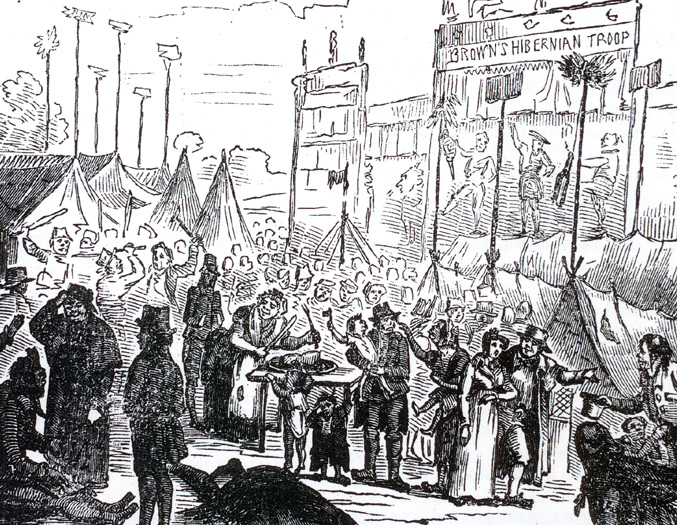
This is a chronological reference timeline for the Irish walking stick — and, by extension, for the British and Irish stick traditions generally. The events listed are the ones that mark significant transitions in the object, the practice, the wood, or the cultural meaning of stick-making in these islands. Some entries are precise historical dates; others are approximate (a century, a decade); a few are flagged [VERIFY] where the dating is uncertain in the standard sources.
For the long-form treatment of any era, the relevant article is linked at the corresponding entry.
Pre-modern: c. 4000 BC – AD 700
c. 4000 BC — Earliest archaeological evidence of structured coppice management in Britain and Ireland. The Sweet Track in the Somerset Levels — a wooden trackway built across boggy ground — uses worked hazel and other coppiced species, suggesting that the multi-stem-from-stool management system was already being practised at the start of the Neolithic. The same management system continues to produce British and Irish stick wood three thousand years later. (See /woods/hazel/ for the coppice tradition.)
c. 2000 BC — Labbacallee wedge tomb in County Cork is constructed. Later folk-tradition will identify it as the burial place of the Cailleach, the divine hag of winter who carries a blackthorn staff. (See The Cailleach.)
c. 800 BC – AD 100 — Iron Age Ireland; the bata (stick) appears in the legal codes and oral tradition as a constant feature of everyday rural life. Heavy hardwood clubs are referenced in early sagas and law-tracts.
c. AD 400 – 700 — Ogham inscriptions on standing stones across Ireland and parts of Wales and Scotland. The ogham alphabet is later given tree-name associations in the Auraicept na n-Éces; whether these associations are continuous from the inscription period or are a later reconstruction is an open scholarly question.
Medieval: AD 700 – 1500
c. 700 – 900 — The earliest of the materials that would later be compiled into the Auraicept na n-Éces are produced. Tree-classifications based on legal status (noble, peasant, shrub, bramble) are codified in the early Brehon Law tracts. Oak, hazel, holly, ash, yew, pine, and apple are the seven airig fedo (noble trees of the wood). Blackthorn is classified as a shrub. (See The Auraicept na n-Éces tree-list.)
1100 – 1700 — Peak of the British and Irish coppice tradition. Most lowland woodland in both islands is under some form of coppice rotation, supplying the everyday rural economy with hazel pole-wood for hurdles, wattle-and-daub building, fuel, and stick-making. The system is largely intact in 1500.
c. 1390 – 1418 — The Book of Ballymote (c. 1390) and the Book of Lecan (c. 1418) are compiled, preserving the Auraicept na n-Éces in its surviving manuscript form. The tree-classification system is fixed in writing.
Early modern: 1500 – 1750
1550 – 1690 — Systematic clearance of Irish forests under Tudor, Stuart, and Cromwellian administrations. The great oak forests of County Wicklow — including the area around the village of Shillelagh — are largely felled to supply the Royal Navy’s shipbuilding programme and to deny cover to the dispossessed Irish populations. By the 1690s, the forests are substantially gone. (See The village of Shillelagh, County Wicklow.)
c. 1700 — The modern walking-stick form — fitted with a leather strap, finished with traditional oils, with a metal ferrule at the foot — crystallises in Irish rural use. Whether this development is parallel to or derivative of similar developments in Britain is unclear; the form is recognisable in both regions by the early eighteenth century.
c. 1730 – 1840 — The era of faction-fighting in rural Ireland. Organised collective stick-fights between rival clans, parishes, and trades become a defining element of public rural life, fought at fairs and pattern days. The era produces named factions — Caravats, Shanavests, Three-Year-Olds, Cooleens — whose stick-fighting traditions overlap with the broader bataireacht martial-arts practice. (See Bataireacht.)
The eighteenth century: 1700 – 1800
1670s – 1780s — The word shillelagh enters English-language print. The Oxford English Dictionary records its earliest cited example in Francis Grose’s 1785 Classical Dictionary of the Vulgar Tongue, where it is glossed as “an oaken sapling, or cudgel”.
1750s – 1840s — Donnybrook Fair, in what is now the south side of Dublin, is the most famous of the Irish faction-fighting venues. The word donnybrook enters English to mean a noisy public fight on the strength of its reputation.
c. 1782 — Francis Wheatley’s painting Donnybrook Fair — a major eighteenth-century artistic record of the fair — is completed. Multiple versions of the subject by Wheatley, Erskine Nicol, and others document the era through the early nineteenth century.
The nineteenth century: 1800 – 1900
c. 1820 – 1850 — The peak of organised bataireacht as a recognised martial-arts practice. The Doyle family system (later transmitted to Newfoundland with the Doyle emigration) and other family lineages develop distinct curricula in this period.
1820s onward — The Highland Clearances transform the Scottish Highlands into a sporting-estate economy. The Scottish stick tradition — the gillie’s pole, the deer-stalker’s stick, the holly thumb-stick — develops in conjunction with this economic transformation. (See The Scottish stick tradition.)
1835 — Benjamin Clayton II’s widely-circulated engraving of Donnybrook Fair is published. The engraving captures the late-period faction-fighting culture; the institution it depicts is suppressed within twenty years.
1845 – 1852 — The Great Famine kills approximately one million people in Ireland and drives approximately two million to emigrate. Faction-fighting collapses with the rural population that sustained it; mass emigration carries the stick to the United States, Britain, Canada, and Australia.
1855 — Donnybrook Fair is officially suppressed.
1859 — Erskine Nicol’s painting Donnybrook Fair — the most widely-reproduced artistic record of the era — is exhibited.
1884 — The Gaelic Athletic Association is founded. The GAA channels rural-young-male energy toward hurling and football and away from the older combative culture of the stick.
1886 — Oliver Rackham’s later compilation of British and Irish woodland history will identify this period as the start of significant coppice abandonment, with the post-1850s economic shifts toward wire fencing, mass-produced building materials, and railway-distributed coal beginning to undermine the working economic basis of coppice woodland.
The twentieth century: 1900 – 2000
1916 – 1922 — The Easter Rising, the War of Independence, and the founding of the Irish Free State. The disruption to ordinary urban and rural life affects folk-traditions including the May bush in Dublin (see The May bush), with the public form of the practice largely declining in the post-1922 period.
1937 – 1938 — The Folklore Commission’s Schools’ Collection is gathered: primary-school children across rural Ireland record local folk-traditions from their elderly relatives, producing roughly half a million pages of material now searchable at Dúchas.ie. Many of the surviving fairy-thorn taboo, May-bush, and Cailleach references are preserved through this collection.
1957 — Estyn Evans publishes Irish Folk Ways (Routledge & Kegan Paul), the first comprehensive scholarly synthesis of the Irish material-culture tradition. The book remains a standard reference.
1963 — John F. Kennedy visits Ireland in June. The visit produces multiple stick-gifts to the President, contributing to the modern American framing of the shillelagh as a piece of Irish-American identity. (See Famous shillelagh owners in history.)
1965 — The Notre Dame Fighting Irish leprechaun is officially adopted as a registered university trademark, with a shillelagh as the central prop of the mascot’s costume.
1975 — Patrick D. O’Donnell publishes The Irish Faction Fighters of the 19th Century (Anvil Books). The first comprehensive scholarly synthesis of the faction-fighting era; remains the standard reference.
1977 — The Coolattin estate — the historic seat of the Fitzwilliam family near the village of Shillelagh in County Wicklow — is sold. The surviving fragment of the historic Wicklow oak forest, Coolattin Oak Wood, eventually passes into Special Area of Conservation status.
c. 1990s — Glen Doyle and other figures begin teaching bataireacht publicly outside their family lineages, opening the curriculum to non-family students for the first time. The Antrim Bata school presents a parallel tradition. The bataireacht revival from the 1990s onwards is the first sustained re-emergence of the practice since the 1840s.
1992 — Ash dieback (Hymenoscyphus fraxineus) is first reported killing ash in Poland. The disease spreads westward through Europe over the following two decades. (See /woods/ash/.)
1999 — The M18 motorway in County Clare is re-routed around a lone fairy thorn at Latoon, following a public campaign led by storyteller Eddie Lenihan. The episode is the most famous modern example of the lone-thorn-tree taboo affecting development decisions. (See The fairy-thorn taboo.)
The twenty-first century: 2000 – present
2003 — Niall Mac Coitir publishes Irish Trees: Myths, Legends & Folklore (Collins Press). The most comprehensive single synthesis of the Irish tree-folklore tradition currently in print; remains a standard reference for this site.
c. 2006 – 2012 — Ash dieback enters Britain. Forest Research finds evidence that the pathogen had arrived before 2006; the disease is confirmed in the United Kingdom in February 2012. Ireland and Northern Ireland follow within a few years.
c. 2010 onwards — The modest revival of Irish hedgerow-cut stick-making, supported by the international gift market and by a small but growing interest from heritage-craft collectors. Several small Irish workshops continue to produce real handmade sticks at scales ranging from hobby through to small full-time operations.
c. 2010 – 2020 — The May bush tradition is revived in Dublin and other localities, supported by Dublin City Council heritage programming, community history groups, and individual households drawing on the Folklore Commission’s archived material.
2024 – 2026 — Ash dieback is established across Britain and Ireland; mature ash death is a regular feature of the landscape. Forest Research and various breeding programmes are working to identify and propagate dieback-tolerant individuals to maintain working populations of the species. Camán production for hurling continues to depend on ash, with prices for ash camán-stock rising substantially over the decade.
2026 — The Walking Stick Journal begins publishing.
Forward thirty years (speculative)
The journal does not predict the future; the entries above are historical only. But it is worth noting briefly the major uncertainties that shape the next thirty years of the Irish stick:
- The outcome of ash dieback — whether tolerant ash populations can be propagated fast enough to maintain working volumes, or whether ash will become a much rarer species in British and Irish woodlands by the mid-twenty-first century
- The economic viability of small-batch hedgerow stick-making as the rural population continues to age and the working knowledge of the craft is held by fewer and older makers
- The cultural register of the shillelagh in the diaspora as the third- and fourth-generation Irish-American populations move further from their direct emigrant ancestors
- The bataireacht revival as it either consolidates into a recognisable martial-arts tradition or re-fades into family-lineage practice
- The Irish-language survival of the older craft vocabulary that gives the tradition much of its cultural depth
The thread that connects 4000 BC to 2026 — three thousand years of continuous British and Irish stick-and-staff use — has been broken several times, suppressed several times, and revived several times. There is no particular reason to expect either continuity or further disruption in the coming decades; the pattern has been one of long survival in modified forms, and the form most likely to survive into the next chapter is, on the evidence, the one that has survived this far: a small wood, cut from a hedge, seasoned for years, finished by hand, carried for a lifetime.
This is a reference timeline; the long-form treatment of each era is in the linked articles. The pillar history is in A short history of the Irish walking stick. The bibliography of standing references is at /about/bibliography/.
Sources & further reading
- Patrick D. O'Donnell, The Irish Faction Fighters of the 19th Century (1975), Anvil Books / WorldCat
- Estyn Evans, Irish Folk Ways (1957), WorldCat
- Oliver Rackham, The History of the Countryside (1986), Dent / WorldCat
- shillelagh, n., Oxford English Dictionary
- Niall Mac Coitir, Irish Trees: Myths, Legends & Folklore (2003), Collins Press
Related reading
- guidesA short history of the Irish walking stick
Three centuries of an everyday object — from faction-fight weapon to emigrant gift to the heritage piece a small handful of makers still cut by hand.
- historyBataireacht
Irish stick-fighting — once everywhere in rural Ireland, suppressed for over a century, taught now by a small number of teachers and clans.
- historyThe Auraicept na n-Éces tree-list
The early Irish text that gave each ogham letter a tree, ranking them by social status — the nearest thing the medieval Irish material has to a formal arboreal taxonomy.
- historyThe American-Irish diaspora and the shillelagh
How an everyday Irish countryside object became the central material symbol of Irish-American identity — and what the symbol carries that the original object does not.