A short history of the Irish walking stick
Three centuries of an everyday object — from faction-fight weapon to emigrant gift to the heritage piece a small handful of makers still cut by hand.
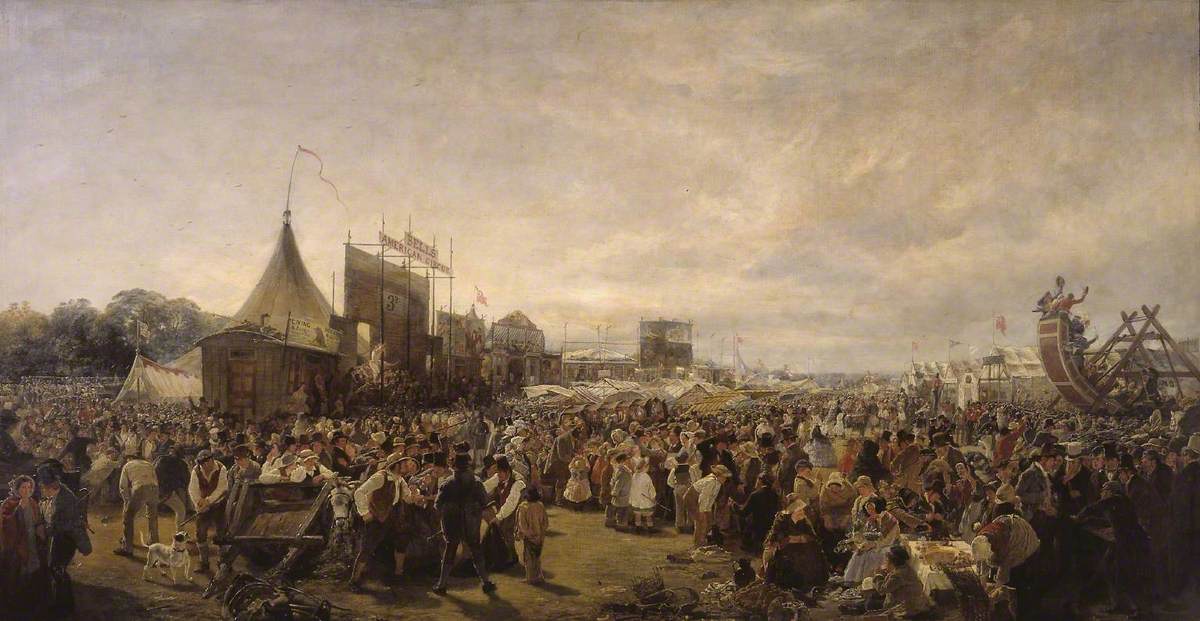
The Irish walking stick has been continuously made and continuously carried for at least three hundred years. Some part of that period it was an iconic everyday object; some part of it a weapon; some part of it a tourist souvenir; some part of it almost forgotten. What survives now is a heritage object, made by a handful of makers, in roughly the same way it has always been made. The form has been remarkably stable. The cultural meaning attached to it has shifted three or four times.
This is the long version of how the object got from there to here.
Before the eighteenth century
Stick-and-staff use is older than any of the records that document it. Heavy hardwood clubs and walking-staves are referenced in early Irish texts; the bata — Irish for stick — is a constant in medieval and early-modern Irish life, mentioned in legal codes, monastic rules, and the standard fittings of the rural household. What one does not find before about 1700 is the named, recognisable object that the modern reader would recognise as a “walking stick” — the specific length, the carved head, the leather strap, the metal ferrule, the stable form that survives in present-day pieces.
That form crystallised in the eighteenth century, and it crystallised in conjunction with two specific developments: the growth of country fairs as the social heart of rural Ireland, and the availability of suitable hardwood in the form of seasoned blackthorn and oak from the country’s hedgerows and surviving forests. The stick became a recognisable, individually-owned, daily-carried object somewhere in the late seventeenth or early eighteenth century. The first English-language records of shillelagh in print [VERIFY OED first-attested date] sit at the front edge of that period.
The eighteenth century: the iconic object
By the middle decades of the eighteenth century, the Irish walking stick was a fixed part of the rural Irish kit. A countryman owned one in roughly the way a present-day countryman owns a coat: as something he expected to have, expected to wear out and replace once or twice in a lifetime, and expected to use without thinking. The stick had two primary uses. It walked you home from the fair. And, on the wrong night, in the wrong company, it was the weapon you happened to be carrying when the row started.
This is the era in which the cultural identity of the Irish stick was set, and it was set in a register that combined the practical and the violent in a way the present day finds slightly difficult to read. Travellers’ accounts from the period — English, French, occasionally Italian — note repeatedly that the Irishman went armed with a stick as a matter of course; that the stick was treated with care; that disputes over and around it were significant elements of village life. None of this was thought of as remarkable by the Irish at the time. It was the working state of the object.
Two material practices supported this. First, the hedge-cutting practice that produced the wood — a slow, selective, year-on-year management of blackthorn and oak from local hedgerows — was widespread enough that any reasonably resourceful family could find a candidate stick within a short walk. Second, the stick-fighting tradition that taught how to use one — bataireacht — was, in this period, a piece of inherited household knowledge passed within families and within the recognisable factions of the surrounding parishes. The two practices were inseparable. A stick was both made and used in an ecosystem of local craft and local knowledge that no individual maker or fighter would have described as a “tradition” because it was simply how the world was.
The faction-fighting era
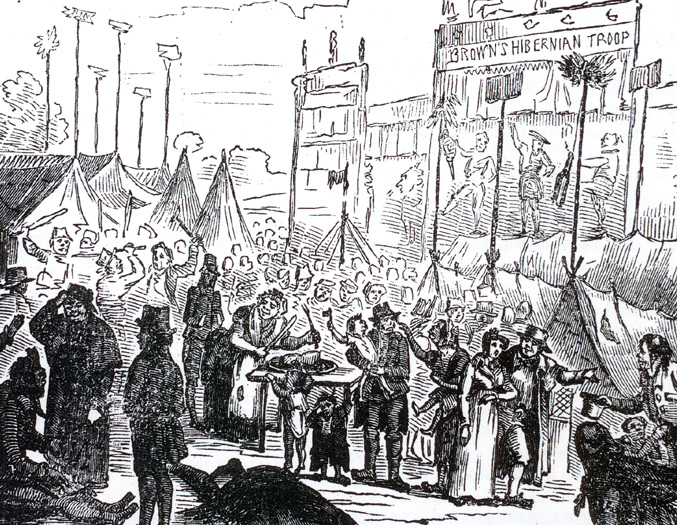
The phase of Irish life in which the stick had its most public role ran roughly from the 1730s to the 1840s. This is the era of organised faction-fighting: ritualised collective brawls between rival clans, factions, and parishes, contested at fairs and pattern days, with sticks as the principal weapon. The factions had names that survived into the police records and the broadside ballads — the Caravats and Shanavests in Tipperary, the Three-Year-Olds and Four-Year-Olds in Limerick, the Cooleens and Lawlor-Black-Mulvihills in Kerry. Donnybrook Fair, on what is now the south side of Dublin, was the most public of the venues; the word donnybrook entered English to mean a noisy public fight largely on the strength of its reputation.
For the object — the walking stick itself — the practical effect of faction-fighting was that the stick became the most legible material symbol of rural Irish identity, in the eyes of both insiders and outsiders. Insiders carried sticks as everyday equipment. Outsiders, especially the British administrative class, read the sticks as evidence of an Ireland that needed to be civilised. Both readings were partly correct. The stick was an everyday tool and a piece of contested cultural assertion. (For the practice of fighting with one, see Bataireacht.)
The Famine and the dispersal
Two events ended the eighteenth-century stick culture as a continuous everyday practice.
The first was the Great Famine of 1845–1852, which hollowed out the rural Irish population most associated with the practice. Faction-fighting had already been declining under prosecution and changing public taste; the Famine ended its mass base by emptying the countryside.
The second was the mass emigration that followed. The Irish diaspora carried both the practice and the object overseas — primarily to the United States, secondarily to Britain, Canada, and Australia — and what arrived in those places was a culture in transition. The fighting use of the stick was largely shed within a generation. The symbolic use — as a marker of Irish identity — strengthened, particularly in the American context, where the shillelagh became the central material symbol of an emerging Irish-American cultural register.
The objects that travelled were a mixture of working sticks brought from home and sticks bought specifically as souvenirs from a returning visit to Ireland. By the 1880s the souvenir stick had become a recognisable commercial product, sold at Irish ports and at tourist sites including the village of Shillelagh itself, and the line between a working stick and a gift-shop one began to blur in a way it has not really un-blurred since.

The late-Victorian retreat
The second half of the nineteenth century was the period in which the stick moved decisively from everyday use into the symbolic and folk-craft register.
Three institutional pressures squeezed what remained of the older practice. The Catholic Church, recovering its public footing in the post-Emancipation decades, distanced itself from faction-fighting and stick-fighting as cultural embarrassments. The Royal Irish Constabulary prosecuted gatherings. And the Gaelic Athletic Association, founded in 1884 to revive Gaelic sports, channelled the energies of rural young men into hurling and football and away from the older combative culture. Donnybrook Fair itself was suppressed in 1855. The remaining public stick-contests dwindled across the second half of the century until they were unusual enough to make the newspapers when they happened.
The object survived the practice. Walking sticks continued to be cut, seasoned, and finished by hedgerow makers across rural Ireland — the practice of stick-making had no centralised institution to attack — and the everyday non-fighting use of the stick (as a walking aid, as a tool, as a heritage piece) carried on without interruption. What changed was the cultural surround. The stick, which in 1820 had been the weapon of a recognisable faction, was by 1900 a quieter object, more often associated with priests and farmers than with public assembly.
The Gaelic Revival of the 1890s and 1900s did not put the stick at the centre of the cultural projects it sponsored — those were focused on language, sport, and literature — but the revival’s general elevation of Irish folk material kept the stick visible as part of an inherited landscape. By the time of independence in 1922, a walking stick was an unselfconscious feature of rural Irish dress, in a register somewhere between heritage and habit.
The twentieth century: tourism, souvenir, identity
The twentieth century is when the stick’s contemporary life took its current shape, and most of the shaping happened outside Ireland.
In the United States, the shillelagh consolidated as the central material symbol of Irish-American identity. Notre Dame’s Fighting Irish mascot adopted the stick as part of his kit. St Patrick’s Day parades featured sticks ceremonially. Pubs displayed them on walls. The American tourist returning from a visit to Ireland brought back a shillelagh with the same regularity that the Spanish visitor brought back a fan or the French visitor a beret. The mass production of inexpensive blackthorn and faux-blackthorn sticks for this market, mostly in Ireland, began in the early twentieth century and continues to the present.
In Ireland itself, the picture was different. The stick remained an everyday object in some rural communities into the second half of the twentieth century, particularly in Kerry, Mayo, and parts of Donegal. The Folklore Commission’s parish-by-parish collection of the late 1930s — now searchable at Dúchas.ie — captures the stick still in active everyday use in many of the localities it surveyed. By the 1970s and 1980s, however, the stick had largely retreated to the heritage register in Ireland too. Younger people did not carry one. Older people did, often the same one for fifty years.
The diplomatic gift function of the stick — the presentation of a fine handmade piece to visiting heads of state, military officers, civic dignitaries — accelerated through the twentieth century in parallel with the souvenir trade. Every American president to visit Ireland from John F. Kennedy onward has, on the public record, received a stick of some kind during the visit [VERIFY each]; many heads of state from elsewhere have done the same. (See Famous shillelagh owners in history.)
The small-batch revival
The shape of the stick’s twenty-first-century life was set by two slow developments.
The first was the continuation of small-batch hedgerow stick-making in a handful of rural Irish workshops, never quite extinguished, never quite mass-market. Through the second half of the twentieth century, a small number of makers — family-scale, often inherited, working with the same wood from the same stretches of hedge as their grandparents — continued to produce sticks at the older standard, even as the souvenir trade dominated the visible market. The work was rarely written about. It was never branded. The continuity is in some sense the most remarkable element of the whole story.
The second was the revival of bataireacht as a martial-arts practice from the 1990s onward, led by family lineages — most prominently the Doyle Clan System — that had carried the stick-fighting curriculum quietly through the suppressed decades. (See Bataireacht for the full account.) The bataireacht revival has not, on its own, driven a meaningful increase in stick-making volume, but it has put the older traditions back into a visible cultural conversation in a way that had not been possible since the 1840s.
The current state, then, is a heritage object made by a handful of small makers, used as a walking aid by a smaller subset of users, presented as a gift on appropriate occasions, taught as part of a small but growing martial-arts revival, and bought as a souvenir by visitors at a different scale and standard from any of the above. The object itself, in the form a careful maker still produces, is essentially unchanged from what a Tipperary maker in 1810 would have recognised. The cultural surround has done all the moving.
What survives
Three hundred years on, the practical knowledge that produces a real handmade Irish walking stick is held by a small number of people. The hedgerow that produces the wood is held by farmers. The stick-fighting that gives the object its older meaning is taught by a few teachers. The reference points that make the object legible — the village of Shillelagh in Wicklow, the Cailleach’s staff, the faction-fighting era, the JFK gift, the Notre Dame mascot — exist as a kind of distributed cultural memory rather than a single coherent tradition.
What is striking is how much has survived. The form is intact. The wood is still cut from the same hedges. The makers still work in the same way, on the same timescales, using the same materials. A walking stick from a careful Irish maker in 2026 is recognisably the object the eighteenth century made — older in some ways than the country itself, in any of its present political shapes.
There is no neat resolution to the story. The object is in less daily use than it was a century ago, in more institutional use than it was fifty years ago, and in roughly the same workshop-scale production as it was three hundred years ago. None of these are likely to change soon. The stick will go on being made by hedgerows, in winter, by people whose names rarely appear on the work — for as long as the wood, the skill, and the knowledge of where to cut it all remain in place.
This is the long-form pillar on the object across time. The material side of how a stick is made is in How traditional Irish walking sticks are made. The cultural side of stick-fighting specifically is in Bataireacht. The wood histories are at blackthorn and oak.
Sources & further reading
- Patrick D. O'Donnell, The Irish Faction Fighters of the 19th Century (1975), Anvil Books / WorldCat
- Estyn Evans, Irish Folk Ways (1957), Routledge & Kegan Paul / WorldCat
- Faction Fighting in Pre-Famine Ireland, History Ireland
- Dúchas — The National Folklore Collection of Ireland, University College Dublin
- shillelagh, n., Oxford English Dictionary
Related reading
- guidesShillelagh: Meaning, History & How to Spot a Real One
An Irish blackthorn club, a contested word, and a heritage object that has outlived its job description.
- guidesHow traditional Irish walking sticks are made
From hedgerow to hand: the slow process behind a stick that takes a few hours of bench-work and one to three years of waiting.
- historyBataireacht
Irish stick-fighting — once everywhere in rural Ireland, suppressed for over a century, taught now by a small number of teachers and clans.
- woodsBlackthorn Tree Wood: Curing
The hedgerow tree behind most Irish sticks: dense, dark, slow-growing, and beloved of hedge-witches.