The village of Shillelagh, County Wicklow
A small village in south Wicklow that gave its name to a stick — or, on the other etymology, didn't. Either way, it is worth knowing about.
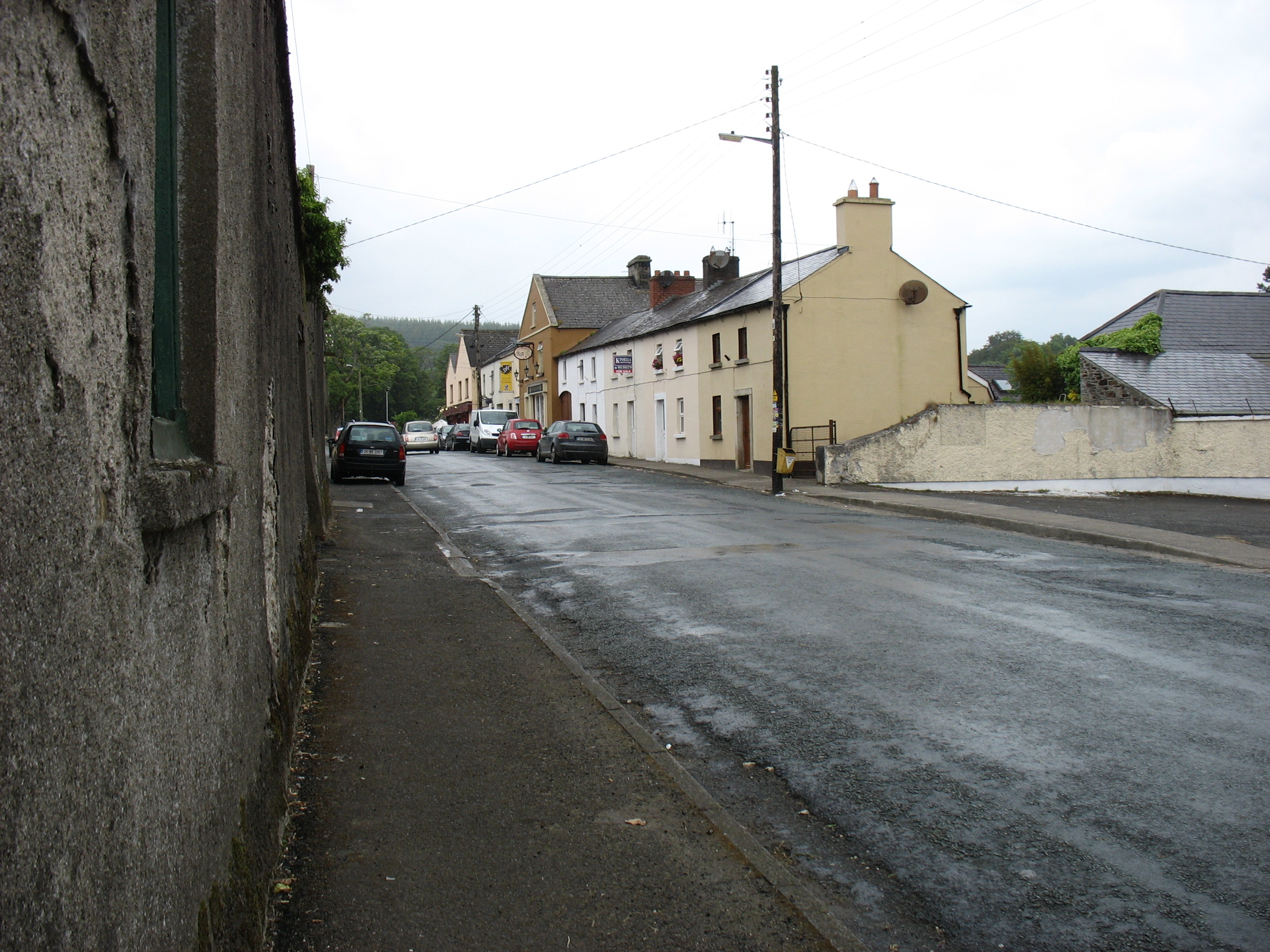
The village of Shillelagh sits in the south-west corner of County Wicklow, a few miles north of the Carlow border, in a soft river valley draining down to the Slaney. It is small — population in the low hundreds at the most recent census [VERIFY current figure] — and quiet, with the appearance of any number of inland Wicklow villages and the absence of any obvious commercial reason to stop. The surrounding countryside contains, in patches, what is left of the forest that once gave the place much of its identity.
The village’s most famous export, by some distance, is its name. Whether the word shillelagh derives from this place is an open question that the linguistic literature has been arguing about for nearly two hundred years. The village exists either way. This is what is in it.
Geography
Shillelagh sits in a valley at the confluence of several small streams that feed into the Slaney via the Derry River. The terrain is gentle compared with the higher Wicklow Mountains to the north — the land here is rolling rather than mountainous, the soils heavy enough to grow the broadleaf woodland the area was historically known for, the climate damp and mild in the way of the south-east of Ireland.
The village’s main street runs east-to-west along the valley floor, with side roads climbing the gentler slopes on either side. The architecture is largely nineteenth century estate-village — brightly-painted small terraces, a couple of public buildings, the church on the hill — built or rebuilt in coordinated fashion under the patronage of the Fitzwilliam family, the ascendancy landowners who held the surrounding lands as the Coolattin estate from the seventeenth century until 1977. The estate and the village were essentially a single economic unit for most of that period.
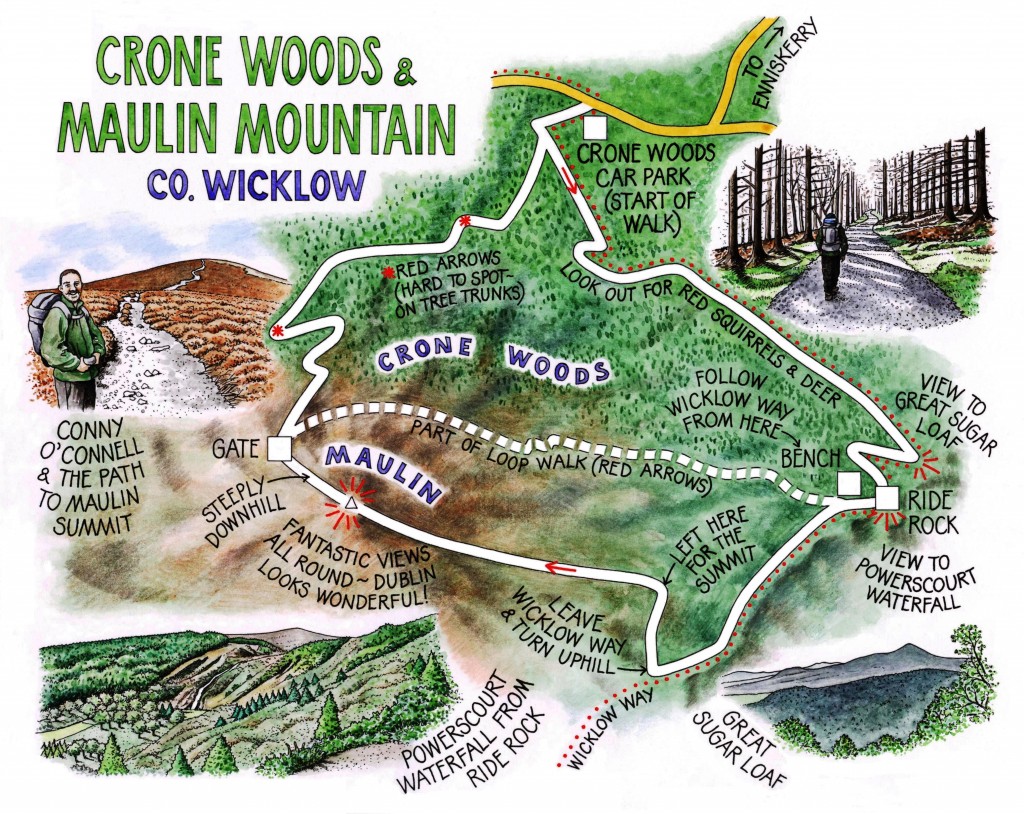
To the immediate west of the village, the Coolattin Oak Wood — a fragment of what was once a much larger expanse of native Irish oak — survives as a Special Area of Conservation. The wood is the most direct surviving connection between the village’s name and the tree it is best associated with, and it is the proximate reason most heritage-minded visitors come.

The historical oak forest
The story that connects the village to the famous stick begins in the medieval period and was substantially over by the late seventeenth century.
For most of the medieval and early-modern period, the south-east of Ireland — the area covered by modern counties Wicklow, Wexford, Carlow, and Kilkenny — was the most heavily forested part of the island. The forests were predominantly native oak (Quercus robur and Q. petraea), with ash, hazel, birch, and holly as understory and edge species. The Slaney valley specifically, including the area around the village now called Shillelagh, was one of the densest and most economically important stands.
The wood from these forests supplied the medieval Irish economy and, after the Tudor and Stuart conquests, the colonial economy that succeeded it. Oak from the south-east was used for:
- Shipbuilding, particularly for the Royal Navy from the late sixteenth century onward, when Ireland’s forests were exploited for fleet construction during a period when English supplies were running short
- Domestic and ecclesiastical building, in beams, roof timbers, and panelling that survive in seventeenth-century houses across Ireland and parts of Britain
- Furniture, especially the heavy seventeenth-century carved oak associated with the period
- Coopering for the wine and spirits trades
The clearance was systematic. By the end of the seventeenth century — accelerated under Cromwell and completed by the 1690s — the great oak forests of the Irish south-east had been substantially destroyed. What had been continuous forest for thousands of years was, within roughly a century and a half, almost entirely gone. The clearance was as much a political project (denying cover to the dispossessed Irish populations who used the forests as refuges) as a commercial one, and the surviving accounts make clear that contemporaries on all sides understood it as such.
What remains is a few small fragments, of which Coolattin Oak Wood is the most significant in the south-east. The wood at Coolattin is not technically the same wood as in 1600 — it has been managed, replanted, and partly recut multiple times over four centuries — but the trees are descendants in the genuine biological sense, and the site is one of the few places in Ireland where an idea of the pre-clearance landscape can be visualised.
The etymology question
The word shillelagh — for the short Irish club typically made of blackthorn or oak — appears in English-language print by the late seventeenth or early eighteenth century [VERIFY OED first-attested date]. The question of where the word comes from has been argued over since the nineteenth century without definitive resolution.
The two main theories, presented honestly:
The place-name theory. Shillelagh derives from the village (or the surrounding oak forests called by the village’s name), with the place-name passing into general use as a generic term for an oak cudgel from the area. The argument is supported by the fact that the south-east of Ireland was the historic centre of Irish oak production, that “shillelagh” entered English print at roughly the period when the area was still a recognisable wood-supply region, and that the place-name is recorded in the right form (with various spellings) substantially before the stick term is recorded in English.
The phrase theory. Shillelagh derives from the Irish phrase sail éille — sail meaning a willow rod, éille meaning a thong or strap — denoting a stick with a wrist strap attached. The argument is supported by the fact that the leather wrist strap is one of the most distinctive features of a finished shillelagh; that sail éille is well-attested as an Irish-language compound; and that the etymology by descriptive feature (rather than by place of origin) is more typical of how Irish-language compound terms have entered English in general.
The Oxford English Dictionary, which is the standard reference for English-language etymology, presents both possibilities and treats the question as unresolved [VERIFY against current OED entry]. The Foclóir Gaeilge–Béarla on the Irish-language side does the same. The evidence is genuinely mixed and the question is, in lexicographic terms, open.
What is not disputed is that the village’s name is older than the English-language word, and that whatever the etymology, the association between place and stick was current enough by the eighteenth century to be a piece of folk-memory worth recording.
The Fitzwilliam estate
For most of the eighteenth, nineteenth, and twentieth centuries, the village and the surrounding land were part of the Coolattin estate, owned by the Fitzwilliam family (the Earls Fitzwilliam, an Anglo-Irish ascendancy family with substantial landholdings in both Ireland and England).
The Fitzwilliams’ relationship with the Irish landscape was, like most Anglo-Irish landowner relationships of the period, complicated. They were substantial improvers in the eighteenth-century sense — laying out the village in the planned form it largely retains, building the church and several civic buildings, investing in agricultural infrastructure — and they were also substantial extractors, continuing the timber trade that had begun under earlier landowners and, in the nineteenth century, presiding over the clearance evictions during and after the Great Famine.
The estate was sold in 1977 [VERIFY exact date], with Coolattin Oak Wood passing into public ownership and conservation status thereafter. The breakup of the estate was a slow process across the twentieth century — Land Commission acquisitions, farm sales, the gradual de-coupling of the village from a single landowner — that was largely complete by the late twentieth century.
What survives of the estate today, beyond the village itself, includes the oak wood, the Coolattin House (now under separate ownership, periodically open for events), and the walled estate boundaries that still pattern the surrounding land.
The village today
Shillelagh in 2026 is a quiet rural village. It has a small commercial centre — a few shops, a post office, a couple of pubs — a primary school, a Catholic church, the surviving Anglican church on the hill, and a small heritage centre that addresses the place-name question and the local history. It is a stop, briefly, for tourists interested in the etymology of the famous stick; it is, more substantively, a working agricultural village in a quiet part of Ireland.
The shillelagh-tourism trade, such as it is, is small and largely seasonal. There is no working stick-maker resident in the village (so far as the journal is aware [VERIFY]) — the surviving Irish stick-making workshops are mostly in Kerry, Cork, and parts of the west — and the connection between the place-name and the object is largely a matter of historical association rather than ongoing craft. Visitors who arrive expecting to see sticks being cut tend to be disappointed; visitors who arrive expecting a quiet south-Wicklow village in a soft valley with a particularly pretty oak wood next door tend to be pleased.
Visiting
The village is reachable from Dublin in roughly an hour and three quarters by road, by way of the M11 motorway and the N81. The nearest train station is Bunclody [VERIFY distance and current rail service], with Wexford or Carlow as the larger transport hubs. The Wicklow Way, the long-distance walking route, passes some kilometres to the north.
For a visitor with an interest in the stick rather than the village specifically, the more useful pilgrimage is to Coolattin Oak Wood itself, accessible from the village by a short drive or longer walk, with marked trails through the surviving oak stand. The Wood is open to the public during daylight hours, with parking near the entrance.
For a visitor with a more general interest in the south-Wicklow landscape, Shillelagh is one of several villages in the area worth combining into a longer route — Tinahely, Carnew, Aughrim, and the river valleys to the north all repay a slow afternoon’s drive. The whole area is among the more peaceful corners of the Irish east coast, and the connection between the place and the famous stick is enough of a peg to hang an afternoon’s wandering on, even for the visitor who concludes that the etymology is probably the other way round.
This is a short geographical and historical piece. The full etymology argument is in the What is a shillelagh? pillar; the larger context for Irish oak is in /woods/oak/. Corrections, particularly on the current state of the village and on the OED dating question, are welcome.
Sources & further reading
- Shillelagh, County Wicklow — placename and history, Logainm.ie / Department of Tourism, Culture, Arts, Gaeltacht, Sport and Media
- Coolattin Oak Wood — natural heritage, National Parks & Wildlife Service, Ireland
- Oliver Rackham, Trees and Woodland in the British Landscape (1990), Phoenix Press / WorldCat
- Wicklow County Council — local history, Wicklow County Council
- shillelagh, n., Oxford English Dictionary
Related reading
- guidesShillelagh: Meaning, History & How to Spot a Real One
An Irish blackthorn club, a contested word, and a heritage object that has outlived its job description.
- woodsOak
The other Irish stick wood — older, heavier, and the source of the original Wicklow shillelaghs.
- guidesA short history of the Irish walking stick
Three centuries of an everyday object — from faction-fight weapon to emigrant gift to the heritage piece a small handful of makers still cut by hand.
- historyBlackthorn in Irish mythology
The fairy tree, the Cailleach's staff, and the dark twin of the May hawthorn — what the older tradition actually says about the wood.