Rowan
Mountain ash, the Scottish protective tree — folklore-laden, occasionally walked-on, never the working backbone of any stick tradition.
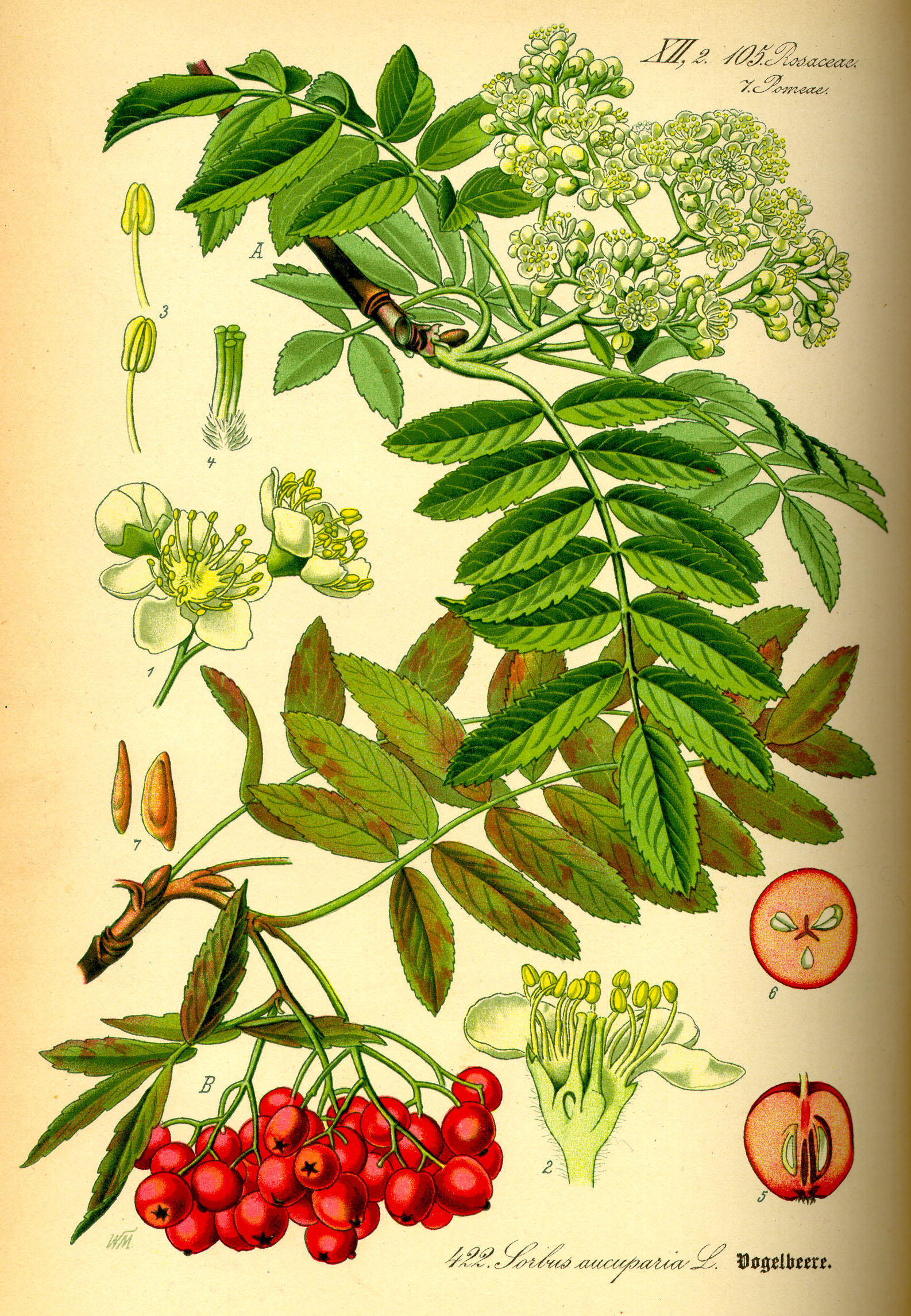
Rowan is an unusual entry in any stick-wood reference. The wood itself is competent but unremarkable — tight-grained, pale, similar to apple, useful for fine work where it can be obtained — but the tree’s place in British, Irish, and Norse folklore is enormous, and the cultural register the species occupies is talisman, not tool. A walking stick cut from rowan is, for most of the species’ working tradition, doing protective work as much as walking work; the practical material qualities are secondary to the cultural ones.
This makes rowan a stick wood that the journal has to handle on different terms from oak or ash or hickory. The technical properties matter, but the folklore matters more; the working tradition is real but small; and the species is most often invoked as a protective talisman rather than as a serious walking-aid timber.
Quick reference
| Common names | Rowan, mountain ash, quickbeam, witchwood, caorann (Irish), caoran/rànach (Scottish Gaelic), cerddin (Welsh) |
| Binomial | Sorbus aucuparia |
| Family | Rosaceae (the rose family) |
| Native range | Most of Europe, western Asia; abundant in upland Britain and Ireland |
| Habit | Small to medium tree, 5–15 m; long-lived but rarely massive |
| Bark | Smooth grey when young, becoming finely fissured with age |
| Leaves | Pinnate compound, 9–15 lance-shaped serrated leaflets, ~10–25 cm long overall |
| Flowers | White, five-petalled, in dense flat corymbs, late spring |
| Fruit | Bright orange-red berries in heavy clusters, ripening late summer through autumn |
| Wood density | ~770 kg/m³ at 12% MC (Sorbus generally) |
| Janka hardness | ~7,520 N (estimated from specific gravity; Sorbus generally) |
| Working tradition | Limited as a stick wood; substantial as a folkloric and protective material |
Mountain ash that is not ash
The first thing to clarify, because the common name is confusing: rowan is not ash. The English name “mountain ash” is a reference to the leaf shape — both species have pinnate compound leaves, and at a glance from a distance they can be mistaken — but the two are in different botanical families. True ash (Fraxinus excelsior, see Ash) is in the olive family, Oleaceae. Rowan is in the rose family, Rosaceae, and is a much closer relative of apple, pear, hawthorn, and the cultivated stone fruits than of any Fraxinus.
This matters for several reasons. The wood character is fruit-wood (Rosaceae) rather than ring-porous ash-and-oak hardwood: tight-grained, pale, even-textured, takes a fine polish. The leaves, despite the superficial resemblance, are distinguishable: rowan leaflets are smaller (5–7 cm individual leaflets vs ash’s 7–12 cm), more finely serrated along the margins, and the leaf rachis is often slightly downy. The flowers are completely different — rowan’s white five-petalled corymbs vs ash’s wind-pollinated greenish clusters — and the fruit is unmistakably different: rowan’s brilliant red berry clusters vs ash’s dry winged samaras.
In Gaelic-speaking traditions the rowan has its own names entirely, separate from the ash: caorann in Irish, caorann/rànach in Scottish Gaelic, cerddin in Welsh. The Norse name reynir, from which the modern English “rowan” is derived, is also distinct from any ash terminology. The “mountain ash” name appears to be a comparatively late English coinage, probably eighteenth-century, that papered over an older indigenous name out of botanical confusion.
The plant
Rowan grows as a small to medium upland tree across most of Britain and Ireland, with its centre of frequency in the Scottish Highlands, the Welsh hills, and the Irish mountains. It is a hardy species — tolerant of poor thin soil, exposed conditions, high altitude (up to ~900 m in the British uplands), and acidic peaty ground — which is why it is so often the dominant or co-dominant tree in upland scrub and the upper edge of native woodland.
Three features identify a rowan:
The pinnate compound leaves. Each leaf is 10–25 cm long with 9–15 lance-shaped leaflets along a central stalk. The leaflets are toothed along the margins (with sharper, finer serrations than ash) and arranged opposite or nearly opposite. In autumn the leaves turn a clear orange-red — one of the more reliable autumn-colour signatures in the British uplands.
The flowers and berries. In late spring the rowan produces dense flat corymbs of small white five-petalled flowers — characteristic Rosaceae blossoms, easily distinguished from the catkins of birch or the hanging clusters of laburnum. By August or September the corymbs have become heavy clusters of bright orange-red berries (technically pomes, like miniature apples), which persist on the tree well into autumn and are heavily fed on by thrushes, starlings, and waxwings.
The bark. Smooth, silvery-grey on young trees, becoming finely fissured with age. Rowan rarely reaches massive girth — a substantial mature tree is typically only 30–40 cm in trunk diameter — and the bark texture is closer to that of a mature cherry or apple than to oak or ash.
The tree is dispersed by birds — the orange-red berries are heavily attractive, and rowan seedlings appear in unlikely places: rocky cracks high on Scottish hillsides, the splits of old oak trunks (the so-called “flying rowan” of folklore), the tops of stone walls. This is part of why the species occupies the cultural register it does: rowan grows where other trees cannot, often appearing in surprising and apparently miraculous locations, which gives it a “between-worlds” character that the folkloric tradition latches onto.
The protective folklore
Rowan is the canonical anti-witchcraft tree of British, Irish, and Norse folk-tradition. The cultural register is enormously well-attested — Richard Mabey’s Flora Britannica (1996), Oliver Rackham’s countryside histories, and the substantial folklore-collection literature of the late nineteenth and early twentieth centuries record rowan’s protective role across most of the cultural geography of upland Britain and Ireland. The patterns are remarkably consistent across regional variations:
Anti-witchcraft talisman. A bunch of rowan twigs, traditionally tied with red thread, was hung over the byre door, the dairy, or the hearth to protect against malign supernatural interference. The form is documented across Scotland (where the practice persisted into the twentieth century in the Highlands and the Hebrides), Ireland (where rowan twigs appear at quarter-day cross-quarter festivals — see The Cailleach for the broader cycle), Wales, and the north of England. The protective power was specific to rowan — substituting another tree was understood to break the protection.
Dairy protection. Rowan’s strongest folkloric association is with milk and butter — particularly with protecting the dairy from the supernatural interference understood to cause butter to fail to churn, milk to sour without cause, or cattle to dry up. A small rowan stick used as a churn-staff, or a rowan twig tied to the dairy cow’s tail, or rowan tied around the milk-pail handle: these forms appear repeatedly in the folkloric record.
Cradle and threshold. Rowan twigs above a baby’s cradle (against changeling-substitution), rowan over the doorway (against the entry of malign visitors at night), rowan in the pocket (general personal protection): the cultural pattern is consistent. The protective register applies at points of vulnerability — the threshold, the infant, the woman in childbed.
The Norse association with Sif. In Old Norse mythology, the rowan is sacred to Sif, wife of Thor — the connection is recorded in the eddic literature, though the surviving texts are fragmentary and the precise nature of the association is uncertain. The Old Norse name for the tree, reynir, descends through Old English rūn and Middle English roun into modern English “rowan”, giving the tree one of the few common names in British botany of unambiguously Norse origin.
For the broader cultural cycle in the Irish tradition specifically, see The Cailleach and Blackthorn in Irish mythology, where rowan plays a supporting role to the more central blackthorn, hawthorn, and oak figures. For the Auraicept na nÉces tree-list (the medieval Irish manuscript that grades native trees), see Auraicept na nÉces tree list — rowan appears in the list under its Irish name luis.
Rowan as a stick wood
The working-craft register is much smaller than the folkloric one, but it does exist. Rowan wood is competent for stick-making at small scales: tight-grained, pale, takes a fine polish, machines and carves cleanly. The dimensional limits are real — rowan rarely produces a working stem of more than 3–4 cm at typical British and Irish sizes, and the wood does not season as forgivingly as blackthorn or hawthorn — but for a hand-stick or a short cane, rowan is workable.
The Scottish upland walking-stick tradition does include rowan, particularly for hand-sticks (~85–95 cm) cut from young saplings in the high glens. The wood’s pale colour and tight grain take a polish well, and a rowan hand-stick has a subtle, fruit-wood-pleasant register that distinguishes it from the more assertive blackthorn or hawthorn. Some Scottish working makers — in the lineage of the highland-and-island stick traditions — have used rowan deliberately for sticks intended as gifts, where the protective folkloric register adds value to the working object.
In Ireland, rowan is an occasional but not central stick wood. The classical Irish stick-making tradition centres on blackthorn (see Blackthorn) with secondary roles for oak, holly, and ash. Rowan appears in the literature mostly in folkloric contexts (the rowan-and-red-thread protective bundle) rather than as a serious working stick wood. A maker who works in rowan is making a deliberate choice for the cultural register, not the timber properties.
The wood itself, taken on its own terms, has these characteristics:
- Density ~770 kg/m³ — the Wood Database’s figure for Sorbus species generally, between apple (~830 kg/m³) and holly (~650 kg/m³) and close to hawthorn (~785 kg/m³)
- Janka hardness ~7,520 N, estimated from specific gravity rather than measured — close to apple (~7,700 N)
- Grain tight, fine, even-textured; cleaves cleanly along the grain but is not strongly figured
- Colour pale cream to pinkish-tan, with little distinction between sapwood and heartwood; ages to a light honey
- Working carves and turns cleanly; takes a fine polish; accepts oil finish well
- Seasoning standard for fruit-wood — slow drying, with a tendency to check (split) at the ends if not sealed; about 12–18 months for a stick blank to reach working moisture
The yield from a typical rowan tree is small. A mature 15-metre rowan in upland Scotland might produce two or three usable stick blanks at 90–100 cm length and 3 cm diameter, plus shorter material for handles or knobs. There is no industrial timber supply for rowan — what working makers obtain is from felled trees on their own ground, from windfall, or from sympathetic estate or forestry contacts.
Cutting and seasoning
For a working maker who has access to a rowan stem of suitable size:
Cutting. Take the stem in winter (between leaf-fall and bud-burst) when the sap is down. Cut a length 10–20% longer than the finished stick to allow for end-checking and trimming. The traditional taboo against cutting rowan applies to the felling of mature trees; coppice cuts and judicious thinning are within the tradition’s tolerance, but a working maker should not be cutting the dominant rowan in a hill-stand.
Sealing. Seal both ends of the cut stem immediately with wax, paint, or PVA glue — rowan is prone to end-checking like all fruit-woods.
Drying. Slow seasoning, indoors and out of direct sun, ideally in a stable atmosphere. 12–18 months is the conservative target; some makers report acceptable results at 9–12 months for thinner stems.
Working. Once seasoned, rowan carves and turns cleanly. The pale colour benefits from a thin oil or shellac finish to bring out the warmth; a heavy varnish darkens the wood unattractively.
Mounting. Brass or silver collars; horn or bone knobs; the protective register pairs well with traditional materials. A rowan stick fitted with a horn handle and a brass collar is a deeply traditional Scottish form.
Beyond walking sticks
Rowan has a small but real working tradition outside stick-making:
- Spindle whorls and pirns: traditional Scottish hand-spinning equipment, often turned from rowan
- Tool handles for fine work: where the dimensional limit of rowan is not a problem (small chisels, gouges, awls)
- Carving stock: rowan carves cleanly and takes detail well; some Scottish folk-art carvers use it for protective figures and small ceremonial objects
- Charcoal: rowan charcoal was used historically in some highland forge-work, though oak and birch were more common
- Walking-stick handles, tool-handle inlays: where a small piece of fine-grained pale wood adds contrast to a darker shaft
The berries, separately, have a long British and Irish tradition of being made into rowan jelly (a tart, slightly bitter preserve traditionally served with game) and rowan wine. The bark and the leaves are not commercially worked.
Compared with other stick woods
Rowan against the canonical British and Irish stick woods:
- Against blackthorn (see Holly vs blackthorn vs oak vs ash): rowan is less assertive in character and less culturally weighted toward the working-stick register. Blackthorn is the working stick; rowan is the protective object.
- Against hawthorn (see Hawthorn): hawthorn is broadly comparable in density and grain character, and the two species are close kin (both Rosaceae). Hawthorn has a stronger working-stick tradition; rowan has a stronger folkloric one.
- Against holly (see Holly): holly pales to white and takes a glassier polish; rowan is warmer-toned. The Wood Database’s figures put rowan (Sorbus species generally) denser and harder than English holly.
- Against ash (see Ash): ash is much larger-stemmed, longer in working length, and the workhorse of British and Irish hill-walking sticks; rowan is the niche choice for hand-sticks specifically.
Rowan’s role in the broader stick-wood family is supplementary rather than central — it occupies a register that none of the other timbers occupy (the protective-folklore register), and within that register it is unmatched, but for serious working sticks the canonical hardwoods are the better choice.
Sources & further reading
- Sorbus aucuparia L. — Plants of the World Online, Plants of the World Online, Royal Botanic Gardens, Kew
- Rowan — A-Z of British Trees, Woodland Trust
- Mabey, R. (1996) — Flora Britannica, Sinclair-Stevenson / WorldCat
- Rackham, O. (1986) — The History of the Countryside, J.M. Dent / WorldCat
- Rowan in Norse mythology — Mythological Encyclopedia entries, Encyclopaedia Britannica
- Rowan (Sorbus spp.) — wood properties, The Wood Database
- Apple — wood properties, The Wood Database
Related reading
- woodsIs Hazel a Hardwood?
The coppice wood par excellence — light, springy, abundant, and with the longest unbroken folk-tradition of any British or Irish tree.
- woodsHolly
The pale-wooded thumb-stick tree of Scotland and Wales — and the hedgerow shrub that sometimes turns up in Irish work too.
- woodsHawthorn Tree Wood: Janka & Uses
Blackthorn's hedgerow companion: lighter in colour, and the fairy tree of British and Irish folklore.
- historyThe Scottish stick tradition
Holly, the gillie's pole, the deer-stalker's stick, and the Highland sporting-estate culture that produced one of the more distinctive walking-stick forms in northern Europe.