Makers' marks by region
A regional cut on the makers'-marks reference — Irish (Wicklow, Kerry, Cork, Donegal, Antrim), English (Lake District, Wealden, others), Welsh, and Scottish marking conventions and how to read them.
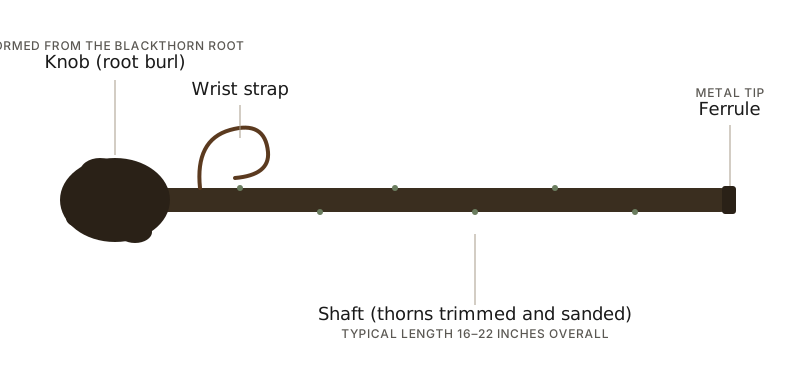
The broader Makers’ marks catalogue covers the general framework for reading walking-stick makers’ marks. This page is the regional cut — how the marking conventions vary by region, what typical Irish, English, Welsh, and Scottish maker stamps look like, and how to combine regional markers with marking conventions for fuller identification.
For the broader catalogue, see Makers’ marks catalogue. For the regional stick-style context, see Regional stick styles of Ireland and Regional stick styles of Britain.
Mark locations
Standard mark locations on a working stick:
- Under the knob — a burnt or stamped mark on the underside of the head, typically only visible if the stick is laid flat or held inverted. The most discreet location; common for working makers who want identification without aesthetic disruption.
- On the shaft near the head — a small mark on the shaft within 4-6 inches of the head, visible at arm’s length. Common for show-grade and presentation pieces where the maker’s mark contributes to the aesthetic register.
- Near the ferrule — a mark within 2-3 inches of the foot, visible only at close inspection. Less common; sometimes used for working pieces where the maker wants identification without visual prominence.
- On a silver collar (when present) — engraved on the silver hallmarked collar at the head; can include both maker’s mark and hallmark date letters.
- On an attached card — for some makers, the identification card accompanying the piece is the principal mark; the stick itself may carry only a small stamp or no mark.
Irish makers’ marks
Wicklow
Pre-1960 Wicklow pieces frequently lack maker’s marks; the tradition was substantially working rather than commercially organised. Surviving marked pieces include:
- Branded marks — a hot iron stamp pressed into the wood, often showing the village name “SHILLELAGH” or a regional identifier
- Initial marks — simple initials of the maker, typically 2-3 letters
- Wicklow-specific conventions — some makers used a shamrock-and-initials format
Post-1980 revival Wicklow makers use more contemporary marking conventions, often including their full surname and sometimes their workshop location.
Kerry
Modern Kerry makers (the contemporary working centre) use distinctive marking conventions:
- Hand-stamped full name — many Kerry makers stamp their full surname
- Workshop location identifier — “KILLORGLIN” or “KERRY” sometimes accompanies the maker name
- Identification card included — substantial Kerry commissions often include a printed identification card
- Sometimes hand-engraved silver collar for presentation pieces
McCaffrey Crafts, the journal’s editorial recommendation, uses a hot-iron-branded mark including the family name on the underside of the knob.
Cork
Cork makers (historical and modern) used modest marking conventions:
- Initial stamps — common in older Cork pieces
- Workshop or village identifiers — sometimes the village name is stamped alongside maker initials
- Less commercial branding than Kerry or Wicklow conventions
Donegal
Donegal pieces frequently lack maker’s marks; the tradition was largely community/family rather than commercial. When marked:
- Initials only — simple maker initials
- Sometimes the village name — “GLENTIES” or similar local identifier
- Modest hand-stamped mark — typically smaller and less prominent than Kerry or Wicklow conventions
Antrim
The journal has found no source on makers’ marks for Antrim or Antrim Bata sticks. The Antrim Bata school’s website says nothing about maker’s marks or lineage stamps, so no marking convention is claimed here.
For the broader Antrim Bata context, see Bataireacht and The Antrim Bata tradition.
English makers’ marks
The journal has no sourced account of a single marking standard across English makers, so the regional notes below describe tendencies only.
Lake District
Lakeland makers favour:
- Substantial hand-stamped marks — visible at arm’s length
- Working maker identification — name plus working location (“KENDAL”, “CONISTON”, etc.)
- Modest decorative integration — the mark is part of the working register rather than ornamental
Wealden (Sussex/Kent)
Wealden makers favour:
- Modest marking conventions — small, discreet stamps
- Working register dominant — the mark serves identification rather than aesthetic display
- Sometimes village or estate names rather than individual maker names (for working production from larger estates)
Other English regions
- East Anglian makers — modest conventions; many pieces unmarked
- West Country makers — modest marking; sometimes hedge-laying-tradition identifiers
Welsh makers’ marks
Welsh makers (substantial shepherd’s-crook tradition) favour:
- Welsh-language marks — sometimes the maker’s name in Welsh-language form
- Crook-tradition identification — some makers include a small crook icon
- Modest stamp size — usually smaller than English or Irish equivalents
- Sometimes regional identifier — “MERIONNYDD”, “GWYNEDD”, etc.
For Welsh tradition context, see The Welsh stick tradition.
Scottish makers’ marks
Scottish makers favour:
- Thumb-stick tradition identification — sometimes a small Y-fork icon accompanying the maker name
- Highland-region identifiers — “INVERNESS”, “FORT WILLIAM”, etc.
- Substantial ceremonial pieces with hand-engraved silver collars (particularly for Highland Games and regimental presentation work)
- Celtic-knot decoration integrated with the maker’s mark on some presentation pieces
For Scottish tradition context, see The Scottish stick tradition.
Reading marks together with regional style
For full identification, combine the maker’s mark with regional stylistic markers:
Example 1: A heavy blackthorn shillelagh with substantial root burl, modest hand-stamped “MCC” initials under the knob, hand-rubbed beeswax finish.
Reading: The substantial root burl and blackthorn shaft suggest Irish tradition. The modest initial mark is consistent with mid-twentieth-century working maker convention. The MCC initials could indicate any number of makers; combine with provenance information to narrow further. The finish style suggests Kerry or Wicklow tradition.
Example 2: A hazel walking stick with crook handle, hand-engraved “T. JONES, LLANRWST” mark on the shaft near the head.
Reading: The crook handle and hazel material strongly suggest Welsh tradition. The Llanrwst location (in Conwy) is in north Wales; this is a Welsh hill-tradition piece. The maker is identifiable as T. Jones of Llanrwst; checking against working maker directories may confirm specific identity.
Example 3: A substantial blackthorn stick with carved figural eagle head, hand-stamped maker mark “J. EWING, BIRMINGHAM 1908” near the head, hallmarked silver collar (Birmingham assay office, date letter for 1908).
Reading: The carved figural head is more typical of American or continental tradition than British; combined with the Birmingham origin and the assay date, this suggests an English competition or presentation piece from the early Edwardian period. The Birmingham silver hallmark confirms 1908. The piece is identifiable as J. Ewing’s work from 1908.
What marks don’t tell you
A few honest acknowledgements:
- Marks don’t establish grade — a working-grade piece can have substantial marks; a presentation-grade piece can have modest marks. Grade is determined by construction, not by marking.
- Marks don’t establish authenticity for very old pieces — pre-1900 pieces frequently lack marks entirely; absence of marks doesn’t indicate fake
- Modern fakes can include faked marks — counterfeit Irish products sometimes include faked maker stamps; the mark is part of the diagnostic but isn’t conclusive by itself
- Marks need to be combined with other markers — the construction quality, materials, finishing, and other diagnostic markers from How to spot a counterfeit blackthorn all contribute to authentication
Where to look up specific marks
For specific maker identification:
- Crafts Council of Ireland — Irish maker registry
- Antique cane and walking-stick specialist dealers — substantial reference resources, particularly Klever (1984) for European maker identification
- Major auction houses’ antique-cane departments — for valuable pieces with potentially significant maker provenance
For the broader makers’-marks catalogue with general conventions, see Makers’ marks catalogue. For the regional style context, see Regional stick styles of Ireland and Regional stick styles of Britain. For dating individual pieces, see Dating a vintage walking stick.
Sources & further reading
- Crafts Council of Ireland (Design & Crafts Council Ireland), Design & Crafts Council of Ireland
- Antique Cane World — maker identification reference, Antique Cane World
- Klever, U. — Walking Sticks: Accessory, Tool, and Symbol (1984), Schiffer / WorldCat
Related reading
- historyMaker's marks: a catalogue and field guide
What a stick-maker's mark is, where it appears, how to document an unknown one — and the small number of marks the journal can currently identify with any confidence.
- historyRegional stick styles of Ireland
How to identify an Irish walking stick or shillelagh by its county or regional origin — Wicklow, Kerry, Cork, Donegal, Antrim, and the broader Munster, Leinster, Connacht, Ulster traditions.
- historyRegional stick styles of Britain
How to identify a British walking stick by its English, Welsh, or Scottish regional origin — the Lake District, Sussex/Kent, Welsh hills, Scottish Highlands, and the broader four-nation tradition.
- guidesDating a vintage walking stick
How to date an inherited or acquired walking stick — the wood, ferrule, head fittings, strap, finish, and silverware markers that locate a piece in a specific historical period.