Regional stick styles of Ireland
How to identify an Irish walking stick or shillelagh by its county or regional origin — Wicklow, Kerry, Cork, Donegal, Antrim, and the broader Munster, Leinster, Connacht, Ulster traditions.
The Irish walking-stick tradition isn’t monolithic. Across the country’s four provinces and 32 counties, regional variations developed in materials, dimensions, construction conventions, and finishing. A working stick from Wicklow looks different from one made in Kerry; both differ from a Donegal piece; all three differ from an Antrim Bata.
This guide is the regional identification reference. For a buyer trying to place an inherited stick in its origin, for a collector building a regional set, or for a buyer commissioning a piece in a specific regional tradition, the markers below indicate where in Ireland a working stick comes from.
For the broader Irish tradition context, see Ireland. For the canonical village-origin history, see The village of Shillelagh, Wicklow. For the Bataireacht martial tradition, see Bataireacht.
Quick reference
| Region | Canonical materials | Characteristic markers |
|---|---|---|
| Wicklow | Oak, blackthorn | Substantial root burls; the canonical “shillelagh” register |
| Kerry | Blackthorn | Modern working maker concentration; substantial commissioned work |
| Cork | Blackthorn, ash | Modest decoration; working register |
| Donegal | Blackthorn, hazel, ash | Coastal working tradition; mixed material use |
| Antrim | Blackthorn | Home county of the Antrim Bata school’s family line; the journal has found no published description of a regional stick style |
| Galway / Mayo | Hazel, blackthorn | Less commercially developed; folk-tradition pieces |
| Dublin | Mixed; cane-trade pieces | Urban gentleman’s-cane register; less working tradition |
Wicklow — the canonical heartland
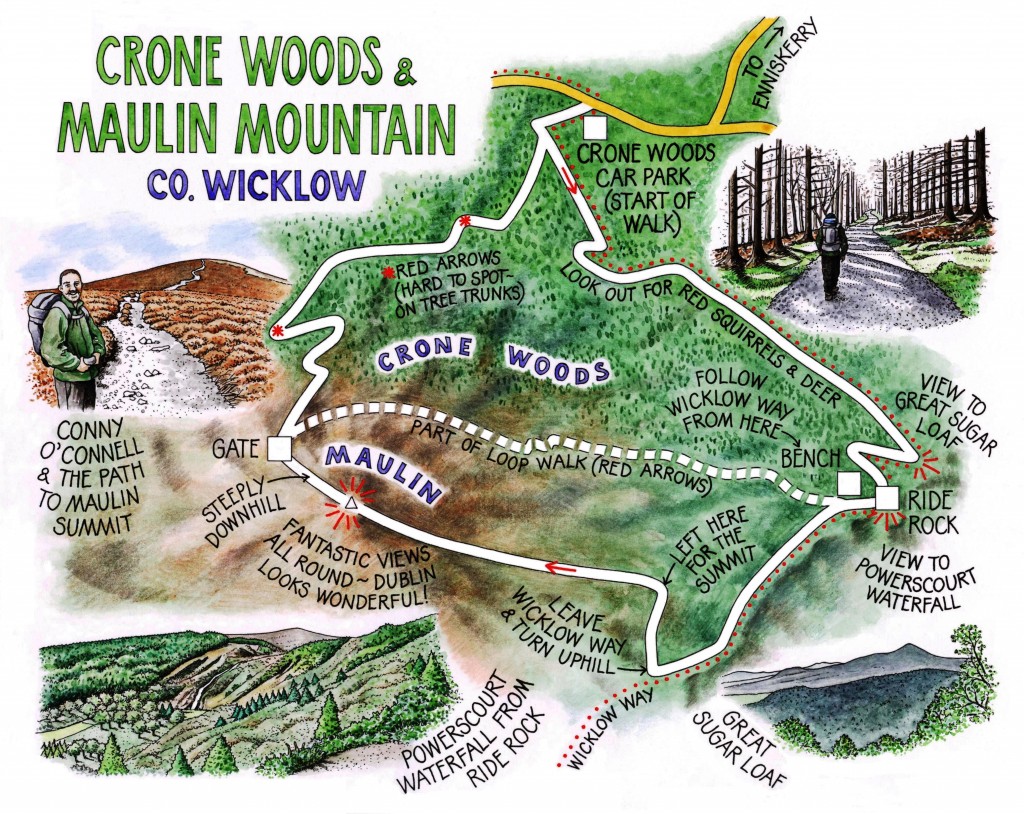
The village of Shillelagh in south County Wicklow gives the form its name and anchors the canonical Irish tradition. The Wicklow oak woods (substantial native oak coverage at Crone Woods, Tomnafinnoge, and broader Coolattin estate) supplied the working materials for generations.
Wicklow markers:
- Substantial root-burl heads — the canonical large knob from mature blackthorn stems
- Oak as well as blackthorn — the Wicklow oak tradition is distinctive; many older Wicklow pieces are oak rather than blackthorn
- Working register dominant — Wicklow sticks read as working tools, not decorative pieces
- Sometimes thorn-stub character preserved to emphasise the blackthorn provenance
- Hand-rubbed beeswax finish rather than high polish
The village of Shillelagh maintained substantial stick-making activity through the nineteenth and early twentieth centuries; the tradition declined through the mid-twentieth as the working-class rural demand for walking sticks declined, then revived modestly from the 1980s onward as cultural-heritage interest grew.
A “Wicklow piece” today may be from a contemporary maker working in the regional tradition, or from a historical maker (pre-1960) whose work has survived in family collections. Both register as Wicklow tradition.
Kerry — the modern working centre
Kerry — particularly the area around Killorglin in central Kerry — is the modern centre of working Irish stick-making. The journal’s editorial recommendation, McCaffrey Crafts, is a Killorglin-based working maker.
Kerry markers:
- Predominantly blackthorn — Kerry hedgerows are blackthorn-rich
- Substantial natural root-burl heads — selected for character
- Working-grade and show-grade dominant — Kerry makers produce across all four working tiers
- Hand-finished surface with thorn-stub character preserved
- Modest brass band or no collar — Kerry tradition favours working register over heavy silverwork
A “Kerry piece” today is more likely than not from one of the small group of named contemporary Killorglin makers. The regional concentration produces distinctive maker fingerprints (specific finish conventions, specific knob preferences) that experienced collectors can identify.
For the broader Kerry context and McCaffrey specifically, see The makers page.
Cork — modest working tradition
The Cork region (city and county) had a substantial working-stick tradition through the nineteenth and early twentieth centuries, though less commercially organised than Wicklow or Kerry. Modern Cork has a smaller working-maker community.
Cork markers:
- Blackthorn and ash both common — Cork hedgerows include substantial ash, and Cork working makers used both materials
- Modest decoration — less substantial knob selection than Wicklow; more workmanlike register
- Working register — Cork pieces read as tools, not display
- Sometimes carved handles rather than natural root burls — Cork tradition includes a hand-carved-handle subtradition
Identifying Cork pieces requires careful attention; many older Cork pieces are unmarked, and the regional markers are subtle.
For the dedicated Cork makers tradition page, see Cork stick makers (forthcoming in the journal’s expanding regional coverage).
Donegal — the coastal working tradition
The Donegal stick-making tradition reflects the western coastal context: working sticks for genuine working users on rough ground, less commercially organised than southern Irish traditions, with mixed material use reflecting the regional flora.
Donegal markers:
- Blackthorn, hazel, and ash all common — Donegal hedgerows include substantial hazel
- Working tradition prominent — Donegal pieces are working tools first
- Modest size and weight — Donegal pieces tend toward the smaller end of typical Irish range
- Plain knobs or modest root burls rather than substantial showpiece heads
- Simple finish — oil rather than polished beeswax
Donegal sticks rarely carry maker identification; the working tradition wasn’t substantially organised for retail. Most surviving Donegal pieces are from family or community working tradition rather than commercial production.
For the dedicated Donegal makers tradition page, see Donegal stick makers.
Antrim — the Bata tradition
The Antrim region of Northern Ireland is the heartland of the surviving Bataireacht martial tradition — see Bataireacht for the broader context.
The journal has found no published description of an Antrim regional stick style, and no construction specification from the Antrim Bata school (its chief instructor’s own guidance on choosing a fighting stick is summarised on the Antrim Bata page). What can be said is the school’s own account of its lineage:
The Antrim Bata school says its techniques were handed down the Ramsey family of County Antrim, nearly vanished after the faction-fighting era, and have been the subject of a revival movement since the early 2000s.
For the dedicated Antrim Bata tradition page, see The Antrim Bata tradition.
The four provinces
Beyond specific county traditions, broad four-province patterns are visible:
Munster (Cork, Kerry, Limerick, Clare, Tipperary, Waterford) — substantial working tradition; blackthorn dominant; Kerry as the modern working centre.
Leinster (Wicklow, Dublin, Wexford, Kilkenny, others) — historical canonical tradition centered on Wicklow; substantial commercial production through nineteenth century; Dublin’s urban gentleman’s-cane tradition distinct from rural working tradition.
Connacht (Galway, Mayo, Roscommon, Sligo, Leitrim) — folk-tradition register dominant; less commercially organised; hazel substantial in the working materials mix.
Ulster (Antrim, Down, Donegal, others) — the Antrim Bata school’s family line is from County Antrim; the journal has found no published description of a distinct Donegal or Antrim stick style.
Dating regional traditions
Most regional markers above describe both historical and contemporary pieces. For dating a specific stick, combine regional markers with the temporal markers in Dating a vintage walking stick.
Some specific historical period markers within regional traditions:
- Pre-1900 Wicklow oak pieces — substantial historical interest; survive in family collections and at antique markets
- Pre-1939 Kerry blackthorn — predates the modern working revival; carries period working character
- Mid-twentieth century working pieces from all regions — the most common surviving vintage stock; varying quality
Where regional traditions persist
Modern working makers in regional traditions:
- Wicklow — limited current commercial activity; some local makers continue
- Kerry — substantial current activity; the modern working centre
- Cork — small current community; mainly individual makers
- Donegal — limited current commercial activity
- Antrim — see The Antrim Bata tradition for the school’s own account; the journal has found no source for commercial stick-making in the county
For buyers wanting a piece in a specific regional tradition, the working-maker community in each region is small enough that direct contact is the right approach. The Crafts Council of Ireland resources are one starting point.
Common regional identification mistakes
- Assuming all Irish sticks are Wicklow — Wicklow is the canonical origin but most modern working production is Kerry
- Assuming heavy decoration = high regional tradition — substantial Kerry and Antrim working pieces have modest decoration; the regional register isn’t measured by silverwork
- Reading modern reproduction as historical regional piece — modern pieces can carry regional-tradition character without being historical; check dating markers separately
- Treating “Made in Ireland” labels as regional identification — generic Made-in-Ireland labels often indicate Dublin retail rather than specific regional production
Where to commission in a specific regional tradition
For commissioning in the Kerry tradition specifically, see The makers page. For commissioning in other regional traditions, direct contact with working makers in the region is the appropriate approach. The Crafts Council of Ireland is one starting point for finding working makers.
For the broader cultural and historical context, see Ireland, Bataireacht, and the various history collection pages covering Irish walking-stick tradition.
Sources & further reading
- Patrick D. O'Donnell — The Irish Faction Fighters of the 19th Century (1975), Anvil Books / WorldCat
- Niall Mac Coitir — Irish Trees: Myths, Legends & Folklore (2003), Collins Press
- Estyn Evans — Irish Folk Ways (1957), WorldCat
- Dúchas — National Folklore Collection of Ireland, University College Dublin
Related reading
- historyThe village of Shillelagh, County Wicklow
A small village in south Wicklow that gave its name to a stick — or, on the other etymology, didn't. Either way, it is worth knowing about.
- historyBataireacht
Irish stick-fighting — once everywhere in rural Ireland, suppressed for over a century, taught now by a small number of teachers and clans.
- historyMaker's marks: a catalogue and field guide
What a stick-maker's mark is, where it appears, how to document an unknown one — and the small number of marks the journal can currently identify with any confidence.
- historyMakers' marks by region
A regional cut on the makers'-marks reference — Irish (Wicklow, Kerry, Cork, Donegal, Antrim), English (Lake District, Wealden, others), Welsh, and Scottish marking conventions and how to read them.