Maker's marks: a catalogue and field guide
What a stick-maker's mark is, where it appears, how to document an unknown one — and the small number of marks the journal can currently identify with any confidence.
A maker’s mark on a handmade walking stick is the small stamped, burned, engraved, or carved sign by which a particular stick-maker identifies their work. It is — when present — the single most reliable evidence that a stick is what it appears to be: a handmade piece by a specific named maker rather than an anonymous mass-market product.
Maker’s marks on British and Irish stick-making are substantially less documented than they are in adjacent crafts (silver hallmarks, gun-makers’ marks, furniture-maker stamps). There is no central register of historical Irish stick-maker marks comparable to the Sheffield silver registers; there is no scholarly catalogue of nineteenth-century Welsh crook-makers’ brands. Most working makers have left no recoverable mark-record beyond what can be reconstructed from individual surviving pieces.
This page is, accordingly, two things at once: a field guide for documenting an unknown mark when you encounter one, and a developing catalogue of the few marks the journal can currently identify with confidence. Reader contributions are actively sought; the catalogue grows when readers send in photographs of marks the journal has not seen before.
What a maker’s mark is and isn’t
A maker’s mark is a deliberate identifier. It is placed by the maker, with intention, in a location where a knowing buyer would expect to find it. It is small (typically a few millimetres to a couple of centimetres in size), persistent through normal use, and consistent across the maker’s output.
A maker’s mark is not:
- A production stamp from a factory (mass-market sticks sometimes carry a brand name or country-of-origin stamp; this is regulatory rather than maker-identifying)
- A retailer’s mark (a tag, label, or sticker added by a shop or distributor)
- A previous owner’s mark (initials, inscriptions, or names added by a user, sometimes including dates of significant events the stick was carried for)
- An incidental mark from manufacture (saw-marks, chisel-marks, or finishing-tool traces that aren’t deliberately identifying)
- A damage mark (woodworm, weathering, or use-wear that incidentally produces a recognisable shape)
Distinguishing a real maker’s mark from these adjacent kinds of mark is part of the documentation work. The questions to ask: is the mark consistent in form, is it placed where a maker would put one, and does it appear on multiple known pieces from the same maker?
Where to look
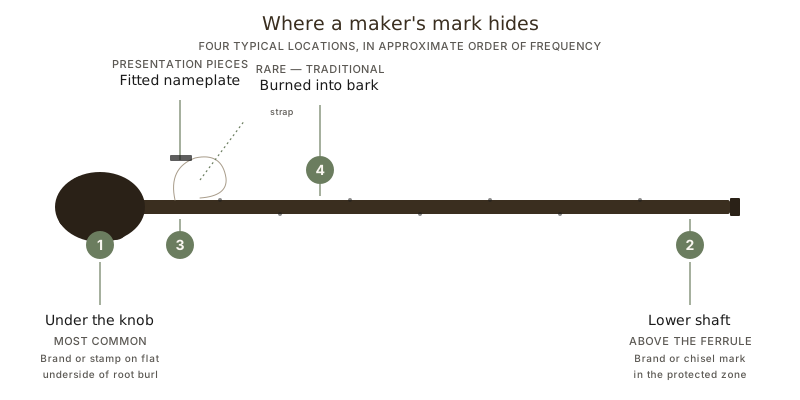
There are four typical locations on a handmade stick where a maker’s mark may appear. Most makers use one of these; some use two; very few use more.
1. The underside of the knob. On a shillelagh, the natural root burl that forms the knob has a flat or slightly curved underside where a small branded mark (burned in with a hot iron) or stamped mark (impressed with a steel die) can be placed. This is the most common location for Irish blackthorn shillelaghs, where the knob is the most visually distinctive element of the piece.
2. The lower shaft, above the ferrule. On a longer walking stick, the lower few inches of the shaft — between the user’s normal grip and the ferrule at the foot — is a common location for branded or chiselled marks. The mark sits on the part of the stick that gets visually inspected when the user looks at the foot, and is protected from the worst handling-wear by being below the gripping zone.
3. A fitted nameplate at the head. On more elaborate presentation pieces, a small brass or silver nameplate is fitted into a routed seat just below the handle, usually engraved with the maker’s name and sometimes a date. This is most common on Welsh and Scottish show-sticks and on Irish ceremonial/presentation pieces; rarely seen on plain working sticks.
4. Burned into the bark. On barked-finish blackthorn pieces, some Irish makers burn a small monogram into the natural bark of the upper shaft — an old practice that survives in only a few workshops. The mark is visible against the dark bark and is impossible to remove without destroying the surface.
A mark in any of these four locations, on a piece that otherwise passes the standard handmade-stick tests (root-burl knob, real leather, no thick varnish), strongly suggests genuine handmade provenance.
Common forms
Maker’s marks across the British and Irish stick-making tradition take a handful of recognisable forms:
Single initial. A capital letter, branded or stamped, often with a small decorative border. Common in nineteenth-century Irish work where the maker was a local figure whose initial was known to the regional buyer base.
Two-letter monogram. Two interlocking or overlapping initials, often in a small circle or oval frame. The Welsh tradition uses this form heavily; many Welsh show-stick makers can be identified by their distinctive monogram even when no other documentary evidence survives.
Full surname. A short surname stamped or branded in a small font — “DOYLE”, “FFRENCH”, “MCCAFFREY”. More common on twentieth-century pieces than on earlier ones, and on pieces sold internationally where a single initial would not be informative.
Place-and-name combinations. A two-line mark with the maker’s name on one line and a town or county on the second. Common on Scottish gillie’s poles and on Irish twentieth-century commercial pieces.
Symbol marks. A small device — a thistle, a shamrock, a stag’s head, a regimental crest — that identifies a particular workshop without using letters. Less common than letter-based marks; more common on pieces commissioned for institutions or for particular families.
Number-and-letter marks. A combination of letters with a number, typically a year or a serial number. Helps date a piece precisely; suggests a maker who produced enough volume to want serial-numbering. Rare before about 1900.
The form alone does not identify the maker, but it narrows the search. A two-letter monogram with a Welsh-style frame is unlikely to be Irish; a full McCaffrey-family-name brand is very unlikely to be earlier than the twentieth century.
Documenting an unknown mark
If you have a stick with a mark you cannot identify, the journal recommends documenting it as follows. Sending the documentation to the editor, with the journal’s permission to publish, helps build the catalogue for other readers.
1. Photograph the mark in good light. Use a daylight-balanced light source, no flash, the camera close enough that the mark fills at least a quarter of the frame. Take three or four photos at slightly different angles to capture any depth or texture in the mark.
2. Photograph the whole stick. Several full-length shots showing the wood character, the head, the foot, and any other distinguishing features.
3. Note the dimensions. Length of the stick, diameter at the gripping zone, weight if you can measure it.
4. Identify the wood as best you can. Blackthorn, oak, holly, ash, hazel, or unknown. The wood narrows the regional origin substantially.
5. Record the provenance you have. Where the stick came from, when and where it was acquired, whether the original buyer is known.
6. Send the package to [email protected], with a brief note describing the question.
The journal’s working practice is to acknowledge receipt within a few days and to attempt identification through the standard reference sources (the National Museum of Ireland’s collection notes, regional craft archives, published mark catalogues). If the mark is identifiable, the journal will reply with the attribution and — with the contributor’s permission — add the mark to the published catalogue below. If the mark is not identifiable, the journal will say so and add it to a holding-list of unidentified marks for future readers to potentially recognise.
The catalogue (under development)
The journal can currently identify, with reasonable confidence, the following maker’s marks. The catalogue is short by intention: better to list a small number of well-documented marks than to speculate at scale.
Identified marks
This section is under active development. As of the current publication date, the journal has confirmed the following:
- McCaffrey Crafts — the contemporary Killorglin workshop (see /makers/). Marks not currently documented in detail on this site; readers with photographs of dated McCaffrey-stamped pieces are particularly welcome to write in.
The catalogue will expand as readers contribute documentation. Specific marks the journal is actively researching include:
- Nineteenth-century Wicklow oak shillelagh marks — the workshops that produced the original “Shillelagh” oak pieces from the Coolattin area before the estate-village transition; mark patterns are not currently documented but probably exist on surviving pieces in private and museum collections
- Welsh show-stick monograms from the Royal Welsh Show competition era (twentieth century) — a substantial body of marked pieces exists in private collections and at the Royal Welsh Show’s archive; documentation is scattered
- Scottish Highland gillie’s-pole marks — particularly on pieces with named-officer or named-estate provenance
- Irish twentieth-century commercial workshop marks — the small commercial workshops that supplied the diaspora gift trade between roughly 1920 and 1970, several of which are no longer active
A reader who knows of a specific mark that should be documented — or who has a photograph of an unidentified mark on an inherited stick — can substantially improve this catalogue by writing to the editor.
Unidentified marks (holding list)
This is the submissions list: marks that readers have sent in but that the journal has not yet been able to attribute. Each entry will eventually move to either the identified catalogue (if a contributor or researcher recognises it) or to a “lost-record” section (if the journal concludes the mark is not currently documentable).
This list is currently empty pending reader contributions.
A note on maker’s marks and authentication
Maker’s marks are strong but not conclusive evidence of authenticity. They can be:
- Faked — though this is rare in practice for stick-making, where the forgery economics are not particularly favourable
- Misattributed — a mark that resembles a known maker’s brand but was actually used by a different (sometimes earlier, sometimes later) workshop
- Added to a non-original piece — a buyer or restorer adding a mark to an unmarked stick to suggest provenance it does not have
- Damaged or worn beyond recognition — particularly on heavily-used vintage pieces where the lower-shaft area has worn against pavements and gateposts
A maker’s mark is most reliable when combined with:
- The standard handmade-authentication tests (covered in Handmade vs machine-made sticks)
- A coherent provenance history (purchase record, family inheritance, dealer documentation)
- Wood and form characteristics consistent with the named maker’s known output
- (Where applicable) the patina and wear characteristics of a stick of the named maker’s likely date
A stick with all five elements aligned — a recognised mark, an authentic build, a coherent provenance, consistent wood and form, and appropriate patina — is, for collector purposes, as well-documented as British and Irish stick-making generally allows.
Why this catalogue is short
The journal acknowledges, as plainly as possible, that this page is currently more framework than catalogue. The reasons:
-
No central register exists. Unlike silver, where the Sheffield Assay Office has maintained continuous mark-records since the eighteenth century, British and Irish stick-making has never had an institution responsible for recording maker’s marks at scale. The records that exist are scattered, partial, and largely held privately.
-
Many marks are not documented in any published source. The journal’s reference shelf — Fossel and Jones — does not include a comprehensive marks-catalogue. The published material covers technique, history, and tradition but not mark identification.
-
The makers themselves did not always preserve marks-records. A small workshop that closed in 1948 left, in most cases, no archive of which marks were used in which years. Reconstructing this from surviving pieces is slow work that no single researcher has undertaken at scale.
-
The journal is new. The catalogue is built reader by reader, contribution by contribution. It will be more complete in 2030 than in 2026, and more complete in 2040 than in 2030 — provided the contributions keep coming.
The honest version is that this page is the start of a catalogue rather than a finished one. The framework is the genuine offer here; the catalogue itself will grow if readers find it useful enough to contribute to.
A final note: the journal welcomes contributions even when the contributor is not certain of the attribution. A photograph of an unidentified mark with a brief note about where the stick came from is genuinely useful to the catalogue, because the next contributor may recognise what the previous one did not. The aggregate of partial information often produces more than any single contribution would on its own.
If you have a stick with a maker’s mark — identified or otherwise — please write to [email protected] with photographs and any provenance you have. The catalogue grows from the contributions.
Sources & further reading
- Theo Fossel, The Stickmaker's Handbook, WorldCat
- Irish Folklife Division — National Museum of Ireland (Country Life), National Museum of Ireland
Related reading
- comparisonsVintage vs new sticks
A thirty-year-old well-cared-for blackthorn stick is, in some respects, a finer object than a new one. Here is what time does to a stick, and what to look for in the secondary market.
- comparisonsHandmade vs machine-made sticks
The two products look almost identical at the price-point of $15 vs $150. Here is exactly what the price difference is paying for, and what fails on the cheap one.
- guidesYour first stick
If you've never owned a real handmade Irish stick before, this is the eight-question framework that will get you to the right one. Most readers can answer all eight in five minutes.
- historyA timeline of the Irish walking stick
A long view of stick-and-staff use in Britain and Ireland, from prehistoric woodworking evidence to the small-batch revival of the present day.