The best walking stick for shorter walkers (under 5'4)
Sizing, weight, and handle recommendations for walkers under 5'4 — where the standard Irish stick is too long, too heavy, and proportionately wrong, and what to specify instead.

The standard handmade Irish walking stick is sized for a 5’10 user. Users under 5’4 need a substantially different stick — different length, different shaft diameter, often different wood — and the sizing error from buying a stock 36-inch stick is at least as large as the error a tall walker makes by buying the same stick.
This guide is for walkers under 5’4.
Why the standard stick is wrong
The 36-inch stick is the canonical Irish working length because it suits a 5’10 user in working boots at the comfortable elbow-flex target (see Sizing and fit). A user at 5’2 in normal footwear needs about 33 inches; a user at 5’0 needs about 31. The standard stock-size mismatch is 3 to 5 inches — substantial enough that the stick is genuinely the wrong tool.
The signs of an over-long stick on a shorter user:
- Elbow forced into sharp flex (40°+ rather than the 10–20° target) — produces shoulder fatigue and lifts the carrying shoulder.
- Hand has to grip below the natural head position — the user grips the shaft below the knob to compensate, which makes the head unbalanced and reduces the user’s ability to wrap fingers comfortably.
- The ferrule wanders — too-long stick has more lever than the shorter user’s arm can control, and the ferrule moves erratically on contact rather than planting firmly.
- Wrist and forearm fatigue — every step transmits the stick’s excessive lever back into the wrist; over a long day, the cumulative fatigue is substantial.
The fix is to order at the right length.
Specific lengths by height
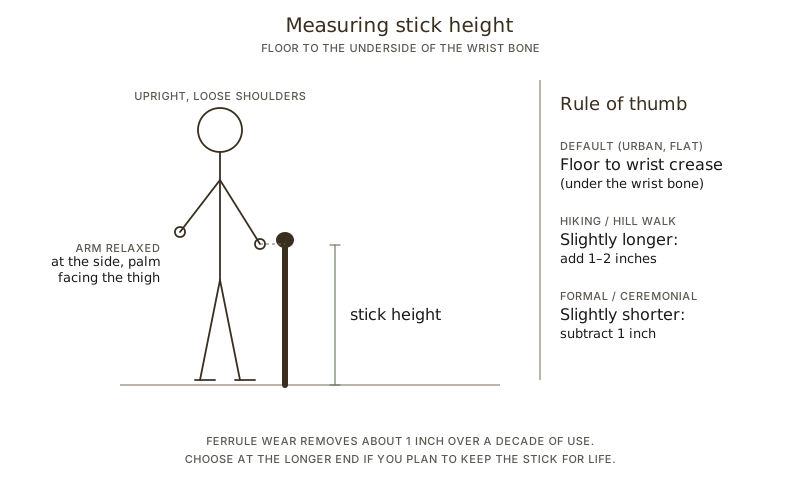
Approximate starting points for level-ground walking in average footwear. Use the seven-measurement method in Sizing and fit for a precise number.
| User height (in walking shoes) | Approximate stick length |
|---|---|
| 5’3 (160 cm) | 33–34 inches |
| 5’2 (157 cm) | 33–33½ inches |
| 5’1 (155 cm) | 32–33 inches |
| 5’0 (152 cm) | 31½–32½ inches |
| 4’11 (150 cm) | 31–32 inches |
| 4’10 (147 cm) | 30–31 inches |
| Under 4’10 | 28–30 inches; commission required |
Adjustments:
- Hill walking: subtract 1 inch (smaller than the tall-walker adjustment because shorter walkers have a smaller stride and the relative effect is amplified)
- Substantial heel (hiking boots): add ½ inch
- Forward-leaning posture: subtract 1 inch
The user’s actual measurement should always be the starting point.
The shaft-diameter problem
The diameter conversation for shorter walkers runs in the opposite direction from tall walkers. A 36-inch stick at 22mm feels substantial in the hand of a 5’10 user; the same 22mm shaft on a 32-inch stick feels chunky and over-built, both visually disproportionate and uncomfortable to grip for users with smaller hands.
Working diameters for shorter walkers:
- 30–31 inch stick: 18–20mm at the grip; 16–18mm at the ferrule
- 32–33 inch stick: 20–22mm at the grip; 18–20mm at the ferrule
- 33–34 inch stick: 20–22mm at the grip; 18–20mm at the ferrule
The smaller diameters serve two purposes:
- Grip comfort — most adults with smaller hands cannot comfortably wrap their fingers around a 24+ mm shaft for extended periods. The 20mm range fits naturally.
- Proportionate appearance — a stick that looks “right” in the hand has a length-to-diameter ratio similar to a stock 36×22mm stick. Holding length-to-diameter near 1500:1 keeps the aesthetic balance.
For blackthorn (see Blackthorn) at the lower diameter range, working makers select younger, more recently-coppiced stems — these grow thinner and straighter than the substantial mature stems used for heavier sticks. The selection is straightforward; thin blackthorn is plentiful in any working hedgerow.
Weight implications
At identical dimensions, mass follows density. By the Wood Database’s figures, hawthorn (about 785 kg/m³) is roughly 15% heavier than ash (about 680 kg/m³), and oak (about 675 kg/m³) is about the same as ash. The journal has found no published density figure for blackthorn or hazel, so it quotes no weights for them.
For a smaller user, the weight difference between denser and lighter woods is more noticeable than for a larger user: a given weight saving is proportionately larger on a smaller carrier.
For shorter walkers doing substantial daily walking, the practical guidance:
- General walking, weight-sensitive: ash or hazel at 33×22mm. See Ash and Hazel.
- General walking, traditional register: blackthorn at 33×22mm. The canonical Irish wood. See Blackthorn.
- Ceremonial / occasional use: blackthorn at the user’s natural length, no weight concern. The aesthetic register of blackthorn beats the lighter woods for formal carry.
- Hill walking, smaller frame: hazel or hawthorn at 31–32×20mm; the lighter wood plus the shorter length gives the user better leverage and less fatigue. See Hawthorn.
Handle considerations
The handle on a shorter user’s stick deserves attention. A heavy root-burl knob designed for a 36-inch stick is proportionately over-built on a 32-inch stick.
Working handles for shorter walkers:
- Modest root-burl knob — natural blackthorn root knobs come in a range of sizes; working makers can select a smaller, more proportionate burl for a smaller stick.
- Polished thumb-shape — a smaller, polished thumb-rest at the head, sized for the user’s smaller hand grip.
- Crook handle — a Welsh-style crook (see The shepherd’s crook) at a smaller scale; the curved handle fits a smaller hand without disproportionate over-build.
- Plain knob — a simple rounded knob, sized for the user’s grip span.
The handle should fit the hand comfortably. A user with small hands (typical hand-span 7 inches or under) needs a smaller handle than a user with average hands; this is one of the most visible mismatch points on an off-the-shelf stick.
Wood recommendations
By use case for shorter walkers:
General walking, traditional Irish register: blackthorn at 33 inches, 22mm at grip, modest root knob. The canonical choice; the smaller dimensions remain unmistakably blackthorn in character.
General walking, weight-sensitive: ash at 33 inches, 20–22mm at grip, modest knob or polished thumb. Lighter, springier, easier on the wrist over long carries. See Ash.
Country walking, slightly cheaper: hazel at 32–33 inches, 20mm at grip. Hazel is the working “everyman” wood of British and Irish hedgerow craft (see Hazel); produces light, attractive sticks at the lower price points.
Hill walking, smaller body: hawthorn at 31–32 inches, 20mm at grip. The hardwood character at smaller scale; suits smaller-frame walkers on rough ground. See Hawthorn.
Formal / ceremonial: blackthorn at the user’s natural length, 22–24mm at grip, with a more substantial knob acceptable since weight is not a daily concern. See Best stick for ceremonial use.
Hand-stick (short hand-held aid, ~85 cm): holly or hawthorn at 31 inches, 22mm — see Holly and the hand-stick tradition.
Stock vs commission for shorter walkers
The off-the-shelf market for sub-34-inch sticks is thinner than for the standard 36–38 inch range. Most working Irish makers stock at least one or two pieces below 34 inches at any given time, but the selection is limited.
Practical paths:
- 34 inches — usually available in stock; the shortest “standard” size most makers carry
- 32–33 inches — available in stock at some makers; may require asking specifically; lead time generally short
- 30–31 inches — commission required; lead time 4 to 6 weeks; modest premium over standard sizes
- Below 30 inches — commission only; specialised stock selection; lead time 6 to 10 weeks
For commissions, the briefing template in Commissioning a bespoke stick covers the specifications the maker needs.
Sizing for children and young adults
Walking sticks for children are a niche but real use case — for hill walking with grandparents, for ceremonial carry in family processions, for Highland Games and similar cultural events. Working Irish makers will produce short children’s sticks on request:
- Adult height 4’0–4’6 (typical ages 7–10): 24–28 inch stick, 16–18mm shaft
- Adult height 4’6–5’0 (typical ages 10–13): 28–32 inch stick, 18–20mm shaft
- Adult height 5’0–5’4 (teen-to-adult transition): 31–34 inch stick, 20–22mm shaft
For a child’s stick, the handle should be specifically scaled to the child’s hand; the head decoration should be modest (the child can’t carry a heavy knob comfortably); and the wood choice should favour lighter species (hazel, hawthorn) for the same weight-saving reasons.
A children’s stick is typically purchased with a specific event in mind (a wedding, a family reunion, a child’s first hill walk). Working makers respond well to this kind of commission; the cultural register is the right kind of family-tradition register.
What to expect at delivery
Shorter-walker sticks deliver in the standard pattern — see Your first stick for the general delivery walkthrough — with two specific notes:
- Trim allowance is critical — at 31 inches target, a 1-inch over-build is more than 3% of total length; the maker should explicitly confirm the trim allowance and the at-home trim plan
- Handle proportionality — the buyer should specifically inspect the handle proportions on first unboxing; if the head feels over-built for the shaft, contact the maker about a re-fit
Common shorter-walker mistakes
The most frequent errors:
- Buying the stock 36-inch stick and “managing” — the 3 to 5 inch sizing error produces real ergonomic damage over time; managing is not a solution
- Specifying the right length but the standard 22–24mm diameter — produces a chunky, disproportionate stick that doesn’t grip comfortably
- Choosing a heavy root-burl knob on a small shaft — head-heavy stick that wanders in motion
- Trying to “size down” a stock stick at home by cutting — works for length, but doesn’t address the diameter mismatch; the cut stick still feels chunky in the hand
- Buying a child’s stick that’s too tall thinking the child “will grow into it” — children’s sticks should fit now; growth happens fast enough that the next stick will be needed within a year or two anyway
A shorter walker who orders to the right length, the right diameter, and the right handle proportion gets a stick that fits naturally and lasts a working lifetime.
Where to commission
For shorter-walker commissions, see The makers page. The journal’s recommended Irish maker handles short-length custom orders routinely and will scale the handle and decoration to match the smaller dimensions. Lead times for sub-34-inch custom orders typically run 4 to 8 weeks.
Sources & further reading
- European ash — wood properties, The Wood Database
- Oneseed hawthorn (Crataegus monogyna) — wood properties, The Wood Database
- English oak — wood properties, The Wood Database
Related reading
- guidesSizing and fit: how to size a walking stick precisely
The seven-measurement method — wrist, elbow, terrain, posture, footwear, intended use, and seasonal layering — that gets a working walking stick to the right length the first time.
- guidesYour first stick
If you've never owned a real handmade Irish stick before, this is the eight-question framework that will get you to the right one. Most readers can answer all eight in five minutes.
- guidesThe best walking stick for a woman
Sizing scaled to typical female proportions, weight reductions for smaller-frame carrying, handle scaling, and the woods and forms that suit women buyers — without the patronising 'lady's stick' register that mars most of the cane trade.
- guidesThe best walking stick for arthritis
Handle ergonomics, weight, grip diameter, and ferrule choice for walkers with arthritis — the four specifications that determine whether a stick relieves or aggravates joint discomfort.