Commissioning a bespoke walking stick
How to brief a working stick-maker, what specifications to include, the lead times you should expect, and the seven-section briefing template that produces the right stick the first time.

A bespoke walking stick is not bought from stock; it’s commissioned. The buyer and the maker have a working conversation about what the stick should be, the maker selects stock and works the piece to specification, and the finished stick arrives some weeks later. Done well, the commissioning process produces a stick that fits the buyer’s hand, use, and aesthetic precisely. Done poorly, it produces a generic stick at a custom price.
This guide is for buyers commissioning a stick for the first time. The seven-section briefing template covers what the maker needs to know.
Why commission rather than buy from stock
Stock walking sticks fit the average user well; they don’t fit any specific user perfectly. The fitting variables that matter — exact length, shaft diameter, handle scale, wood character, head selection, finish, ferrule type — vary substantially across users, and stock production has to pick a centre of the distribution.
Commissioning suits buyers who:
- Sit outside typical sizing (tall walkers above 6 ft, shorter walkers below 5’4)
- Have specific use cases (hill walking, ceremonial, arthritic, Nordic pairing)
- Want a specific wood, head form, or aesthetic the maker doesn’t keep in regular stock
- Are buying for a presentation occasion (retirement, wedding, regimental gift)
- Want to build a long-term relationship with a working maker
- Are willing to wait 6 to 16 weeks for the right stick
Buyers who fit typical proportions, want a standard working stick, and need it within 2 to 4 weeks can usually buy from stock satisfactorily; commissioning isn’t required.
The seven-section briefing template
A well-formed commission briefing covers these seven sections. Most working makers will accept this format in an email or written letter; some prefer a phone or video conversation as the primary briefing format and the email as confirmation.
Section 1: User
Who’s the stick for? Specifics that affect the work:
- Recipient name and basic description — “this stick is for me” or “this stick is a gift for my father, retiring after 40 years in farming”
- Height in walking shoes — the canonical first measurement
- Approximate hand size — small, average, large, with hand-span if known
- Posture in normal walking — upright, slight forward lean, substantial forward lean
- Footwear typical for use — trainers, boots, dress shoes, mixed
- Any specific medical or mobility considerations — arthritis affecting the hand or wrist, hip replacement, recovering from injury, balance issues
For gift commissions, the recipient’s preferences if known (a working person who prefers minimal decoration vs a more flamboyant personality who’d want a substantial knob) are relevant.
Section 2: Use
What will the stick actually do? Specifics:
- Primary use case — daily walking, hill walking, ceremonial only, mixed
- Typical terrain — urban pavement, country path, hill / mountain, mixed
- Weather conditions — fair weather only, all-weather, including wet hill walking
- Frequency of use — daily, weekly, occasional, ceremonial-only
- Travel pattern — stays at home, travels with the user, both
- Defensive register — primarily a walking aid, with possible self-defence backup (within reasonable legal limits)
- Pairing — single stick, matched Nordic pair, second stick to an existing piece
This section is where the buyer often has implicit assumptions that the maker can’t read; spelling them out prevents mismatches.
Section 3: Dimensions
The specific measurements:
- Length — derived from the seven-measurement method in Sizing and fit, with the conditions specified (“measured to wrist in winter boots with 1-inch heel”)
- Length trim allowance — whether to deliver at exact target length or with 1-2 inch over-build for at-home trim
- Shaft diameter at grip — millimetres; typically 18-30mm depending on user
- Shaft diameter at ferrule — millimetres; should taper from grip diameter
- Total mass target — if weight-sensitive, specify a target weight range
For users who don’t know their preferred shaft diameter, the maker can produce a sample if the buyer can visit, or recommend a diameter from the user description.
Section 4: Wood
Which wood, and any specific stock preferences:
- Primary wood choice — blackthorn, ash, oak, hawthorn, etc.
- Backup wood if primary unavailable — for time-sensitive commissions, an acceptable alternative
- Stock character preferences — straight vs character-grown, light-coloured vs dark, particular bark or surface character
- Root burl preferences — for blackthorn specifically, substantial knob, modest knob, no knob (rare for blackthorn but possible)
- Provenance preferences — wood from a specific region or specific hedgerow, if the buyer has a connection
Working makers carry seasoned stock of the canonical Irish woods (blackthorn, ash, oak, hawthorn, hazel, holly). For specialty woods (yew, cherry, crab apple, elder), the maker may need to source specifically; lead time can be longer.
Section 5: Head and decoration
What the stick’s head should look like:
- Handle form — root-burl knob (size: substantial, moderate, modest), polished thumb, derby, crook, fritz, plain knob, carved figural
- Collar — none, brass band, silver collar (sterling, hallmarked)
- Engraving — none, simple inscription, full presentation engraving with text and dates
- Strap — leather wrist strap, none, decorative strap with brass swivel
- Specific aesthetic — minimal/severe, traditional, substantial/decorated
For ceremonial commissions, this section is the longest part of the briefing. See Best stick for ceremonial use for the ceremonial-specific decoration conversation.
Section 6: Finish
What the stick’s surface should be:
- Surface treatment — oil (matte working finish), polished beeswax (low sheen), shellac/French polish (medium gloss), lacquer (high gloss)
- Colour development — natural (whatever the wood does), darkened (stained or burnt), bleached (rare; some holly pieces)
- Ferrule type — brass cap, steel cap, rubber, convertible (brass with removable rubber + spike)
- Specific preferences — preserve natural bark character, smooth removal of bark, specific finish character
Most working sticks use oil or polished beeswax; most ceremonial sticks use polished beeswax or shellac. Lacquer is uncommon in the British/Irish tradition.
Section 7: Schedule and budget
The practical specifics:
- Target delivery date — when the buyer wants the stick in hand
- Acceptable late delivery — how many weeks beyond target before it becomes a problem
- Budget range — what the buyer can spend; ranges are fine (“£250-£350”)
- Payment preferences — deposit-and-balance, full upfront, etc.
- Shipping destination and constraints — domestic, international, customs considerations
- Photography requests — if the buyer wants photos during the process or at completion
For presentation gifts on a specific date, work backwards from the date with substantial margin. A retirement gift for a Friday-evening dinner three months away should be commissioned now with delivery target two weeks before the dinner.
What the maker provides in response
After receiving the briefing, the working maker typically responds within a few days with:
- Confirmation that the commission is accepted (or, if the maker can’t take it, an explanation and possibly a recommendation to another maker)
- Lead time estimate — typically a range of weeks based on current workload
- Price quote — usually a fixed price or narrow range, depending on the specification’s specificity
- Stock selection conversation — for high-end commissions, photos of available stem stock or invitation to visit
- Payment terms — deposit percentage, balance schedule
- Any clarifying questions — points where the briefing is unclear or where the maker has technical questions
The buyer should respond promptly to clarifying questions and confirm acceptance of terms. Once accepted, the maker begins work; substantial changes after acceptance become harder.
Realistic lead times
By commission type:
- Standard blackthorn working stick (specified measurements, modest decoration): 6 to 10 weeks
- Standard wood other than blackthorn: 6 to 12 weeks (slight extension for less common stock)
- Specialty wood (yew, cherry, crab apple): 12 to 20 weeks
- Substantial ceremonial commission with silver collar and engraving: 10 to 16 weeks
- Matched Nordic pair: 8 to 14 weeks (matched stock selection adds modest time)
- Tall-walker commission (40+ inches): 8 to 14 weeks (specific stock selection)
- Children’s stick: 4 to 8 weeks (smaller stock, faster turnaround)
Working makers are often booked weeks ahead. A buyer commissioning today should expect their commission to be the maker’s NEXT piece of work, with finish on whatever’s currently in progress before starting the new commission. The lead time is real working time, not “we’ll get to it when we feel like it” time.
Payment conventions
Most working Irish makers use one of two payment structures:
- Deposit + balance: 30-50% deposit on order acceptance; balance due before shipment. Standard for moderate-to-high-value commissions.
- Full upfront: 100% on order acceptance. Sometimes used for first-time buyers; sometimes for any buyer the maker prefers to work with this way.
Some buyers want to pay nothing upfront and pay-on-delivery. Most working makers won’t accept this; the materials investment (substantial seasoned stock) and the labour committed to the commission don’t lend themselves to a maker carrying the buyer’s risk.
For high-value commissions involving silverwork, the maker may pay the silversmith on the buyer’s behalf and add the silversmith’s invoice to the balance. Some makers prefer the buyer to commission and pay the silversmith directly; this varies by maker.
What to expect at delivery
The finished stick typically arrives:
- In a stick-length parcel — wrapped to prevent transit damage; well-padded
- With brief documentation — the maker’s identification, care instructions, sometimes a personal note about the piece
- With the trim allowance preserved — if specified, the 1-2 inch over-build for at-home trim
- With any commissioned packaging — presentation box, cloth bag, etc.
The buyer should:
- Unbox carefully — inspect for transit damage before assuming anything’s wrong
- Photograph the piece on receipt — for records and any conversation with the maker
- Check measurements — confirm the length and shaft diameter against the commission spec
- Test the fit — stand, hold, check elbow flex (see Sizing and fit)
- Allow a week of indoor acclimatisation — let any residual moisture equilibrate
- Write to the maker confirming receipt — acknowledges arrival, opens any remaining questions
Handling disagreements
If the finished stick is materially different from the commission specification, the buyer should:
- Photograph the discrepancy clearly — close-up of the issue, full-stick context, comparison to the specification
- Contact the maker promptly — within a week of delivery, ideally
- State the concern factually — not “this is wrong” but “the shaft diameter is 26mm at the grip; the commission specified 22mm”
- Ask the maker’s view — there may be a working reason for the deviation (stock character forced an adjustment; the maker should have communicated this earlier but may not have)
Reputable makers respond to legitimate concerns with remake or adjustment. The conversation should be working-professional, not adversarial; both parties want the buyer to be satisfied long-term.
If the stick is exactly what was specified but the buyer has changed their mind, the conversation is harder. Most working makers will accept return for substantial credit but won’t fully refund — the labour and materials are already invested. Some makers will offer to remake at reduced cost. Spend time on the briefing rather than expecting to renegotiate post-delivery.
Common commissioning mistakes
- Vague briefing — “a nice blackthorn stick for me” produces whatever the maker thinks is “nice”, which may not match the buyer’s intent
- No length specification — produces an “average” stick that doesn’t fit the buyer’s actual proportions
- Specifying decoration without specifying use — produces a beautiful piece that’s wrong for the buyer’s daily walking
- Underestimating lead time — buyer needs the stick by a specific date but commissions too late; either accepts a late delivery or accepts a non-ideal stock alternative
- Underestimating budget — buyer asks for premium specifications at entry-level budget; the maker either declines or compromises silently
- Trying to micro-manage the maker’s process — produces friction without improving the outcome; trust the maker’s craft within the commissioned specification
- Failing to respond to clarifying questions — delays the commission and frustrates the maker; respond promptly
Where to commission
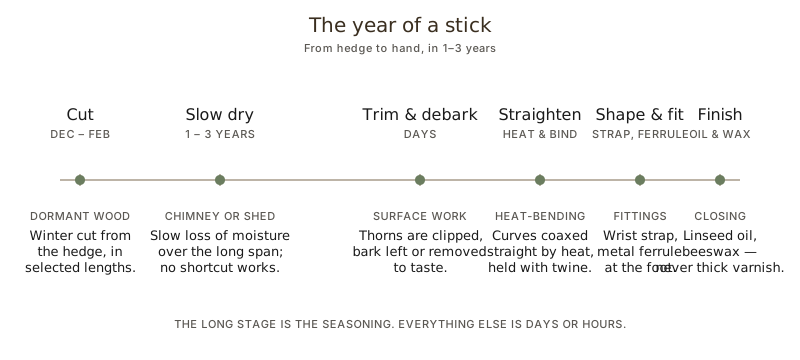
For commissioning an Irish walking stick from a working maker, see The makers page. The journal’s recommended Irish maker handles commissions in the format described above and welcomes the seven-section briefing approach. For the broader making-process context, see How Irish walking sticks are made.
Related reading
- guidesYour first stick
If you've never owned a real handmade Irish stick before, this is the eight-question framework that will get you to the right one. Most readers can answer all eight in five minutes.
- guidesSizing and fit: how to size a walking stick precisely
The seven-measurement method — wrist, elbow, terrain, posture, footwear, intended use, and seasonal layering — that gets a working walking stick to the right length the first time.
- guidesWalking stick price ranges: what you actually pay for
Honest price transparency across the working stick market — entry, mid, high-end, presentation — what's actually inside each price point, and where you should and shouldn't economise.
- guidesThe best walking stick for ceremonial use
Length, wood, head, and presentation specifications for sticks intended primarily for ceremony, formal carry, and gift-register — where the working-stick sizing rules give way to the aesthetic and symbolic register.