Sizing and fit: how to size a walking stick precisely
The seven-measurement method — wrist, elbow, terrain, posture, footwear, intended use, and seasonal layering — that gets a working walking stick to the right length the first time.

A walking stick at the wrong length is uncomfortable, ineffective, and — over a long day — actively damaging to the user’s wrist, shoulder, and lower back. A walking stick at the right length disappears into the user’s body mechanics and lasts a working lifetime.
Getting there is straightforward, but it isn’t done with one measurement. The single-number “measure to your wrist” rule is correct as a starting point and incomplete as the whole answer. A working walking stick has to fit the user, the use case, the terrain, and the footwear simultaneously. This guide walks through the seven measurements in the order a working maker would ask for them.
The canonical wrist measurement
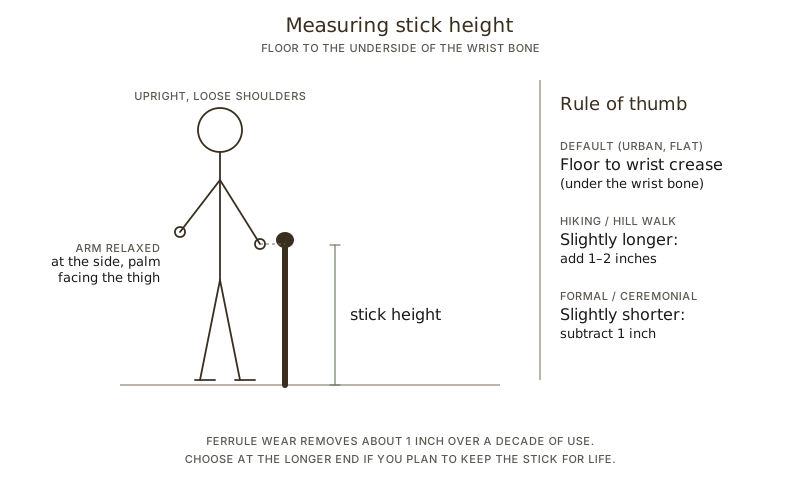
The starting point. The user stands upright in normal posture, in the footwear they’ll actually walk in, on level ground. A second person measures from the floor to the crease of the user’s wrist with the arm hanging naturally at the side. The result is the canonical length.
For most users in typical adult ranges (5’4 to 6’2 in average footwear), the wrist measurement lands between 34 inches and 42 inches. The substantial majority of working sticks sold by Irish makers sit between 36 and 38 inches — the centre of that distribution.
This single measurement produces a stick that, on level ground, allows the user to grip the head with elbow flexed comfortably at about 10–20° from straight. That elbow angle is the working target: it transmits body weight through the stick without forcing the wrist into compression and without requiring the shoulder to lift to accommodate a too-tall stick.
If the user is buying off-the-shelf and can’t have a custom length made, the wrist measurement rounded to the nearest half-inch is the right number. Most makers offer ½-inch increments; some only offer whole-inch increments. Round down (slightly short) rather than up (slightly tall) — a stick that’s marginally too short can still be used effectively; a stick that’s marginally too tall forces the user to lift the shoulder with every step.
The elbow-flex confirmation
After the wrist measurement, the user (or the working maker) confirms with the elbow-flex test. The user stands holding the proposed stick, ferrule on level ground, fingers wrapping the head. The maker looks at the elbow.
The target is approximately the angle the elbow takes when shaking hands — a comfortable, modest flex of 10 to 20 degrees from fully straight. Sharper elbow flex (30°+) means the stick is too tall; the user will fatigue at the shoulder. Almost-straight elbow (5° or less) means the stick is too short; the user will hunch forward over each step.
A good working maker has done this test thousands of times and can read the elbow-flex at twenty paces. A first-time buyer learning the test should do it explicitly: stand, hold, look down at the elbow, adjust.
Terrain adjustments
The wrist measurement assumes level ground. Real walking happens on graded terrain, and the right stick length depends on what the user actually walks on.
Pure flat-ground walking (urban pavement, the canal towpath, the level park) — use the wrist measurement as-is. No adjustment needed.
Mixed terrain with occasional hills (general country walking, footpaths, the average British and Irish rural walk) — subtract ½ to 1 inch from the wrist measurement. A slightly shorter stick handles the brief climbs without the user having to compress their grip awkwardly.
Substantial hill walking (Lakeland, Snowdonia, the Wicklow mountains, the Welsh hills) — subtract 1 to 2 inches. The user braces against the slope with each step; a shorter stick keeps the grip closer to the body’s centre of mass and gives more useful leverage on the ascent.
Steep technical ground (rock scrambling, near-vertical pulls, multi-pitch hill work) — many serious walkers carry a substantially shorter (~30 to 32 inch) stick specifically for the technical sections, in addition to their flat-ground stick. The short stick is held high on the shaft for the steep work; the long stick goes back in the strap for the flatter sections.
For users who do mixed terrain regularly, the practical compromise is to size for the most demanding common use case — usually hill — and accept that the stick will feel ½ inch short on flat ground. The flat-ground penalty is small; the hill penalty for a too-tall stick is substantial.
Posture allowance
The wrist measurement assumes upright posture. Users whose normal walking posture is forward-leaning (some users with chronic back issues, some users with hip arthritis) need a different number.
Forward-leaning posture — subtract 1 to 2 inches from the wrist measurement, depending on how forward the lean is. The shorter stick meets the hand at the right level given that the hand is sitting forward of the user’s vertical line. A correctly-sized stick for a forward-leaning user puts the elbow at the same 10–20° target.
Erect, military posture — add 0 to ½ inch above the wrist measurement. The stick comes up to meet a fully upright hand.
Variable posture (changes through the day, fatigue accumulation) — size for the most-relaxed end of the user’s posture range. The user can always grip slightly higher when fresh; gripping below the stick head is not an option.
A working maker doing in-person fitting will spot posture variance immediately and adjust. A buyer ordering remotely should photograph themselves in their natural walking posture and send the photo to the maker.
Footwear and the heel allowance
This is one of the most common sources of fitting error. The wrist measurement was taken in some specific pair of shoes; the working life of the stick will be split across multiple pairs of footwear with different heel heights.
The traditional Irish stick was sized for substantial working boots with ¾ to 1 inch of heel. A user who measured in trainers and will primarily walk in boots needs to add the heel-height differential — typically ½ to 1 inch — back into the stick length to compensate for the boot lifting them above the measurement line.
The reverse is also true: a user who measured in boots and will primarily walk in trainers should subtract ½ to 1 inch.
Footwear matrix (approximate adjustments from a barefoot or flat-shoe baseline):
| Footwear | Heel allowance |
|---|---|
| Trainers / running shoes | +0 to ¼ inch |
| Loafers / dress flats | +¼ to ½ inch |
| Hiking boots (typical) | +¾ to 1 inch |
| Substantial work boots | +1 to 1¼ inches |
| Cowboy boots | +1¼ to 2 inches |
| Dress shoes (slight heel) | +½ to ¾ inch |
For users who genuinely use the same stick across multiple footwear types, the practical move is to size for the most common footwear and accept the variance. A ½ inch mismatch on occasional alternative footwear is liveable; a 1+ inch mismatch is not.
Intended use
The wrist measurement plus terrain plus footwear gives a working number for everyday walking. Specific use cases benefit from further adjustment.
Pure walking aid (the user genuinely needs the stick for balance or support) — at the wrist measurement after the terrain and footwear adjustments. The stick is doing real load-bearing work.
Walking aid plus ceremonial use (the stick comes out for both daily walks and formal occasions) — at the wrist measurement, no further adjustment. Ceremonial use doesn’t change the sizing.
Primarily ceremonial (the stick rarely walks; it’s carried for register and presentation) — many users prefer a ½ to 1 inch taller stick. The taller stick has presence in formal settings; the lack of walking use means the user doesn’t pay a fatigue penalty for the extra length. See Best stick for ceremonial use.
Defensive register (the stick is also expected to function as self-defence implement — within reasonable legal limits, see Bataireacht for the historical martial register) — at the wrist measurement, no further adjustment. The stick is most effective at the natural walking length; an oversized defensive stick is unwieldy.
Hill-walking stave (the stick is specifically for serious hill use) — see the terrain section above; substantial subtraction from the canonical wrist measurement.
Seasonal layering
The final adjustment most buyers overlook. The wrist measurement was taken on a single day in a single set of clothes. A walking stick used year-round encounters substantial layered clothing in winter — heavy coat, scarf, gloves — that effectively shortens the working grip height.
Winter heavy clothing (heavy overcoat, gloves) — the gripped hand sits ~½ inch higher than in shirtsleeves due to the bulk of the coat sleeve and the glove thickness. A stick sized for shirtsleeves feels slightly short in winter; a stick sized for winter feels slightly tall in summer.
For year-round walkers, the practical compromise is to size in mid-weight clothing (jacket, light gloves) — the midpoint of the seasonal range. Users who walk only in one season can size for that season specifically.
Specifying length when commissioning
A working maker delivering a custom stick will ask the buyer to confirm length, ideally with a measurement taken under known conditions. The standard format:
“I measured myself at 37½ inches to the wrist crease, in walking boots (1-inch heel), in winter outerwear. Please deliver to that length plus 1 inch trim allowance.”
The trim allowance is critical. Working makers deliver 1 to 2 inches above the target length so the buyer can take final trim at home (see How to trim a stick to fit). Removing material at delivery is straightforward; adding material is impossible.
Some makers offer to do the final trim at the workshop based on a buyer’s measurement. This works fine for buyers who have measured carefully and don’t expect their height or posture to change. For older buyers or buyers commissioning a stick they intend to keep for decades, the at-home trim option preserves flexibility — the stick can be re-trimmed in five or ten years if the user’s posture or footwear has changed.
For the broader buyer-decision conversation around commissioning, see Commissioning a bespoke stick.
Common sizing mistakes
A short list of mistakes the working community sees repeatedly:
- Measuring to the elbow rather than the wrist. Produces a stick about 4–5 inches too tall. The user complains the stick fatigues their shoulder; the cause is the sizing error.
- Measuring in slippers or barefoot. Misses the boot-heel adjustment. The stick arrives, the user walks in boots, the stick feels short.
- Measuring during summer in shirtsleeves and expecting it to work in winter overcoat. Half-inch problem; manageable but noticeable.
- Rounding up rather than down. A marginally tall stick is harder to live with than a marginally short stick.
- Assuming a vendor’s “average” length will work. The 36-inch stick is the most common Irish working size because it suits a 5’10 user in typical footwear. Users above or below 5’10 should specify, not assume.
- Not asking for trim allowance. Stick arrives at exact target length; the user discovers a fitting error and has no margin to correct.
A buyer who follows the seven-measurement method and asks for the trim allowance ends up with a stick that fits within a quarter-inch of the optimum. That tolerance is well within working comfort.
When to consult the maker directly
For most users, the seven-measurement method gets to a working number without help. Two situations warrant a direct conversation with the maker:
- Atypical proportions — users whose arm length is unusual relative to their height (long-armed or short-armed). The wrist measurement still works, but a working maker can confirm by eye whether the stick will sit right.
- Specific medical or mobility considerations — users with substantial arthritis, hip replacement, or chronic balance issues should describe the use case to the maker. See Best stick for arthritis.
For everyone else, the seven measurements and a half-inch tolerance get the right stick the first time. For where to commission one, see The makers page — the journal’s recommended Irish maker can work to any specified length and includes the standard trim allowance as a matter of course.
Related reading
- guidesHow to choose the right walking stick height
There is one rule that gets you 95 % of the way there. The remaining 5 % is small adjustments for what you'll actually use the stick for.
- guidesYour first stick
If you've never owned a real handmade Irish stick before, this is the eight-question framework that will get you to the right one. Most readers can answer all eight in five minutes.
- guidesThe best walking stick for hill walking
Length, wood, ferrule, and balance specifications for serious upland use — where a flat-ground stick stops being the right tool and what to specify for hill work specifically.
- guidesThe best walking stick for tall walkers (6 ft and over)
Sizing, balance, and material recommendations for users 6 ft and over — where the standard 36-inch Irish stick stops being the right answer and what to specify instead.