The best walking stick for arthritis
Handle ergonomics, weight, grip diameter, and ferrule choice for walkers with arthritis — the four specifications that determine whether a stick relieves or aggravates joint discomfort.

A walking stick can substantially improve mobility for users with arthritis in the hips, knees, lower back, or feet — it transfers load away from the affected joints and steadies the user on uneven ground. A walking stick can also substantially aggravate arthritis in the hands, wrists, shoulders, or neck if it’s the wrong stick — wrong handle, wrong weight, wrong grip diameter, wrong ferrule.
The difference between the helpful stick and the harmful stick is specification, not luck. This guide is for users with arthritis selecting a stick that will actually help.
The four critical specifications
Most stick buying advice focuses on length and wood. For arthritic users, four other specifications matter more:
- Handle ergonomics — how the load distributes across the hand
- Weight — total stick mass and where it’s distributed
- Grip diameter — the shaft thickness at the user’s holding point
- Ferrule — whether ground impact transmits through the shaft to the wrist
Length and wood matter, but they sit behind these four for users with arthritic concerns.
Handle ergonomics
The handle determines how the stick’s load — including the user’s body weight when leaning — distributes across the carrying hand. For arthritic hands specifically, the difference between a well-distributed and a poorly-distributed handle is the difference between a stick that aids and a stick that injures.
The fritz handle (recommended for most arthritic users). A horizontal projection from the top of the shaft, gripped with the fingers wrapping underneath and the palm resting on top. The L-shape transmits body weight through the horizontal segment directly down the vertical shaft, with no curved or angled component to introduce mechanical stress. The palm rests flat across the horizontal — the largest surface available — distributing pressure widely. Used in modern orthopaedic canes for exactly this reason. See The walking cane for the historical fritz tradition.
The derby handle (second choice). A curved inverted-U shape; the hand enters from below, the fingers wrap the curved underside. Pressure distributes across the four fingers and the lower palm. Slightly more concentrated than the fritz but still comfortable for most arthritic users. The canonical Victorian gentleman’s-cane handle.
The crook handle (mixed). A J-curve shape similar to a shepherd’s crook. The user’s hand grips with the thumb on top and fingers wrapping below. Pressure distributes mostly through the thumb-and-index area, which can aggravate basal-thumb-joint (CMC) arthritis specifically. Suitable for users without thumb arthritis; problematic for those with.
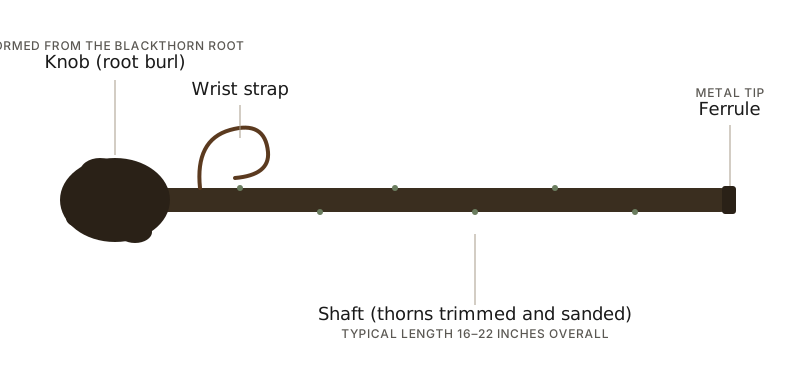
The root-burl knob (avoid for daily arthritic use). The traditional Irish blackthorn head — a natural bulbous knob, gripped over the top by the palm. Pressure concentrates on the centre of the palm where the knob’s apex sits, plus on the bent-back fingers wrapping the knob’s sides. For users with hand or wrist arthritis, this is the hardest handle to use comfortably. Beautiful in the hand, traditionally significant, but not the right ergonomic choice for arthritic daily use.
The polished thumb (variable). A smooth, flatish top with a slight thumb-rest indent. Ergonomically sits between the knob and the derby. Suitable for some arthritic users; depends on the specific handle shape and the user’s hand morphology.
For arthritic users buying their first stick, the recommendation is fritz or derby, full stop. Traditional Irish makers will produce both handle types on commission; the canonical “Irish stick” association with the root-burl knob doesn’t apply when ergonomics is the priority.
Weight
A heavier stick fatigues the carrying shoulder and wrist faster than a lighter stick, and the cumulative fatigue effect is amplified in arthritic joints. For arthritic users, lighter is generally better.
At identical dimensions, weight follows density. Wood Database figures at 12% moisture content:
- Heavier: hickory (about 800 kg/m³) and hawthorn (about 785 kg/m³)
- Middle: ash (about 680 kg/m³) and oak (about 675 kg/m³)
- Lightest: white willow (about 400 kg/m³)
The journal has found no published density figure for blackthorn or hazel.
For arthritic users prioritising weight, ash is the best balance of light weight and adequate strength. Hazel is generally regarded as light and flexible but is less robust under sustained loading. Willow is the lightest but is also the most prone to dings and dents.
Wood recommendations for weight-conscious arthritic users:
- Ash at 33–36 inches, 22mm. Light, springy, durable. See Ash.
- Hazel at 33–36 inches, 22mm. Light and flexible. See Hazel.
- Hawthorn at 33–36 inches, 22mm. Denser than ash, and attractive. See Hawthorn.
For arthritic users who specifically want the blackthorn aesthetic and accept the weight, a thinner shaft (20mm rather than 22mm) reduces the weight by about 15% without changing the appearance dramatically.
Grip diameter
The shaft diameter at the grip point determines how the user’s fingers wrap the stick. For arthritic hands — particularly users with reduced finger mobility or with rheumatoid arthritis affecting the small finger joints — grip diameter matters substantially.
Working diameters:
- Standard (22–25mm) — fits comfortably in the average adult hand with normal mobility. Too thick for many users with reduced finger flexion.
- Reduced (18–22mm) — fits comfortably for users with reduced finger mobility, smaller hands, or established arthritis. Most working makers will produce sticks at this range on request.
- Thin (under 18mm) — feels insubstantial; not generally recommended unless specifically needed for severe hand-flexion limitation.
A user with arthritis should test grip diameter by holding a sample of different shaft thicknesses (a piece of dowel, a wooden spoon handle, a broom handle) and noting which diameter allows comfortable wrap of the fingers without forcing the joints into uncomfortable positions. That diameter is the working specification.
For commissioning, the diameter specification goes in the briefing: “20mm at the grip, tapering to 18mm at the ferrule” or similar. Working makers handle this routinely.
Ferrule
The ferrule is the metal or rubber cap at the foot of the stick. It transmits ground impact through the shaft to the user’s hand. For arthritic users, the ferrule choice can be the difference between a comfortable stick and one that transmits painful shock with every step.
Brass or steel ferrule (traditional, hard) — transmits ground impact directly through the shaft. Looks traditional, lasts longer than rubber, but transmits 100% of the contact shock to the user’s wrist. For arthritic users, hard ferrules are uncomfortable on hard surfaces (pavement, parquet, polished floors).
Rubber ferrule (modern, soft) — absorbs approximately 60% of ground impact through compression of the rubber. Wears faster than brass (a quality rubber ferrule lasts 6–18 months of regular use). For arthritic users, rubber is materially more comfortable.
Hybrid (brass with rubber tip) — a brass collar at the foot with a removable rubber tip. Combines the traditional appearance with rubber’s shock absorption. Available from working makers on request.
Spike (technical / hill walking only) — a steel spike fitted to the ferrule for use on grass, mud, or scree. Not appropriate for arthritic users on hard surfaces.
For arthritic users on mixed surfaces (urban pavement, indoor flooring, occasional country path), the practical recommendation is the rubber-tipped ferrule with a spare tip kept ready for replacement. The shock absorption matters; the cosmetic compromise (a black rubber foot rather than gleaming brass) is a small price.
Length adjustments for arthritic posture
Users with arthritis often hold posture differently from non-arthritic users. The seven-measurement method in Sizing and fit handles most cases, but two arthritic-specific adjustments are worth noting:
- Forward-leaning posture from hip arthritis — subtract 1 to 2 inches from the standard wrist measurement. The user’s hand sits forward of the vertical line, and a stick at standard length forces the user to either reach further forward or compress the elbow uncomfortably.
- Shoulder arthritis or chronic shoulder pain — size slightly shorter (subtract ½ to 1 inch). The shorter stick allows the user to keep the carrying shoulder relaxed; a too-tall stick forces the shoulder to lift with every step.
For users whose posture varies through the day (some arthritis is morning-stiff and improves with movement), size for the more-relaxed end of the range. The user can grip slightly higher in the morning if needed; gripping below the handle is not an option.
The two-stick option
For users with hip, knee, or substantial lower-back arthritis, a single stick on one side creates asymmetric loading — the unaffected side bears more weight, the affected side bears the stick’s leverage. Over time, the asymmetry can produce secondary problems in the previously-unaffected side.
Two sticks — one in each hand, used together with a Nordic-walking-style rhythm — distribute load symmetrically. The technique:
- Lead with one foot; the opposite-hand stick plants at the same time (left foot + right stick, or vice versa)
- Both sticks transfer body weight as the legs swing through
- The user maintains balance through three points of contact at all times (two sticks + planted foot)
- Walking pace can match normal walking; the rhythm becomes natural quickly
For two-stick use, the user wants:
- Matched pair (same wood, same length, same diameter, same handle)
- Slightly lighter weight per stick than a single stick — total carry weight is double
- Both sticks at the same length (typically the user’s wrist-height measurement)
- Both with rubber ferrules
Commissioning a matched pair from a working Irish maker is straightforward; the maker selects two pieces of similar character from the same batch of seasoned stock.
What to expect at delivery
An arthritis-spec walking stick arrives like any other commissioned piece, with three specific things to verify:
- Handle shape and finish — the handle should sit comfortably against the user’s palm without sharp transitions or hot-spots. A working maker delivers handles smoothed to ~600-grit; the buyer should sit the handle in the hand and check for comfort before any walking use.
- Ferrule quality — the rubber ferrule should be a quality fit (not loose, not over-tight) and seated cleanly. A loose ferrule will work off within a few walks; a cheap aftermarket ferrule will compress unevenly and produce wobble.
- Balance check — the stick should balance close to the working grip point (slightly above the midpoint). A nose-heavy or tail-heavy stick is uncomfortable to control with weakened hand strength.
Common arthritic-user mistakes
- Buying a beautiful root-burl blackthorn for daily use — the handle is wrong for arthritic hands; the user finds the stick painful but blames themselves rather than the choice
- Choosing heavy oak for “durability” — the durability is real but the weight punishes the carrying shoulder over time
- Specifying the standard 22–24mm shaft without checking grip comfort — many arthritic users need thinner; specifying without testing produces an uncomfortable grip
- Refusing a rubber ferrule on aesthetic grounds — brass looks better but punishes the wrist on hard surfaces; the cosmetic compromise is worth it
- Using a too-tall stick to “have it for ceremonial use too” — the daily-use stick must fit the daily use; ceremonial register sits at a different length
A user who specifies fritz or derby handle, ash or lighter blackthorn at moderate diameter, rubber ferrule, and the right length for their actual posture gets a stick that supports their walking without aggravating their hands.
Where to commission
For an arthritis-spec commission, see The makers page. The journal’s recommended Irish maker handles ergonomic-handle commissions routinely and will work with the buyer on grip diameter, weight, and ferrule choice. The traditional blackthorn-and-knob register isn’t the right register for daily arthritic use, but Irish makers carry the broader walking-stick tradition (including derby and fritz handles in blackthorn, ash, and hazel) — the editorial recommendation extends to these forms as much as to the canonical shillelagh-form root-burl piece.
For long-term care of an arthritis-spec stick — keeping the rubber ferrule in good condition, replacing tips as they wear, maintaining the handle finish — see How to care for a blackthorn stick and the upcoming maintenance guides in the journal’s expanding craft-and-maintenance series.
Sources & further reading
- European ash — wood properties, The Wood Database
- Oneseed hawthorn (Crataegus monogyna) — wood properties, The Wood Database
- English oak — wood properties, The Wood Database
- Shagbark hickory — wood properties, The Wood Database
- White willow — wood properties, The Wood Database
Related reading
- guidesSizing and fit: how to size a walking stick precisely
The seven-measurement method — wrist, elbow, terrain, posture, footwear, intended use, and seasonal layering — that gets a working walking stick to the right length the first time.
- guidesYour first stick
If you've never owned a real handmade Irish stick before, this is the eight-question framework that will get you to the right one. Most readers can answer all eight in five minutes.
- guidesThe best walking stick for shorter walkers (under 5'4)
Sizing, weight, and handle recommendations for walkers under 5'4 — where the standard Irish stick is too long, too heavy, and proportionately wrong, and what to specify instead.
- guidesCommissioning a bespoke walking stick
How to brief a working stick-maker, what specifications to include, the lead times you should expect, and the seven-section briefing template that produces the right stick the first time.