How to choose the right walking stick height
There is one rule that gets you 95 % of the way there. The remaining 5 % is small adjustments for what you'll actually use the stick for.
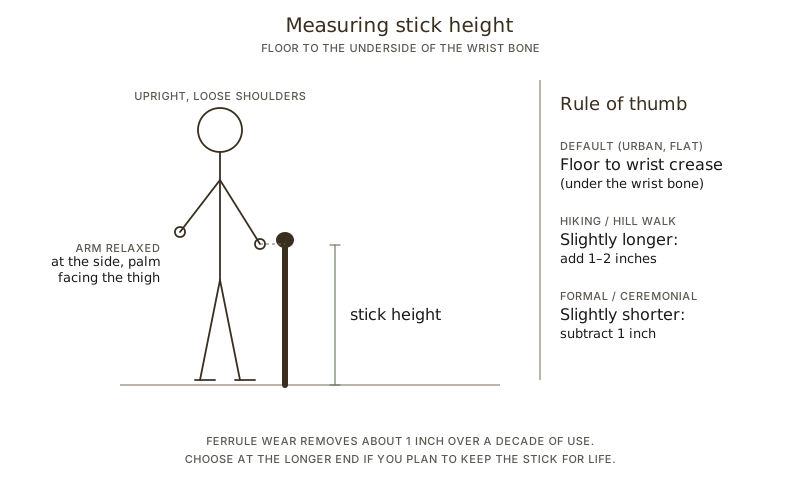
The rule for walking-stick height is simple enough that most makers will tell you in one sentence. Stand upright. Let the arm hang relaxed at the side. The top of the stick should reach the underside of the wrist bone.
That single rule covers most of what you need to know. The rest is small adjustments for what the stick will actually be used for, plus a note on how a stick changes size over its working life.
The basic measurement
To measure for a stick, stand straight on a flat floor, in the shoes you will normally wear with the stick, and let your dominant arm hang naturally. The wrist bone — the small bony bump on the side of the wrist, just above the heel of the hand — is the reference point. The top of the stick should sit at the underside of that bone, with the foot of the stick on the floor.
For most adults, this works out to a stick somewhere between 33 and 40 inches (84–102 cm). Taller users go up to roughly 43 inches (109 cm); shorter users come down to about 30 inches (76 cm). The exact figure depends on the user’s height and arm proportions; the rule above gives the right answer regardless of where in that range you fall.
A common mistake is to fit by visual estimate rather than by measurement. People tend to assume that a stick should reach somewhere around the user’s hip or lower belly. This produces a stick that is several inches too long — high enough to force the user into a slightly raised shoulder when carrying weight, which over a long walk becomes uncomfortable and over a long lifetime becomes a posture problem. The wrist-bone measurement is the older and more reliable test.
Adjustments for use case
The basic rule is calibrated for flat-ground urban walking. Three common variations on that use case warrant small adjustments.
Hiking and hill walking
For a stick that will be used primarily on uneven or sloping ground, add 1 to 2 inches to the basic measurement. The reason is that on a slope, the stick’s foot will sometimes be planted on lower ground than the user’s own feet, which effectively shortens the working length of the stick relative to the user’s arm. A slightly longer stick keeps the wrist closer to its natural neutral position when bearing weight on the down-slope side.
The adjustment is small. A stick that is two inches too long for flat ground will not be unusable on flat ground; it will simply feel slightly tall. A stick that is two inches too short for hill ground will not be unusable on hills; it will feel slightly low at the wrist on the steepest moments.
Formal and ceremonial use
A stick carried for formal or ceremonial purposes — a wedding stick, a presentation piece, an officer’s dress stick — is conventionally slightly shorter than a working walking stick: subtract about 1 inch from the basic measurement. The reason is that a formal stick is held with a slightly more upright posture, often gripped near the head with the elbow tucked, and the shorter length keeps the foot clear of the user’s own footwork. This is the same logic that produces the short swagger stick of military dress regulation; a formal walking stick is intermediate between the swagger stick and the working stick. (See Swagger sticks for the related military object.)
Two-handed staff use
A staff — five feet or longer, gripped in both hands and used for serious hill-walking or for stability on rough terrain — is sized differently from a walking stick. The rule for a two-handed staff is that the top should reach roughly the user’s chin or lower lip when the staff is upright, with the user standing straight. This is an entirely different fit from the walking stick, and a piece sized for one is not interchangeable with a piece sized for the other.
Adjusting an existing stick
A stick from a careful maker is normally finished with a small margin at the foot — typically half an inch to an inch — on the assumption that the buyer or maker may want to trim once the stick has been tested in hand. Trimming is straightforward: a fine-toothed saw, perpendicular to the shaft, with the cut made cleanly through the wood. The ferrule (the metal cap at the foot) is then either re-fitted to the trimmed shaft or replaced with a new one.
Trimming should always be done from the foot, not from the head. The head of a stick is shaped, finished, and often fitted with a strap; it cannot be re-done without redoing the whole top of the stick. The foot is structurally simple — a flat cut and a press-fit ferrule — and can be re-cut without difficulty.
If the stick is too short for the user, no adjustment is possible: a stick cannot be lengthened. The stick is the wrong stick for the user, and a different piece is the only solution. This is the reason makers err on the long side at finishing time.
Ferrule wear over a lifetime
A walking stick is, in effect, getting shorter for as long as it is in use. The metal ferrule at the foot wears against the ground with every step; over a decade of regular daily use, half an inch to an inch of the stick’s length is lost to ferrule wear and to the small amount of wood at the foot that gets shaved with each ferrule replacement.
This matters for two reasons.
First, if you intend to keep the stick for life — which is the working assumption for any handmade Irish walking stick — the starting length should be at the longer end of the appropriate range. Add half an inch to the rule-of-thumb measurement at purchase. This gives you the stick at the right height now, and it gives the stick a few extra millimetres of headroom as wear accumulates.
Second, the ferrule itself is a replaceable part. A worn ferrule should be replaced before the wood beneath it begins to wear; on a regularly-used stick, this typically means a new ferrule every five to ten years. The replacement is simple, can be done by any stick-maker (or, with care, at home), and resets the stick’s wear clock.
What to ask for when commissioning a stick
If you are ordering a stick from a maker, the simplest specification is:
Height: the floor-to-wrist measurement, plus your intended use case (urban walking / hiking / formal / staff)
User: approximate height of the user, and dominant hand
Wood: blackthorn, oak, holly, or ash (see the wood comparison for which fits which use case)
Form: shillelagh, walking stick, thumb-stick, crook, or staff
Fittings: wrist strap (yes/no), ferrule (brass / copper / steel)
A maker will ask follow-up questions about all of these, and most will recommend small adjustments based on what they’re seeing in the wood available. The most important thing is to measure once before contacting the maker, write the figure down, and use that figure as the starting point. Eyeballing the height tends to produce sticks that are too long; measuring it produces sticks that fit.
A small note on adjustable sticks
Modern adjustable walking sticks — the metal-shafted, telescoping kind sold for older users and for hiking — solve the height problem differently. They allow the user to set and re-set the height as the use case requires, which is genuinely useful for some users.
This site is largely about traditional Irish handmade sticks, which are not adjustable, and the height question is therefore a one-time fit at the moment of commissioning. If you are looking for an adjustable stick — for instance, for a user whose mobility needs are likely to change — a metal telescoping stick from a medical-supply manufacturer is the right choice for the use case. A handmade Irish stick is a different object for a different purpose, and the height fit is part of what distinguishes it.
The fit is one of three things that determine whether a walking stick will be carried for life or quietly retired to a corner. The other two are the wood (see the wood comparison) and the maintenance (see how to care for a blackthorn stick). Get all three right and the stick will outlast you.
Sources & further reading
- British Stickmakers Guild, British Stickmakers Guild
- Theo Fossel, The Stickmaker's Handbook, WorldCat
- Andrew Jones, The Sticks Book, WorldCat
Related reading
- guidesShillelagh: Meaning, History & How to Spot a Real One
An Irish blackthorn club, a contested word, and a heritage object that has outlived its job description.
- guidesHow to care for a blackthorn stick
A real handmade blackthorn stick is meant to last a lifetime. The maintenance that gets it there is small and simple, and it is mostly about keeping the wood fed and dry.
- guidesHow traditional Irish walking sticks are made
From hedgerow to hand: the slow process behind a stick that takes a few hours of bench-work and one to three years of waiting.
- comparisonsHolly vs blackthorn vs oak vs ash
Four traditional stick woods, side by side: how they look, how they behave under the hand, and which one belongs in which kind of stick.