Wales
The Welsh stick world — the canonical shepherd's-crook tradition, the hill-farming working register, the Royal Welsh Show competition culture, and the substantial regional craft community across north and south Wales.
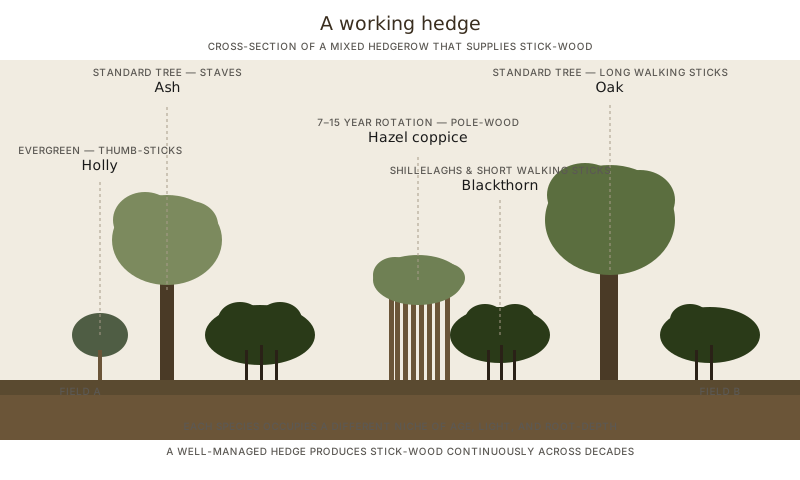
The Welsh walking-stick tradition occupies a distinctive niche within the broader British and Irish stick world. Where the canonical Irish tradition centres on blackthorn-and-shillelagh, and the canonical Scottish tradition centres on the Highland thumb-stick, the canonical Welsh tradition centres on the shepherd’s crook — the curved-handle working stick used historically by Welsh hill shepherds and developed through generations of working-stock tradition into the substantial modern craft register.
This page is the Welsh regional cluster. For the broader Welsh stick-tradition history, see The Welsh stick tradition. For the shepherd’s-crook form specifically, see The shepherd’s crook. For regional identification, see Regional stick styles of Britain.
Quick reference
| Canonical forms | Shepherd’s crook (the centre of the tradition); working hill stick; hand-stick |
| Canonical working woods | Hazel (the workhorse); ash for hill staves; holly for fine pieces; occasional thorn |
| Regional centres | Snowdonia (north Wales); Brecon Beacons (south Wales); Welsh borders |
| Competition culture | Royal Welsh Show; substantial agricultural-show participation across regional shows |
| Working register | Hill-farming working tradition centred on substantial sheep-farming economy |
| Modern community | Active community across hill-farming Wales; substantial agricultural-show participation |
The shepherd’s crook — Wales’s canonical contribution
The shepherd’s crook is the substantial Welsh contribution to the broader British and Irish stick-form vocabulary. The form features:
- A curved handle (the crook proper) at the head, traditionally shaped from naturally-grown crook stems or steam-bent for the curve
- A working shaft below the crook, typically 36-42 inches total stick length
- A pointed or rubber-tipped ferrule for hill use
- Working-grade construction prioritising durability over decoration
The crook handle serves multiple functions:
- Hooking sheep — the canonical working use; the shepherd hooks the crook around a sheep’s neck or leg for handling
- Hill-walking support — the curved handle provides a secure grip and can hook over rocks or fences for momentary support
- Defensive register — within reasonable working tradition, the crook’s substantial mass can serve defensive function
For the full shepherd’s-crook treatment, see The shepherd’s crook.
North Welsh tradition
North Wales — particularly Snowdonia, Gwynedd, and the broader north-western hill country — has substantial working stick tradition centred on:
Substantial shepherd’s-crook production — north Welsh working makers produce crooks for working shepherds and (increasingly) for the craft market
Hazel-tradition working — north Welsh hazel populations supply substantial working stock; hazel hand-sticks and lighter walking sticks are a substantial regional product
Ash hill staves — for serious hill-walking use in the Snowdonia mountains; comparable to English Lake District tradition
Holly fine pieces — north Welsh holly working sits in similar register to Scottish Highland holly tradition
Welsh-language working culture — substantial portion of north Welsh working makers operate in Welsh-language working context
South Welsh tradition
South Wales — particularly the Brecon Beacons, the Black Mountains, and the upland farming areas of Powys and Carmarthenshire — has working stick tradition centred on:
Hill-farming working tradition — substantial sheep-farming economy supports working-stock supply
Royal Welsh Show competition culture — the Royal Welsh Show at Builth Wells is the centre of gravity for south Welsh competition stick-making
Welsh borders working — Powys and Monmouthshire makers sit in tradition close to English Welsh-Border working culture
English-language working culture — south Welsh working makers more typically operate in English-language context though Welsh-language working continues in many communities
Royal Welsh Show competition culture
The Royal Welsh Show (held annually at Builth Wells, Powys) is the principal Welsh agricultural-show venue for stick-making competition. The Show’s stick-making categories attract substantial entries from Welsh makers and from cross-tradition British entries.
Competition categories typically include:
- Working shepherd’s crook — the canonical Welsh competition category
- Fancy shepherd’s crook — show-grade crook work with substantial decoration
- Carved-head walking stick — substantial carved-handle work in the Welsh tradition
- Plain walking stick — working-grade pieces
- Thumb-stick — Welsh version of the Scottish-tradition form
- Hand-stick — short working aids
The Royal Welsh Show competition is a substantial driver of Welsh maker activity and a focus of the craft community calendar.
The hill-farming working register
Welsh stick-making is uniquely tied to substantial working hill-farming culture. Unlike Irish or Scottish traditions where the working register has substantially declined as rural working economies shifted, Welsh stick-making maintains substantial connection to:
- Working shepherds who genuinely use crooks for sheep work
- Hill-farming families maintaining multi-generational stick-making within working farming households
- Welsh-language working culture preserving working terminology and conventions
- Agricultural-show culture integrated with broader Welsh rural-life calendar
The working register isn’t nostalgic; it’s substantially current in the Welsh hill-farming context. A Welsh working crook commissioned today is genuinely used for sheep work as well as for cultural register.
Regional makers
Modern Welsh working makers are a substantial active community:
- Snowdonia makers — particularly around Gwynedd; specialty shepherd’s-crook and hill-stick production
- Brecon Beacons makers — substantial Royal Welsh Show competition participation
- Welsh-border makers — Powys, Monmouthshire; cross-tradition working with English Welsh-Border conventions
- South-west Welsh makers — Carmarthenshire, Pembrokeshire; smaller but consistent community
- North-east Welsh makers — Wrexham, Flintshire; smaller community closer to English Cheshire tradition
The journal does not currently maintain a recommended-makers list for Welsh tradition. The British Stickmakers Guild membership directory and the Royal Welsh Show competition records are the standard starting points for buyers wanting to identify working Welsh makers.
Connections to other traditions
The Welsh stick tradition connects to:
English tradition — substantial cross-tradition exchange particularly with English Welsh-Border counties (Shropshire, Hereford, Gloucestershire). See Regional stick styles of Britain and England.
Scottish tradition — both Welsh and Scottish traditions emphasise crook handles for hill use; substantial overlap in working conventions. See Scotland.
Irish tradition — close cultural-historical exchange across the Irish Sea; some folkloric register and tradition vocabulary shared. See Ireland.
Patagonian Welsh tradition — substantial Welsh-tradition Patagonian community (the Y Wladfa community in Argentine Patagonia, established from 1865) maintains some Welsh stick-making register; specialist niche but real cultural connection.
Reading order
For a reader new to the Welsh stick tradition:
- The Welsh stick tradition — broader historical context
- The shepherd’s crook — the canonical Welsh form
- Hazel and Ash — canonical Welsh working woods
- Holly — fine-pieces Welsh tradition
- Regional stick styles of Britain — comparative regional identification
- Irish vs Scottish vs Welsh sticks — comparative four-region context
A note on coverage
The Welsh stick tradition is substantial and currently working. The journal welcomes contributions from working Welsh makers (particularly Royal Welsh Show competitors and hill-farming-community makers), from Welsh agricultural-show judges, and from Welsh-language working-tradition specialists. Working corrections and additions improve the regional cluster coverage.
Sources & further reading
- Royal Welsh Show — stick-making competitions, Royal Welsh Agricultural Society
- British Stickmakers Guild, British Stickmakers Guild
- National Hedgelaying Society — Welsh regional styles, National Hedgelaying Society
- Welsh Government — rural craft heritage, Welsh Government
Related reading
- historyThe Welsh stick tradition
Ash, the shepherd's crook, the sheepdog handler's stick, and the agricultural-show culture that has kept the Welsh stick-making alive at a working scale.
- woodsHazel
The coppice wood par excellence — light, springy, abundant, and with the longest unbroken folk-tradition of any British or Irish tree.
- woodsAsh
The springy, impact-resistant wood of staves, tool handles, and the Irish hurling stick — and the species now in the middle of a Europe-wide health crisis.
- woodsHolly
The pale-wooded thumb-stick tree of Scotland and Wales — and the harder-than-oak hedgerow shrub that sometimes turns up in Irish work too.