Escrima, arnis, and kali
The Filipino paired-stick martial-arts tradition — rattan in training, kamagong in earnest, and one of the most distinctive stick-and-stave practices in the world.
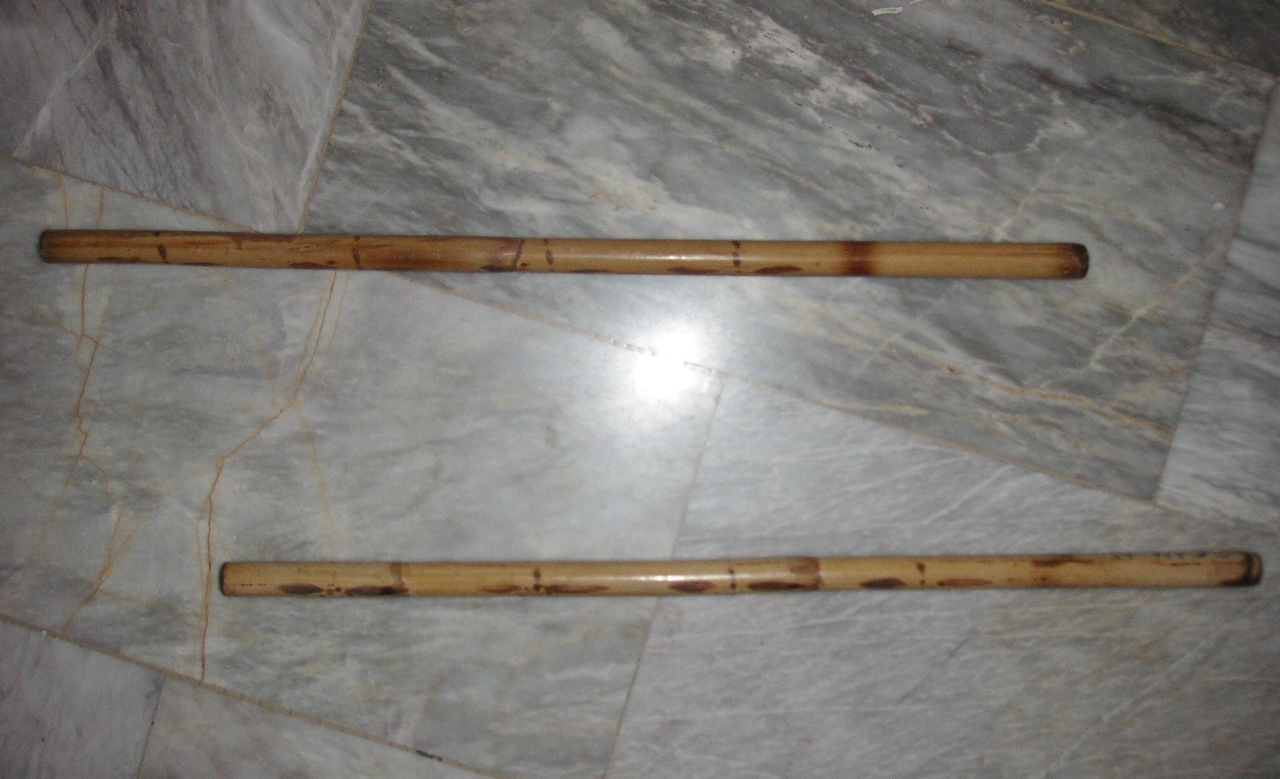
Escrima, arnis, and kali are three names — overlapping but not identical — for the Filipino martial-arts tradition centred on paired-stick combat. The form is internationally distinctive: the canonical training stick is rattan, the canonical length is 26 to 28 inches, the canonical configuration is paired (one stick in each hand) rather than single, and the canonical pace of practice is fast — substantially faster than most Western or Japanese stick arts. A skilled escrima player executes flowing two-handed combinations at a tempo that, to a Western eye unfamiliar with the practice, can look closer to dance than to combat.
The Filipino practices are also one of the more thoroughly-globalised stick arts of the modern era. The twentieth-century Filipino diaspora carried escrima, arnis, and kali to the United States, Australia, Britain, and across continental Europe; the form’s influence on Bruce Lee’s jeet kune do (via Dan Inosanto, see below) gave the practice substantial visibility in the global martial-arts community; and the Republic of the Philippines has, since 2009, recognised arnis as the national martial art and sport.
For a reference page in a journal centred on British and Irish walking-stick traditions, the Filipino arts deserve careful treatment because they sit at a different cultural register entirely from anything Western: the stick is not a walking aid extended into combat use (the British-Isles pattern), it is a weapon that has acquired training and ceremonial registers, and the working tradition is correspondingly different.
Quick reference
| Names | Escrima (Spanish-influenced); arnis (Spanish-influenced, from arnés); kali (Cebuano-influenced, possibly from kalis meaning “blade”) |
| Region of origin | The Philippines, particularly Cebu (escrima centre) and broader Visayas/Luzon |
| Form | Single stick (solo baston) or paired sticks (doble baston); also empty-hand (panantukan) and blade (solo espada) within the broader curriculum |
| Stick length | 26–28 inches (66–71 cm) for the standard training stick; some lineages use shorter (24 inches) or longer (30 inches) variants |
| Stick diameter | ~25–28 mm |
| Primary training material | Rattan — typically palasan (Calamus merrillii) or sega (Calamus caesius) |
| Hardwood material | Kamagong (Philippine ironwood, Diospyros philippensis) for live-blade-equivalent training and presentation |
| Modern status | Republic Act No. 9850 (2009) — Philippine national martial art and sport |
The terminology
The three names are not exact synonyms. The cultural and regional patterns are:
Escrima (also spelled eskrima) — derived from the Spanish esgrima, meaning “fencing”, and the canonical name in the Visayan region of the central Philippines, particularly Cebu. The Spanish-derived terminology reflects the practice’s exposure to Spanish swordsmanship during the colonial period (1565–1898), and the technique vocabulary in escrima retains many Spanish-language terms. The most internationally-known escrima lineage is Doce Pares (“Twelve Pairs”), founded in Cebu in 1932.
Arnis (sometimes arnis de mano, “arnis of the hand”) — also Spanish-derived, from arnés meaning “armour” or “harness”, and the canonical name in the Tagalog-speaking northern and central Philippines. Arnis is the term used in Republic Act No. 9850 (2009) declaring the practice the national martial art, and it is the more politically-recognised name in modern Philippine usage. Modern Arnis, founded by Remy Presas in the 1950s and exported widely through the global Filipino diaspora, is the most internationally-known arnis lineage.
Kali — a more recent term, of disputed but probably indigenous Philippine origin (possibly from Cebuano kalis, meaning “blade”). The term came into wide international use through the 1970s and 1980s, particularly via Dan Inosanto’s expression of the Filipino arts in Los Angeles. Kali is sometimes used as an umbrella term for the entire Filipino martial-arts tradition, sometimes for a specific subset emphasising blade work, and sometimes as a deliberately pre-colonial alternative to the Spanish-derived escrima and arnis names.
The three terms in modern global usage often refer to overlapping but distinguishable practices:
- A practitioner trained in Cebu under a Doce Pares lineage will typically self-identify as an escrimador
- A practitioner trained in the Modern Arnis lineage in Manila will typically self-identify as an arnisador
- A practitioner trained in the Inosanto lineage internationally will typically use kali
- Many modern instructors use all three terms interchangeably, particularly when teaching mixed-lineage curricula in the Western martial-arts world
The political register of the names also matters. The Philippine government’s 2009 declaration uses arnis specifically; some Filipino practitioners regard kali as a foreign-influenced re-naming and prefer the older Spanish-derived terms; some regard escrima and arnis as colonially-tainted and prefer kali. None of the positions is universal, and respectable practitioners disagree on the question.
The form
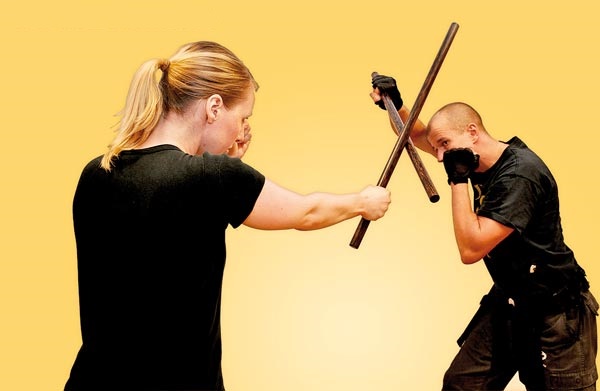
The defining feature of the Filipino arts, distinguishing them from most other stick traditions, is the paired stick. Doble baston — two sticks, one in each hand, used together in symmetric or asymmetric combinations — is the signature configuration, and the kata, drills, and sparring patterns of the form are largely structured around two-handed work.
A canonical practice session for a beginner might start with single-stick (solo baston) basics — twelve numbered angles of attack, each with corresponding defensive responses, drilled at slow speed against a partner’s similar attack — before progressing to paired-stick (doble baston) work, where both hands are armed. The paired-stick configuration enables techniques that single-stick cannot — simultaneous high-and-low attack, simultaneous block-and-counter, complex two-handed traps and disarms — and the body mechanics of two-handed armed practice are, the lineages argue, more readily transferable to empty-hand and blade contexts than single-stick basics.
The technical vocabulary is large. Common elements include:
- The twelve angles — a numbered system of attack lines (high left to low right, etc.) that organises both offence and defence in most lineages, though the exact numbering varies by school
- Sinawali — a category of weaving patterns where the two sticks alternate in a continuous flowing movement, both as a solo-practice flow drill and as the basis for partnered work
- Largo mano — long-range stick work, where the practitioners stay outside grappling range
- Corto — close-range work, including disarms, joint locks, and the transition into empty-hand grappling
- Hubud-lubud — a flowing trap-and-counter drill that is one of the form’s signature partner exercises
- Espada y daga — sword-and-dagger configuration; a rattan stick in the lead hand and a shorter knife (or knife-substitute) in the off hand
The pace is fast. A skilled escrimador in flow drill can execute eight to twelve stick-strikes per second; a freestyle sparring exchange between two well-trained players can include hundreds of contacts in a minute. This is part of why the practice is associated with high-tempo “stick-dancing” appearance from the outside, and part of why partner safety in escrima depends so heavily on the rattan material specifically.
The materials
The choice of stick material is central to the practice. The canonical pattern is:
Rattan for training — the working stick of escrima/arnis/kali is rattan, almost exclusively. The principal species is palasan (Calamus merrillii), a large climbing palm native to the Philippines, supplying the stick trade with stems of suitable diameter (~25–28 mm) and length (cut to 26–28 inches plus working margin). Lesser quantities of sega rattan (Calamus caesius) and other species enter the broader supply, and the timber trade often does not distinguish between species at the retail level — a “rattan stick” sold to a Filipino school in California may be any of several Calamus species, depending on what the supplier had at hand.
The reasons rattan dominates training are practical: rattan is light (much lighter than the equivalent hardwood), flexible (it absorbs impact through the fibrous palm structure rather than transmitting it shock-wise to the wielder’s hand or to the partner’s body), and safe under fast partner contact (it bruises rather than breaks; it splays its fibres at the impact point rather than fracturing across the grain). A skilled escrima pair training at full speed can exchange contact-strikes at twenty to forty per second using rattan without injury; the same exchange with hardwood would be hospital-grade.
The rattan shaft is typically smooth-finished for partner practice — bark removed, surface sanded smooth, sometimes oiled. Some training systems prefer the bark-on form (closer to the natural stem character), and at advanced levels some lineages train with rattan that has been deliberately split or partly-frayed at the contact end to provide tactile feedback.
Kamagong for blade-equivalent work — kamagong (Diospyros philippensis), the Philippine ironwood, is the canonical Filipino hardwood for sticks intended to substitute for live blade in solo practice or for advanced demonstration work. Kamagong is enormously dense (~1,000+ kg/m³), nearly black in colour, takes a glassy polish, and is dimensionally stable. A kamagong stick in the hand is substantially heavier than rattan, behaves more like a blade in motion, and is reserved for solo practice, demonstration, and the highest-level partner work where both partners are competent at controlling contact.
Bahi — palm-trunk hardwood, used in some lineages as an intermediate-density material between rattan and kamagong. Less common internationally than the two principal materials.
Some lineages and individual practitioners use hickory (see Hickory), particularly in the United States diaspora, where local hardwood supply favours American species over imported Philippine ones. Hickory is heavier than rattan but more similar in density to kamagong, and the substitution is workable but not strictly traditional.
For the rattan-vs-bamboo distinction (a common source of confusion among Western viewers), see Malacca cane and Bamboo — Filipino arnis is rattan, not bamboo.

The history
The Filipino stick-fighting traditions predate the Spanish colonial period (which began with Miguel López de Legazpi’s 1565 expedition) by an indeterminate but substantial margin. Pre-colonial Filipino warfare drew heavily on edged weapons — the kris, kampilan, and various blade forms documented in Spanish chronicles from the 1570s onward — and the stick-and-blade traditions of the modern arnis curriculum descend in part from these pre-contact martial practices.
During the Spanish colonial period (1565–1898), several factors shaped the surviving practice:
Suppression and concealment. Spanish colonial authorities periodically prohibited the public practice of indigenous martial arts, particularly with edged weapons. The traditional account, well-attested in modern Filipino martial-arts oral history, holds that some practices survived disguised as folk dances — particularly the moro-moro dance-dramas, where the choreographed combat between Christian and Moro characters incorporated genuine fighting movements within the apparent theatrical context. The exact extent to which this concealment shaped the surviving curriculum is debated by serious historians, but the broad pattern of “fighting tradition surviving inside dance form” is well-documented.
Spanish vocabulary infusion. The Spanish-language military and fencing terminology that entered Filipino martial-arts vocabulary — escrima, arnis, largo, corto, espada, daga, the names of the twelve angles in some lineages — dates from this period. The terminology is now fully naturalised in Filipino practice, but its origin is colonial.
Synthesis with Spanish blade-arts. Spanish esgrima (rapier and sabre fencing) influenced Filipino practice during the long colonial centuries, and several modern arnis lineages preserve techniques and concepts that are clearly Spanish-derived. The synthesis is integral to the form rather than a removable colonial overlay.
The American colonial period (1898–1946) and post-independence era saw the formalisation of the practice into modern lineages, the establishment of named schools, and the beginnings of international export. Key figures include:
- Lorenzo Saavedra and the broader Doce Pares founders in Cebu (1932) — formalising the Cebuano escrima tradition
- Remy Presas (1936–2001), founder of Modern Arnis — a synthesis lineage that became one of the most internationally-taught Filipino styles
- Antonio “Tatang” Ilustrisimo (1904–1997), preserver of the Kalis Ilustrisimo blade-and-stick lineage
- Dan Inosanto (born 1936), Bruce Lee’s training partner and the principal vector for Filipino arts entering the global martial-arts mainstream from the 1970s onward
- Leo Giron (1911–2002), who taught the Bahala Na lineage in Stockton, California, to many of the second-generation American Filipino-arts community
The Pekiti-Tirsia Kali lineage (preserved through the Tortal family) and the Lameco lineage (synthesised by Edgar Sulite from multiple Filipino sources) are also internationally-significant modern lines.
The modern competitive sport
Modern competitive arnis is governed internationally by the World Eskrima Kali Arnis Federation (WEKAF) and several other international bodies. The competitive format typically involves:
- Padded armour (head, body, and limb protection, similar to kendo bogu but adapted for stick contact)
- Padded rattan sticks (with foam covers for full-contact safety)
- Single-stick or paired-stick categories
- Point scoring based on clean strike-and-control, with disqualifications for excessive force or unsafe technique
The competitive practice is one register of modern arnis but not the only one; many practitioners train within traditional lineage curricula without ever entering competition, and the full curriculum (including blade work, empty-hand, and grappling elements) is broader than the competitive ruleset captures.
Republic Act No. 9850 and national status
In 2009, the Philippine government enacted Republic Act No. 9850, declaring arnis the national martial art and sport of the Republic of the Philippines, mandating its inclusion in the school curriculum, and providing for its institutional development. The act is the formal recognition of a status that the practice already had in the cultural register; it has substantial implications for the form’s institutional support, teacher accreditation, and the place of arnis in Filipino national identity.
The recognition is also a contested act in the international Filipino-arts community. Some practitioners welcomed the formal status; some argued that arnis (the Tagalog/Manila-influenced term) was being privileged over escrima (the Cebuano/Visayan term) and kali (the indigenous-revival term); some objected to the centralising effect on a practice that has historically been organised around regional and family lineages rather than national federation.
Compared with other stick martial arts
The Filipino arts against the other major stick-and-stave traditions:
- Against Japanese bojutsu (see The bo staff): Filipino arts are paired and fast; bojutsu is single and codified. Materials differ (rattan vs white oak), pace differs (very fast vs deliberate), partner contact differs (heavy vs light at most levels).
- Against jodo and hanbo (see The jo and hanbo): Filipino length (~70 cm) is closer to hanbo (~91 cm) than to jo (~128 cm). Practice configuration completely different.
- Against single-stick (see Single-stick): the lost English martial art has structural similarities to Filipino solo-baston work but uses ash rather than rattan, fences-style stance rather than Filipino mobile footwork.
- Against canne de combat (see Canne de combat): the French tradition is closer to Filipino in tempo than the English single-stick; both are fast, light, and use a stick in the cane register rather than a heavy stave.
- Against Irish bataireacht (see Bataireacht): the Irish tradition uses heavier blackthorn at substantially slower tempo, with a one-handed grip configuration that has more in common with sabre fencing than with Filipino paired-stick.
For the regional context
The cluster page on the Philippines covers the broader cultural, geographical, and historical setting of Filipino stick traditions: see Philippines. The material-culture context (rattan vs bamboo, Filipino hardwoods including kamagong and bahi) is in Bamboo and Malacca cane.
Corrections from working escrima/arnis/kali instructors, particularly on lineage history and on the terminology debates, are welcome.
Sources & further reading
- Wiley, M. (1994) — Filipino Martial Culture, Tuttle / WorldCat
- Inosanto, D. & Foon, G. (1980) — The Filipino Martial Arts, Know Now / WorldCat
- World Eskrima Kali Arnis Federation (WEKAF), WEKAF International
- Republic Act No. 9850 — Arnis as the Philippine national martial art and sport (2009), Official Gazette of the Republic of the Philippines
- International Modern Arnis Federation Philippines (IMAFP), IMAFP
Related reading
- woodsBamboo
Not a wood at all but the stick-material of half the world: a giant grass that grows a finished culm in three to five years and underpins the entire East Asian stick tradition.
- woodsMalacca Cane: The Victorian Gentleman's Walking Stick
The colonial-era gentleman's cane material — a climbing palm, not a tree, and a solid rattan, not bamboo.
- comparisonsWalking stick vs walking cane vs trekking pole
Three different objects for three different use cases — and the terminology to keep them straight when you're buying one.