Bamboo
Not a wood at all but the stick-material of half the world: a giant grass that grows a finished culm in three to five years and underpins the entire East Asian stick tradition.
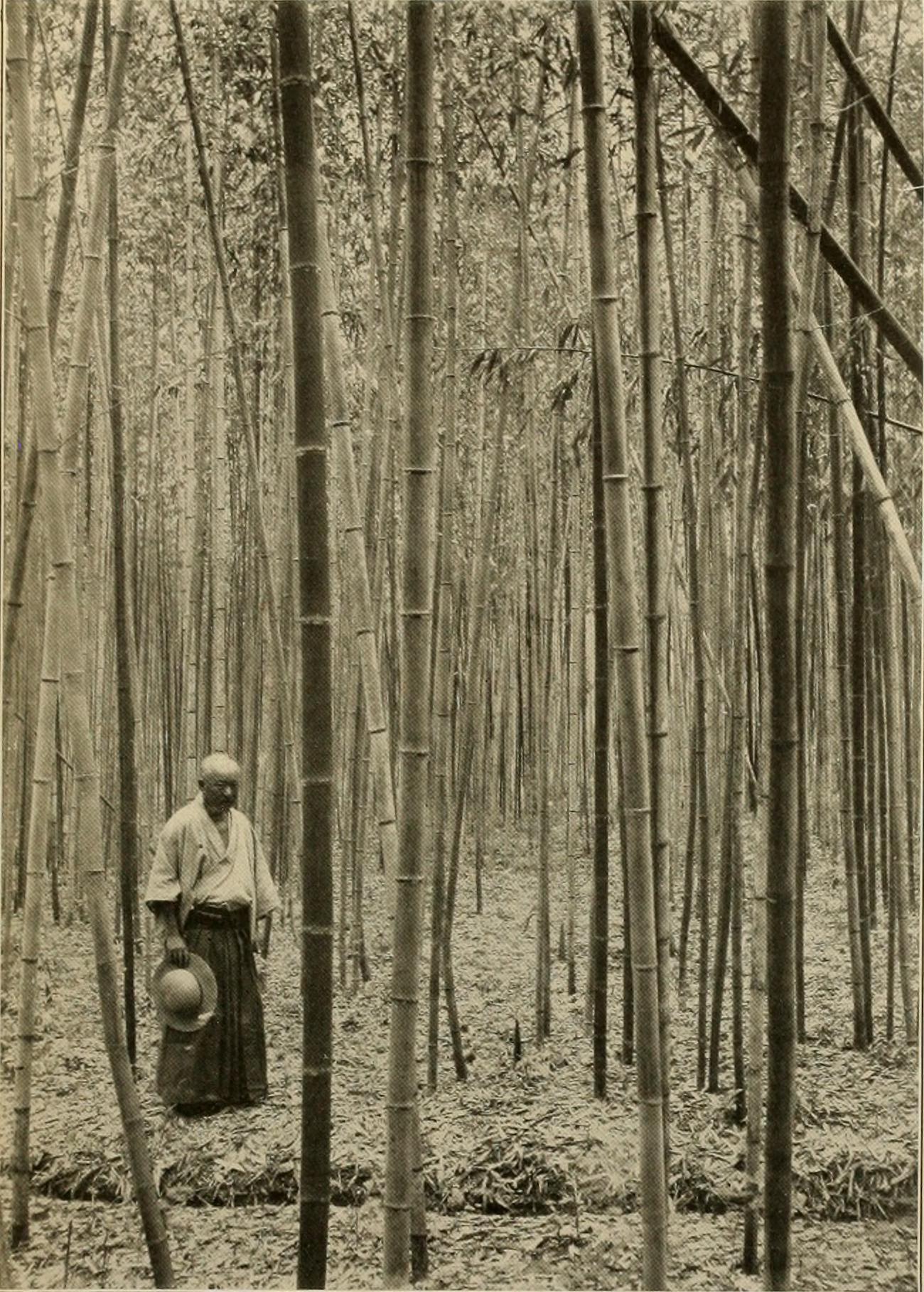
Bamboo is not a wood. It is a giant grass — botanically Bambusoideae, a subfamily of Poaceae — that produces, instead of a solid trunk, a hollow segmented culm of vascular bundles arranged longitudinally in a thin parenchyma matrix. The result is a structural material that is, by weight, stronger in tension than steel and stiffer in compression than oak, growing at rates that no temperate hardwood can approach (some species put on a metre of height a day during peak growth).
For a publication oriented toward the slow-grown, hand-cut, three-year-seasoned blackthorn shillelaghs of the Irish hedgerow, bamboo is the antipodal stick material — fast, hollow, abundant, machine-cuttable, and the cultural property of half the world’s population. It is the wood (the not-wood) of the Japanese bo, jo, and hanbo staves; the shinai of kendo; the cane and walking-stick of working East Asia; the construction material that has built scaffolding for major buildings across Hong Kong, Singapore, and southern China; and the basket and craft material of the entire South-East Asian working economy.
A site that calls itself “The Walking Stick Journal” has to take bamboo seriously. This is the reference treatment.
Quick reference
| Common names | Bamboo (English); take 竹 (Japanese); zhú 竹 (Chinese); daenamu 대나무 (Korean) |
| Family | Poaceae (grasses) — subfamily Bambusoideae |
| Genus / species (stick-grade) | Phyllostachys edulis (moso), P. bambusoides (madake/timber bamboo), P. nigra (black/kuro-chiku), P. pubescens, Bambusa multiplex |
| Native range | Pan-tropical and warm-temperate; heavy concentrations in East Asia, South-East Asia, the Indian subcontinent |
| Habit | Giant grass, 5–25 m at maturity depending on species; clumping or running root systems; produces fully-formed culm in 3–5 years |
| Bark / sheath | Outer culm sheath (smooth, papery) sheds as culm matures; mature culm wall is the working material |
| Internal structure | Hollow segmented culm with nodes (solid divisions) and internodes (hollow tubes); culm wall thickness varies 5–20 mm |
| Flowers | Rarely seen — most species flower once every 50–120 years simultaneously across all individuals (mass flowering, then die-back) |
| Growth rate | Up to 1 m per day during peak shoot emergence; full culm height reached in a single season |
| Density | ~600–900 kg/m³ for working stick-grade species |
| Strength-to-weight | Tensile strength comparable to mild steel by weight; compressive strength comparable to oak by weight |
What bamboo is, structurally
Bamboo’s mechanical properties come from its culm structure. The culm is a hollow tube divided into segments by solid nodes at regular intervals; the wall of the tube is composed of vascular bundles (the structural fibres) running longitudinally through a softer parenchyma (the structural filler). The vascular bundles are unevenly distributed: denser toward the outer surface of the culm wall, sparser toward the inner surface.
This produces a material with anisotropic properties — strong along the length of the culm (longitudinal direction), much weaker across the culm (radial and tangential directions). A bamboo stave, properly oriented, is exceptionally strong and stiff for its weight; the same piece of bamboo split radially is comparatively weak. This is the central mechanical fact about working with bamboo, and it is why traditional craft uses orient the culm carefully and avoid cutting across the grain in load-bearing applications.
The nodes are the structural reinforcement — solid wood-like divisions every 20–60 cm along the culm — that prevent the hollow tube from collapsing under bending. The internodes are essentially hollow cylinders. The combination is, for many engineering purposes, exactly the structure a designer would arrive at if asked to create the maximum-strength, minimum-weight column for a given span.
The species
Bamboo is enormously diverse — over 1,500 species across the Bambusoideae — but a small number dominate the stick-grade timber trade.
Moso (Phyllostachys edulis) is the most economically important timber bamboo in the world. Native to China, widely cultivated across East Asia and parts of the Americas. Reaches 20+ metres at maturity, with culm walls 1–2 cm thick. The standard wood (not-wood) for bamboo flooring, scaffolding, and many martial-arts staves at the working price-point.
Madake (Phyllostachys bambusoides, “timber bamboo”) is the traditional Japanese stave wood. Slightly denser than moso, with a more uniform internode length, and the species most associated with high-end bo and jo staves. The Japanese term takezao (竹竿, “bamboo pole”) in martial-arts contexts usually implies madake.
Kuro-chiku (Phyllostachys nigra, black bamboo) develops a naturally near-black culm surface as it matures (over 2–4 years). Less dense than moso; less suited for impact-bearing martial-arts staves; preferred for decorative walking sticks, calligraphy brush handles, and tea-ceremony equipment.
Bambusa multiplex is a clumping (sympodial) species rather than a running (monopodial) one, common in landscape use across the southern United States and Mediterranean. Less common as a stick wood than the Phyllostachys species.
Other species of regional importance include Dendrocalamus giganteus (giant bamboo, used in southern Asia for poles up to 30 m), Phyllostachys pubescens (a timber-grade species in China overlapping with moso), and Guadua angustifolia (the New World stave bamboo, used extensively in Colombia, Ecuador, and Peru).
For a stick-buyer, the practical takeaway: most working bamboo staves and sticks are moso or madake unless the maker says otherwise. The naturally-black register is kuro-chiku.
Where it grows and how fast
Bamboo’s defining ecological feature is its growth rate. A Phyllostachys edulis shoot, emerging from the ground in spring after a winter of underground rhizome activity, can put on up to a metre of vertical height in 24 hours during peak growth. The full mature height of a 20-metre culm is reached in a single season — typically two to three months from emergence. After that, the culm does not grow taller; it grows in wall-thickness, density, and silica content over the following three to five years until it reaches working maturity.
This is fundamentally different from temperate hardwoods. An oak takes 80–150 years to reach working size. A blackthorn takes 25–50. A bamboo takes three to five. The supply economics are entirely different, and the resulting working culture — short cycles, mass-managed groves, predictable annual harvest — bears no resemblance to the small-batch hedgerow stick-cutting of the British and Irish tradition.
The major commercial growing regions:
China — by far the largest producer, with several million hectares of managed bamboo forest, particularly in the southern provinces (Sichuan, Yunnan, Jiangxi, Hunan, Fujian). Most global moso bamboo flooring originates here.
Japan — substantial domestic cultivation; many traditional martial-arts and craft uses depend on Japanese-grown madake. Bamboo cultivation in Japan has declined since the 1970s as cheaper imports replaced traditional uses.
India and South-East Asia — major producers across Vietnam, Indonesia, the Philippines, Myanmar, and Thailand. South-East Asian bamboo is more often used for construction, scaffolding, and craft than for martial-arts staves.
The Americas — Guadua in South America (especially Colombia); modest cultivation of Asian species in the southern United States. Bamboo is not a North American native at scale.
Africa — limited commercial cultivation; some traditional use in eastern and central Africa.
Cultural traditions: the East Asian stick world
Bamboo is the central stick-material of East Asian martial-arts and walking traditions. The principal stick-forms made from it:
The bo (棒)
The Japanese long staff, traditionally six shaku (about 1.82 m / 72”) in length, used in bojutsu and the Okinawan martial-arts traditions that became karate. The standard bo is white oak (kashi) for high-end work and bamboo for training and lower-cost production; both are in active use. A bamboo bo is lighter and more forgiving in partner practice; an oak bo is heavier and used in advanced study.
The jo (杖)
The Japanese medium staff, four shaku (about 1.27 m / 50”) in length, used in jodo and aikido. Less commonly bamboo than the bo — most working jo are oak — but bamboo jo exist and are used in some training contexts.
The hanbo (半棒)
“Half-staff” — three shaku (about 91 cm / 36”), used in some classical Japanese arts. Bamboo hanbo exist; oak is more common for serious practice.
The shinai (竹刀)
The split-bamboo training sword of kendo. Constructed from four longitudinal staves of bamboo bound at intervals with a cord-and-leather assembly. The shinai is the canonical bamboo stick-form in Japanese martial-arts: lightweight, flexible, designed for full-contact partner practice without the lethality of a wooden bokken or steel katana. Standard adult shinai is about 1.18 m long.
A modern shinai is a piece of finely-tuned mass production: the four staves are individually selected for grain orientation, planed to a consistent profile, bound with calibrated tension. The Japanese All-Japan Kendo Federation maintains formal specifications; competition-grade shinai are produced in Japan, Korea, and increasingly mainland China at substantial scale.
Walking sticks and canes
In China, bamboo walking sticks have a continuous tradition reaching back to the Han dynasty. The cultural register is closer to the British walking stick (an everyday tool for older users) than to the Western ceremonial cane. Bamboo’s lightness makes it particularly suitable for users who would find a hardwood stick fatiguing.
In Japan, the bamboo walking-stick tradition overlaps heavily with the tea-ceremony tradition, with naturally-curved or naturally-knotted kuro-chiku (black bamboo) culms prized for the visual interest the imperfections provide. Tsue (杖, walking stick) is the general Japanese term.
Filipino arnis / escrima / kali
The Filipino martial-arts tradition uses rattan (a different plant — climbing palms in the Calamoideae subfamily, not bamboo) more than bamboo for paired-stick practice, though bamboo training sticks are sometimes used for lower-cost work. Rattan’s solid (not hollow) cross-section gives it different mechanical properties from bamboo. The Filipino traditions deserve their own dedicated treatment; for now see Walking cane — currently in preparation.
Cutting and seasoning
Bamboo cutting and seasoning bear no resemblance to temperate hardwood working.
Cutting is in late autumn through winter, when the culm has its lowest sugar content (sugar content during growing season attracts insects, particularly powderpost beetles, that destroy unprotected bamboo). Mature culms — typically 3–5 years old — are selected for cutting; younger culms have not developed sufficient wall thickness or fibre density.
Seasoning is faster than for hardwood — typically 2–6 months for stick-grade culms — but requires specific protective treatments to prevent insect damage and fungal staining. The traditional Asian methods include:
- Soaking in flowing water for two to four weeks, which leaches sugars from the culm and substantially reduces insect attractiveness
- Smoking over a low fire, which deposits creosote and other antimicrobial compounds in the culm wall
- Boiling in a borax or lime solution, which kills active insect larvae and cures the surface
- Sun-drying in controlled conditions after one of the above treatments
Modern industrial bamboo for flooring and construction is treated with boric acid + borax solutions and kiln-cured at elevated temperatures. The chemistry differs from the traditional methods but the outcome is similar: bamboo that is dimensionally stable, insect-resistant, and ready for working.
The node-and-internode structure has practical implications for stick-making. A finished bamboo stave preserves the visible nodes — the regular dark rings every 20–60 cm along the length — as part of the visual character of the piece. The nodes are also the only points along the culm where the structure can be drilled, pinned, or fitted with hardware without compromising the longitudinal wall strength.
From culm to stick
A finished bamboo walking stick or stave is, in the working tradition:
- Cut from a mature culm (3–5 years old) at the base, well above the ground but typically near the lower nodes
- Trimmed to the desired length, usually with the cut placed at or near a node for end-strength
- Surface-finished by removing the outer waxy bloom (chiku-jakku, the silica-rich outer layer that gives a fresh culm its slick surface) with a careful planing or sanding
- Stained or scorched, in some traditions, to deepen the colour from the natural pale yellow-green to a richer honey-brown; the kuro-chiku species needs no such treatment
- Fitted with a foot (often a metal ferrule for walking sticks) and, if applicable, a handle (carved horn, leather wrap, or a simple fitted hardwood grip)
- Oiled or lacquered for preservation, with traditional Japanese pieces sometimes finished in urushi (Japanese lacquer) for a high-gloss durable surface
The result is a stick that is, hand-for-hand, between a third and half the weight of a hardwood equivalent. A bamboo bo at six feet weighs around 600–700 grams; an oak bo of the same dimensions weighs 1.2–1.5 kg. The difference is decisive for partner-practice martial-arts work and for users who fatigue on hardwood weight.
Beyond sticks
Bamboo’s working uses across global material culture are extensive, and stick-and-stave use is a small fraction of the total. The major non-stick uses:
Construction and scaffolding. Bamboo scaffolding remains the standard practice in southern China and Hong Kong for high-rise construction, with poles bound by nylon ties; a properly-erected bamboo scaffold has a higher load-bearing capacity per unit weight than steel equivalents, and can be erected and dismantled by hand without heavy equipment. The practice is gradually being regulated out of the modern building industry but remains active.
Flooring — moso bamboo flooring is now a mainstream global product, sold across hardware retailers from Tokyo to London to São Paulo. The wood (not-wood) is laminated into engineered planks that compete commercially with oak and walnut flooring at substantially lower price points and with different sustainability characteristics.
Paper — bamboo pulp paper, traditionally used in Chinese and Japanese calligraphy and woodblock printing, remains a small specialty trade.
Furniture and basketry — particularly in South-East Asia, the basketwork tradition is enormous and produces export goods at scale.
Edible shoots — young bamboo shoots are a substantial food crop across East and South-East Asia, particularly the Phyllostachys edulis (moso) shoots that are the major springtime vegetable in much of southern China.
Fishing rods, garden stakes, kite frames, fencing, ladder rungs, tea whisks, fan ribs, chopsticks — the long list of small-product uses is indicative of the material’s working position in East Asian everyday life.
Bamboo vs hardwood for sticks
The summary, for a Western reader trying to place bamboo in the broader stick world:
Hardwood (oak, ash, blackthorn, hickory) is dense, slow-growing, traditional in European and American working cultures. Sticks made from it are weighted, durable, expressive of the slow-craft tradition.
Bamboo is hollow, fast-growing, traditional in East and South-East Asian working cultures. Sticks made from it are light, fast, expressive of an entirely different relationship with the natural world — a material grown in three years, cut in volume, worked in volume, replaced when worn out without ceremony.
A reader oriented toward the British and Irish stick tradition who has never handled a bamboo stave is encouraged to do so. The hand-feel is genuinely different, and the difference reveals something about the cultural register each material brings. A blackthorn shillelagh and a Japanese jo are both wooden (in the broad sense) sticks of about three feet long; they are otherwise almost completely different objects, and the difference is more than aesthetic.
The fuller comparison of the Japanese stave-forms — bo, jo, hanbo — is at Bo vs jo vs hanbo, currently in preparation. The Japanese tradition treatment is at Japan, also in preparation.
This is a reference page. The Asian stick traditions deserve fuller treatment than the journal currently offers; the dedicated regional and form pages linked above are in preparation. Corrections from working makers in Japan, China, the Philippines, and the wider Asian sphere are particularly welcome at [email protected].
Sources & further reading
- Bambusoideae — Plants of the World Online, Plants of the World Online, Royal Botanic Gardens, Kew
- INBAR — International Bamboo and Rattan Organisation, INBAR
- David G. Fairchild, Japanese Bamboos and Their Introduction into America (1903), USDA Bureau of Plant Industry / Internet Archive
- Bamboo — wood properties, The Wood Database
- Donn F. Draeger, Classical Budo (1973), Weatherhill / WorldCat
Related reading
- woodsOak
The other Irish stick wood — older, heavier, and the source of the original Wicklow shillelaghs.
- woodsAsh
The springy, impact-resistant wood of staves, tool handles, and the Irish hurling stick — and the species now in the middle of a Europe-wide health crisis.
- woodsHickory
The American shock-wood: harder than ash, denser than oak, and the standard timber of axe handles, baseball bats, and the bo staffs of Western martial-arts practice.
- comparisonsHolly vs blackthorn vs oak vs ash
Four traditional stick woods, side by side: how they look, how they behave under the hand, and which one belongs in which kind of stick.