Hickory
The American shock-wood: harder than ash, denser than oak, and the standard timber of axe handles, baseball bats, and the bo staffs of Western martial-arts practice.
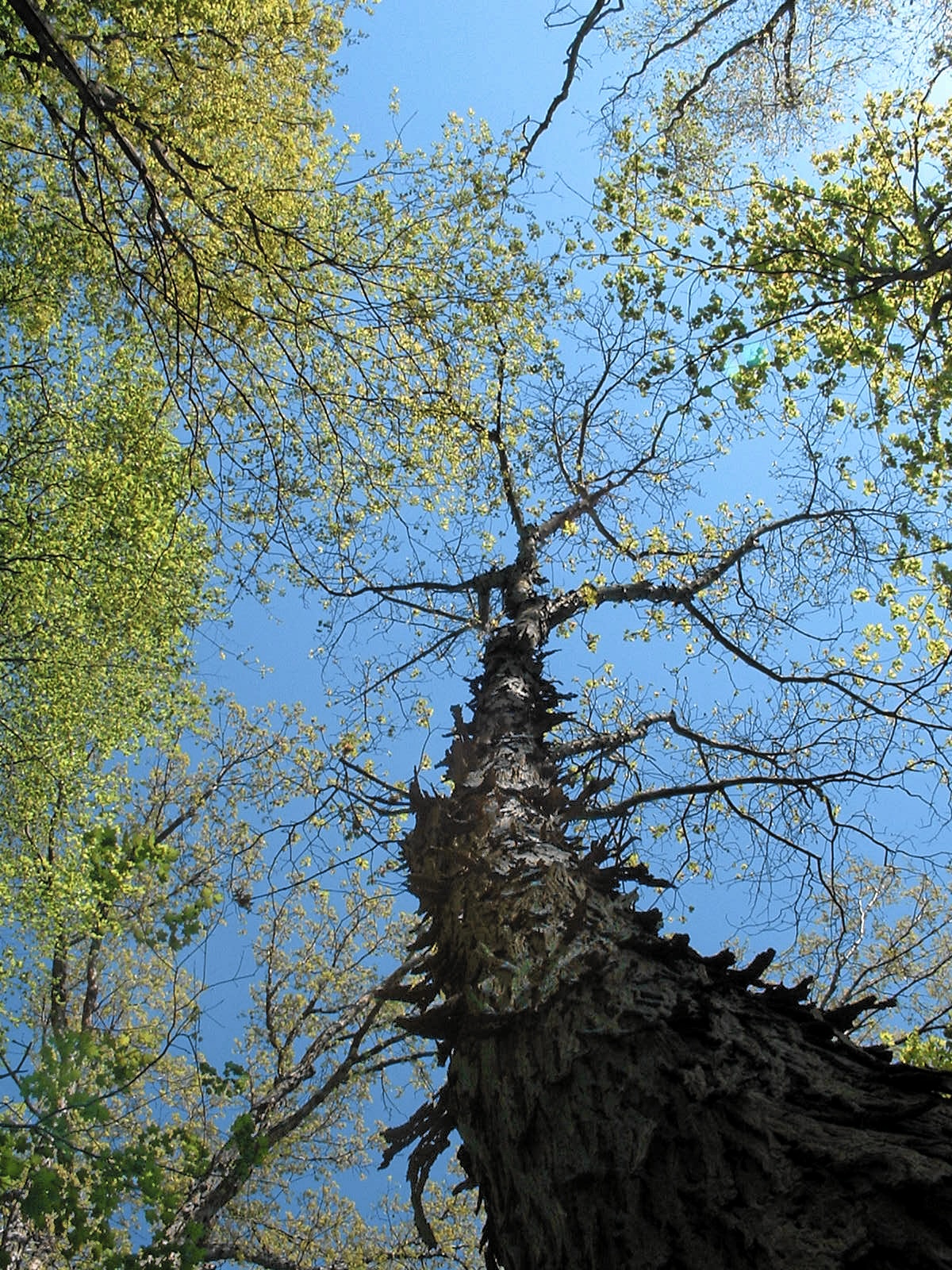
Hickory is the American shock-wood. It is, by Janka measure, harder than European ash and denser than European oak; it absorbs impact along the grain in a way that no British or Irish native timber matches; and it has been the working tool-handle wood of the eastern North American countryside for as long as records exist. For a publication mostly oriented toward British and Irish stick-making, hickory is the wood that opens the door to the broader American tradition — to the carved walking sticks of Appalachia, the bo and jo staffs of Western martial-arts practice, the baseball bats and axe hafts and pickaxe handles that shaped the working economy of the United States from the eighteenth century onward.
The wood is not subtle. It is the densest and hardest commercially-worked hardwood of the temperate American flora, its grain runs straight, and it does the work where lesser timbers fracture. A hickory walking stick at six feet is a different object from an ash one — heavier, stiffer, less forgiving, but tougher under sustained load — and a hickory bo staff in martial-arts practice is the standard against which substitutes are measured.
This is what the stick world needs to know about it.
Quick reference
| Common names | Hickory; shagbark, shellbark, pignut, mockernut, pecan, bitternut (eight or so North American species in regular commerce) |
| Binomial | Carya ovata (shagbark, the iconic species); C. glabra (pignut); C. tomentosa (mockernut); C. illinoinensis (pecan) |
| Family | Juglandaceae (walnut family) |
| Native range | Eastern North America (most species, from Quebec south to Texas); a few species in East Asia |
| Habit | Large deciduous tree, 18–30 m, occasionally to 40 m; long-lived (200–300+ years) |
| Bark | Distinctive — shagbark’s long peeling plates are diagnostic; other species smoother |
| Leaves | Pinnately compound, 5–11 leaflets, 20–60 cm long overall |
| Flowers | Wind-pollinated catkins, spring; nuts in autumn |
| Fruit | Nuts in thick green husks that split open at maturity; some species (notably pecan) produce edible nuts |
| Wood density | ~810–860 kg/m³ (shagbark, 12% MC) |
| Janka hardness | ~8,100 N for shagbark — among the hardest North American hardwoods in commercial use |
The eight or so species
“Hickory” is a genus, not a species, and the practical timber trade distinguishes between several recognised species. The principal ones for stick-making purposes:
Shagbark hickory (Carya ovata) — the iconic species, named for its long peeling bark plates, found across the eastern half of North America. Produces the densest and hardest of the commercial hickories, and is the species most often referenced in tool-handle and stick-making contexts.
Shellbark hickory (Carya laciniosa) — close to shagbark in working character; bark similarly peels but in larger plates. Uncommon in the timber trade compared to shagbark.
Pignut hickory (Carya glabra) — slightly lower density than shagbark; more common in the southern Appalachians; widely used for tool handles where shagbark is unavailable.
Mockernut hickory (Carya tomentosa) — medium density, leathery leaves, common across the southeastern United States. Often blended with other hickories in the timber trade.
Pecan (Carya illinoinensis) — yes, the same tree that produces the edible pecan nut. Wood is softer than shagbark but workable; mostly grown for the nut crop in modern commerce, with timber as a by-product.
Bitternut hickory (Carya cordiformis) — medium density, sulphur-yellow buds in winter (diagnostic), bitter nuts.
For most stick and stave purposes, the timber trade does not distinguish between the species in the way the botanical world does — “American hickory” in commercial nomenclature usually means a blend of shagbark, shellbark, mockernut, and pignut, with the actual species used depending on what the supplier had at the time. For high-end work — a serious bo staff or a competition baseball bat — shagbark specifically is preferred and named.
_(8435925524).jpg)
The plant
Hickory belongs to the walnut family — Juglandaceae — and shares the family’s compound pinnate leaves and large hard-shelled nuts. The trees are large, slow-growing, and long-lived; a mature shagbark hickory at thirty metres is a substantial canopy presence in the eastern North American hardwood forest, sharing the upper canopy with white oak and yellow birch in much of its range.
Three features identify a hickory in the field:
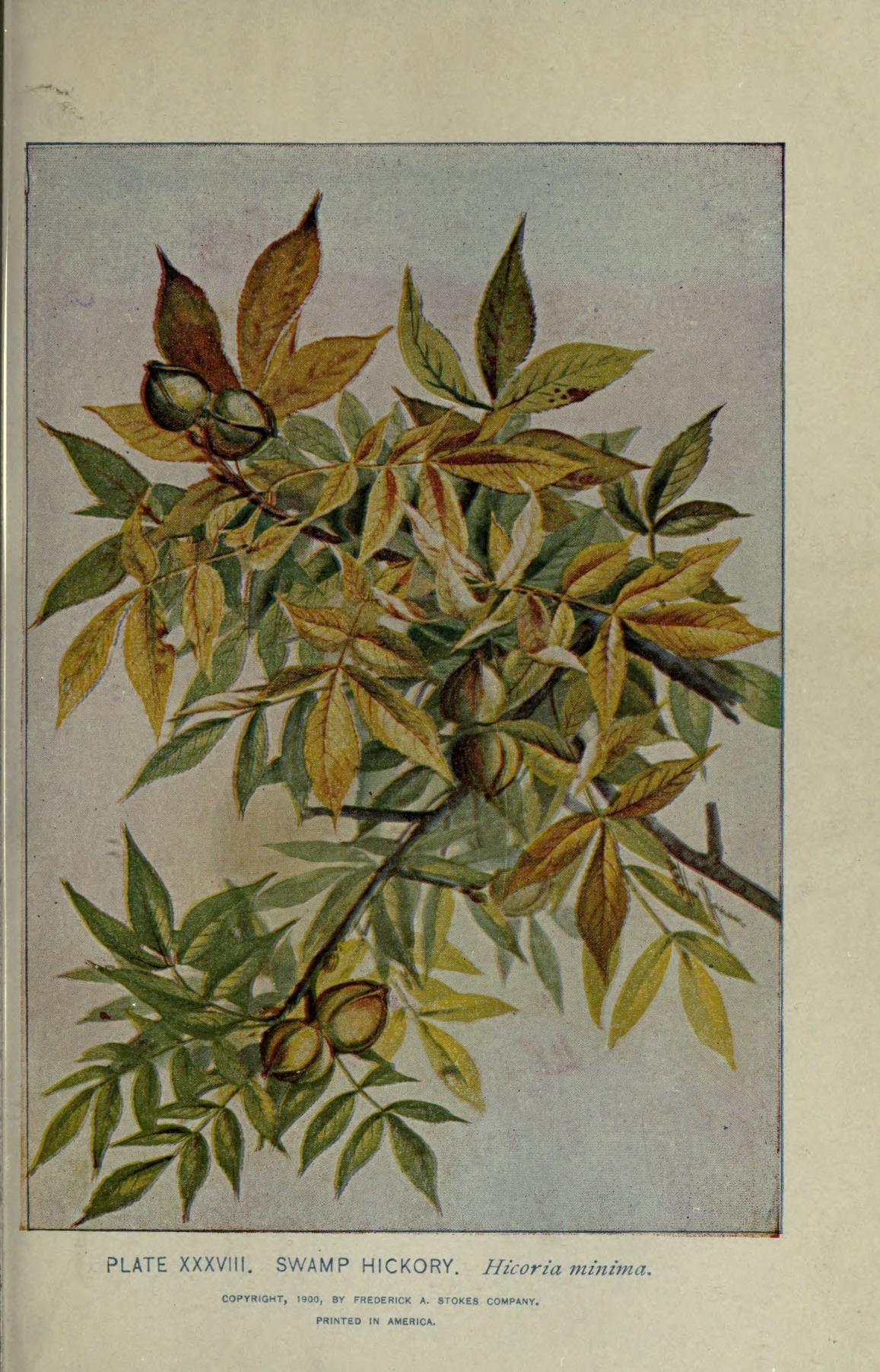
The pinnate compound leaves. Each leaf is 20–60 cm long with five to eleven lance-shaped leaflets along a central stalk. Hickories are easily confused with ash and walnut at first glance — all three have pinnate compound leaves — but hickory leaflets are typically larger, more strongly toothed, and the terminal leaflet is often noticeably larger than the lateral ones (an asymmetry not present in ash).
The bark, on shagbark specifically. The peeling plates of Carya ovata are unmistakable on a mature tree: long strips, twenty to forty centimetres in length, peeling at the top and bottom and arching outward, giving the trunk a deeply textured appearance even at fifty paces. Other hickory species have smoother or more diamond-fissured bark, but shagbark’s signature is unmistakable.
The nut. Hickory nuts are large (2–6 cm), thick-shelled, and ripen in autumn inside a thick green husk that splits open at maturity into four sections. The nuts of most species are edible but tedious to extract — pecan (in the same genus) is the commercially-domesticated exception. Hickory nuts feature in older Appalachian and Southern American foodways but have never reached commercial scale outside pecan.
In the autumn, hickory leaves turn a clear yellow before falling — one of the more reliable autumn-colour signatures in the eastern North American forest, distinct from the reds of red oak and the browns of white oak.
The wood
Hickory is the densest and hardest commercially-worked timber in eastern North America. The Wood Database lists shagbark Janka hardness at around 8,100 N (~1,820 lbf), which puts it well above European oak (~5,000 N), comparable to or above hop hornbeam and tougher than persimmon. Density runs around 810–860 kg/m³ at 12% moisture content for shagbark, with the other commercial species sitting modestly below.
The colour is two-toned, like ash but more strongly: the sapwood is cream-white and forms a substantial outer band on most logs (sometimes called “white hickory” in the trade); the heartwood is a medium reddish-brown (“red hickory”). For high-end sticks and tool handles, the white sapwood is preferred — it is slightly stronger than the heartwood by some measures and is what most modern competition-grade baseball bats are made from.
What sets hickory apart, mechanically, is shock resistance. The wood absorbs sudden impact along the grain in a way that essentially nothing else in commercial commerce matches at scale. The cellular structure — combining the diffuse-porous character of the walnut family with unusually dense, tightly-packed late-wood — produces a timber that flexes under load rather than fracturing, then returns to its original shape without permanent deformation. This is the property that has, for as long as records exist, put hickory where impact happens:
- Tool handles: axes, mauls, sledgehammers, pickaxes, hatchets, hammers
- Sports equipment: baseball bats, hockey sticks (older versions), some lacrosse and field-hockey sticks
- Vehicle parts: pre-internal-combustion wagon and carriage spokes, axles, and shafts; later, in the early aviation era, some structural airframe components
- Drumsticks and percussion mallets: hickory is the standard for drumsticks in modern commerce
- Long bows: a competent substitute for yew in the bow-making tradition; American makers worked extensively in hickory in the colonial and early-republic periods
- Bo staffs: the standard wood for Western training-grade bo staffs, where the shock-resistance is critical for partner work
- Walking sticks and walking staves: the iconic American walking-stick tradition
For walking-stick purposes specifically, hickory produces a stick that is:
- Heavier than its size suggests — denser than blackthorn, denser than oak, denser than ash
- Stiff under load, with less spring than ash; better for prolonged weight-bearing on poor ground than for shock-absorption on impact
- Pale and uniform, when made from sapwood; visually distinct from any British or Irish stick wood
- Highly polished, with prominent grain; takes oil deeply
- Very durable in long use; resistant to dent and surface damage
The visual register of a hickory walking stick is American working — close to a baseball bat or an axe haft in finish and proportions — rather than European refined. This is part of the wood’s character, not a deficiency.
Cutting and seasoning
Hickory seasons more like ash than like blackthorn. The wood is structurally stable, dries cleanly, and the surface checking that affects oak is rare in hickory. One to two years of air-drying is the working figure for stick-length pieces, with longer for larger structural timber.
The cutting is, in the American tradition, often done from felled sawmill logs rather than from selectively-cut hedgerow stems. American hickory comes through commercial timber yards in volume; the small-batch hedgerow practice that defines British and Irish blackthorn cutting is not the dominant model for American hickory work. A working stick-maker in the Appalachian tradition will typically buy hickory billets from a local timber yard or sawyer, season them in their own shed, and shape from the seasoned billet rather than walking a hedge.
This commercial supply chain has practical effects:
Volume. American hickory walking sticks are produced at much higher volume than British and Irish handmade sticks — partly because of the supply chain efficiency, partly because the tradition has different economics. A working maker can produce thirty or fifty hickory sticks a year as a part-time operation; the equivalent work in blackthorn would require many years of seasoning inventory.
Standardisation. Commercial hickory billets come in standard cross-sections (often 1¼” or 1½” square), which means the sticks produced from them tend to be more dimensionally uniform than hedgerow-cut Irish sticks. This is a feature for some buyers (predictable fit) and a deficiency for others (less character per piece).
Lower price point. A handmade American hickory walking stick from a working Appalachian maker typically runs $40–$120, well below the equivalent Irish blackthorn stick at $120–$250. The wood is cheaper, the seasoning is shorter, and the production rate is higher — all of which produce a more accessible price point.
After seasoning, hickory is debarked (almost always — the bark is rarely retained on finished sticks the way blackthorn bark sometimes is), shaped to the desired length and taper, fitted with a horn, antler, or carved-wood handle, and finished with linseed oil or a thin Danish oil. Carved figural handles — eagles, snakes, religious figures, regional emblems — are a strong tradition in Appalachian American stick-making, with several recognised regional schools.
From cut to stick
The forms hickory takes in the working stick world:
The Appalachian carved walking stick. The American folk-art tradition centred in the Appalachian states (West Virginia, Kentucky, Tennessee, North Carolina) produces hickory walking sticks with carved figural handles — eagles, snakes, fishermen, folk-religious figures, regional totems. The tradition is still active; a handful of named makers continue to work in the older style, and the National Council for the Traditional Arts has documented the practice through the National Endowment for the Arts’ Heritage Fellowship programme.
The bo staff. A six-foot Japanese-style bo staff in hickory is the American martial-arts standard. Several American manufacturers — Crane Mountain, Eclipse, Tiger Claw — produce hickory bo staffs at scale; the wood’s shock-resistance under partner-practice contact is the reason. Japanese hardwood bo staffs (typically white oak, kashi) are also imported, but for working training use in American dojos hickory is dominant.
The walking staff (longer than a walking stick, typically 5–6 feet, two-handed grip). Hickory is among the dominant American woods for serious hill-walking and trekking. Unlike ash, which springs under load, hickory holds rigid — preferred by some hikers for stability on rough ground, less preferred by others who want flex.
The cane. The dressier register — gentleman’s canes with horn or carved-wood handles — is occasionally hickory but more often Malacca or other tropical hardwoods. The American carved cane tradition does include hickory, particularly in the South and lower Midwest.
The baseball bat. Tangentially relevant — hickory was the dominant American baseball bat wood from the 1860s through about 1890, when it was supplanted by white ash for most professional use (ash gave more “pop” off the bat, despite hickory’s superior durability). Hickory bats are still made for collectors and traditionalists, but it is no longer the standard wood for competition use.
The visual signature that says hickory specifically: pale cream-to-light-brown wood with high sapwood/heartwood contrast on cross-section; straight grain with occasional interlock; a smooth surface that has been polished rather than left textured; weight that surprises every first-time handler.
Beyond sticks
The list of working uses for hickory across American material culture is extensive:
Tool handles — the dominant use historically, and still substantial despite the post-war shift toward fibreglass and synthetic-resin handles for industrial tools. Hand-made axe and maul handles in working-American forestry remain hickory.
Sports equipment — baseball bats (declining), drumsticks (still standard), some specialty bows and arrows.
Vehicle parts — wagon spokes, axles, ox-yokes, sled runners. The pre-internal-combustion American transportation economy ran on hickory; surviving examples are visible in farming and frontier museums across the eastern United States.
Smoking wood — hickory is the iconic American barbecue smoke wood, particularly for pork. The chemistry of hickory smoke produces the dense, dark, sweet bark on traditional southern smoked pork that has no perfect substitute. This is the domestic-and-restaurant use that most Americans encounter the wood through, and it is several orders of magnitude larger by volume than all stick-and-handle uses combined.
Pecan-trade by-products — pecan (Carya illinoinensis) is grown commercially across the southern United States for the nut crop; the timber from orchard-cleared trees ends up in furniture, flooring, and small-handle production. This is a substantial parallel timber stream to the wild-cut hickory trade.
Folk-medicine — bark and inner bark have been used in older Appalachian and Cherokee medicine [VERIFY current ethnobotanical references]. The medicinal use is documented but no longer commercial.
Hickory vs ash for hiking staves
The most direct comparison from a stick-buyer’s perspective. Both ash and hickory are used for long walking staves and serious hiking sticks; both have shock-resistance as their defining property; both produce light-to-medium-weight finished pieces. The differences:
Ash (Fraxinus excelsior) is the European answer. ~700 kg/m³, ~5,000 N Janka hardness, more spring under load, classic British and Irish working tradition. Currently in the middle of the dieback crisis (see /woods/ash/).
Hickory (Carya ovata and relatives) is the American answer. ~830 kg/m³, ~8,100 N Janka hardness, stiffer under load, robust commercial supply chain. No equivalent disease pressure as of the mid-2020s.
For a serious hiking stick or staff that will be carried over rough ground for decades, hickory is — in working terms — slightly the better wood for shock-and-impact. Ash is lighter and springier, which some users prefer; hickory is heavier and stiffer, which others prefer. There is no universal right answer.
A more detailed treatment is at Hickory vs ash for hiking staves — currently in preparation.
This is a reference page on hickory as a stick wood. The American stick-making tradition more broadly — Appalachian carved figural sticks, the smoking-wood economy, the regional folk-craft cluster around the genus — deserves its own dedicated history piece, currently in preparation. Corrections from American makers and Forest Service forestry staff are particularly welcome at [email protected].
Sources & further reading
- Carya ovata (shagbark hickory) — Plants of the World Online, Plants of the World Online, Royal Botanic Gardens, Kew
- USDA Forest Service — Hickory (Carya spp.) silviculture, USDA Forest Service
- Hickory — wood properties (mechanical), The Wood Database
- USDA Forest Products Laboratory, Wood Handbook (chapter on hickory), USDA Forest Products Laboratory
- Donald Culross Peattie, A Natural History of Trees of Eastern and Central North America (1950), Houghton Mifflin / WorldCat
Related reading
- woodsAsh
The springy, impact-resistant wood of staves, tool handles, and the Irish hurling stick — and the species now in the middle of a Europe-wide health crisis.
- woodsOak
The other Irish stick wood — older, heavier, and the source of the original Wicklow shillelaghs.
- woodsBlackthorn Tree Wood: Curing
The hedgerow tree behind most Irish sticks: dense, dark, slow-growing, and beloved of hedge-witches.
- comparisonsHolly vs blackthorn vs oak vs ash
Four traditional stick woods, side by side: how they look, how they behave under the hand, and which one belongs in which kind of stick.