Japan
Bo, jo, hanbo, shinai — and the bamboo-and-white-oak working tradition behind the most thoroughly-codified stave culture in the world.
The Japanese stick world is, in some respects, the most thoroughly-codified stave culture in the world. The bo, jo, hanbo, and shinai each have formal specifications — length, weight, balance, materials — maintained by national and international federations; the practising lineages have continuous documented histories reaching back to the seventeenth century in some cases; the ranking and grading systems for both equipment and practitioner are public. The contrast with the British and Irish traditions, where most stick-making knowledge is held informally by individual makers, is striking.
For a reader oriented toward the Irish blackthorn shillelagh and the Welsh ash crook, the Japanese stick tradition is a different cultural register from the start. The materials are different (bamboo and white oak rather than European hedgerow hardwoods); the cultural framing is different (martial-arts curricula rather than working agricultural and walking use); the institutional structure is different (formal national federations rather than informal regional traditions). But the underlying object — a piece of carefully-selected wood, sized and shaped to a specific human use, made by hand at scale across centuries — is recognisably the same kind of thing.
This cluster page is the journal’s entry point for the Japanese material.
What the Japanese stick world contains
Four primary stave forms in active classical martial-arts practice:
The bo (棒) — the long staff, six shaku in length (about 1.82 m / 72”). The defining staff of bojutsu (the way of the staff) and the Okinawan kobudo tradition. Traditionally Japanese white oak (kashi) for high-grade pieces; bamboo for training. The full reference is at /sticks/bo-staff/.
The jo (杖) — the medium staff, four shaku (about 1.27 m / 50”). The defining stick of jodo (the way of the jo), traceable to Musō Gonnosuke in the early seventeenth century, with the Shintō Musō-ryū lineage preserving most of the surviving classical curriculum. Also used in aikido’s weapons training. Traditionally white oak. Treatment at /sticks/jo-and-hanbo/.
The hanbo (半棒) — the half-staff, three shaku (about 91 cm / 36”). Used in some classical jujutsu and ninjutsu lineages, and in some aikido curricula. Often substantively the same construction as a jo but shorter. Treatment in the linked jo-and-hanbo page.
The shinai (竹刀) — the split-bamboo training sword of kendo. Constructed from four longitudinal staves of bamboo bound at intervals with cord-and-leather assembly. Standard adult shinai is about 1.18 m long. The shinai is the canonical bamboo stick-form in Japanese martial arts: lightweight, flexible, designed for full-contact partner practice without the lethality of a wooden bokken or steel katana. Specifications maintained by the All Japan Kendo Federation (Zen Nihon Kendō Renmei).
Beyond the primary martial-arts staves, Japan has parallel traditions in:
The walking stick (杖, tsue) — particularly the bamboo and especially kuro-chiku (black bamboo, Phyllostachys nigra) walking-stick tradition associated with tea-ceremony aesthetic and Confucian/Daoist literati culture. Less institutionalised than the martial-arts staves but with a long continuous history.
The bokken (木剣) — the wooden training sword. Not strictly a stick, but the same craft tradition produces bokken alongside bo, jo, and hanbo, and the bokken sits adjacent to the stave family in the working martial-arts equipment kit.
The materials
The Japanese stick world depends on two primary materials, used in carefully-distinguished contexts.
Bamboo
The dominant working material for shinai, training-grade bo staffs, walking sticks, and the broader handicraft economy. Several species are used:
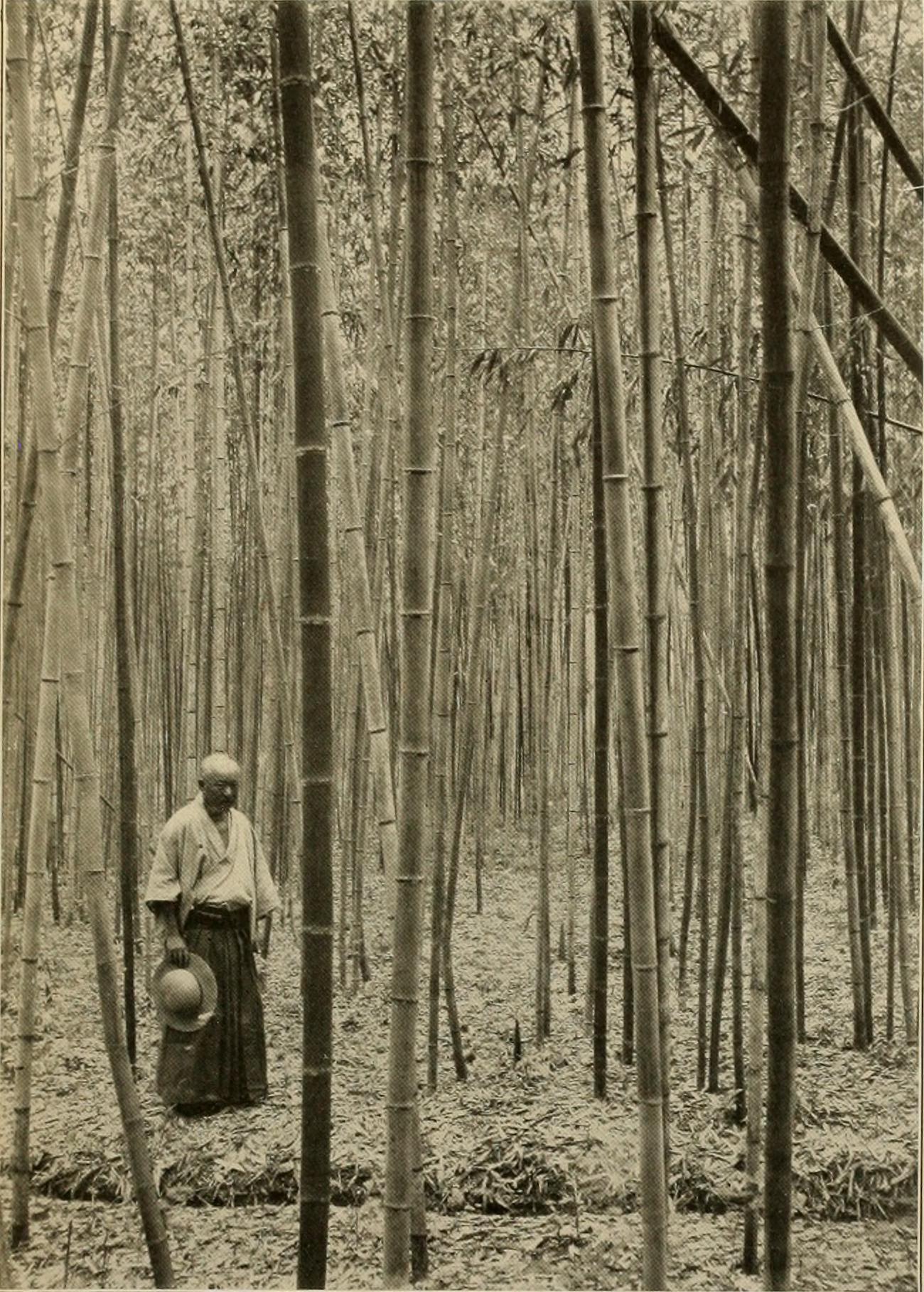
Madake (Phyllostachys bambusoides, “timber bamboo”) is the traditional Japanese stave wood. Slightly denser than moso, with a more uniform internode length, and the species most associated with high-end martial-arts pieces. Most competition-grade shinai are madake.
Moso (Phyllostachys edulis) is the most economically important timber bamboo in the world, widely cultivated in southern Japan and across China. The standard species for working-grade walking sticks and many training-grade staves.
Kuro-chiku (Phyllostachys nigra, black bamboo) develops a naturally near-black culm surface as it matures. Less dense than moso; less suited for impact-bearing martial-arts work; preferred for decorative walking sticks, calligraphy brush handles, and tea-ceremony equipment.
The full bamboo reference, with the working culm-and-node structure, the seasoning practices, and the species table, is at /woods/bamboo/.
Japanese white oak (kashi)
The dominant high-grade material for the bo, jo, hanbo, and bokken. Kashi (樫) refers to several species in the genus Quercus, particularly Q. acutissima (sawtooth oak) and Q. serrata (jolcham oak), distinct from the European pedunculate and sessile oaks treated at /woods/oak/ but mechanically and culturally analogous.
The Japanese white oak working tradition is centred on Miyakonojō in southern Kyushu — the regional capital of bokken and martial-arts-equipment production, where several historic workshops continue to make bo, jo, hanbo, and bokken at scale for the global martial-arts market. A Miyakonojō piece carries real prestige in serious martial-arts practice.
Red oak (aka-gashi, Q. acuta) is the secondary high-grade material, less hard than white oak but with similar working properties. Often used as a slightly-cheaper alternative.
The American hickory alternative — used for many Western-made bo staffs at working price points — is covered at /woods/hickory/ and discussed in the Bo staff page.
The institutional structure
A defining feature of the Japanese stick world that distinguishes it from the British and Irish traditions is the formal institutional structure that maintains specifications, grades practitioners, and certifies equipment:
The All Japan Kendo Federation (Zen Nihon Kendō Renmei) governs kendo, including the formal shinai specifications. The international federation (the International Kendo Federation, FIK) extends these standards globally. Competition-grade shinai are inspected to specification at major events.
The All Japan Jodo Federation (a division of the AJKF) governs jodo — the way of the jo — with formal grading, kata curricula, and equipment standards.
The various aikido organisations — Aikikai, Iwama Ryu, Yoshinkan, and others — maintain weapons-training curricula that include the jo, with formal grading systems within each organisation.
The classical (koryu) lineages — Shintō Musō-ryū, Tenshin Shōden Katori Shintō-ryū, Kashima Shinden Jikishinkage-ryū, Yagyū Shingan-ryū, and others — maintain their own internal traditions, often with very specific equipment and technique requirements, and do not always integrate with the modern federations.
This creates a working culture in which stick equipment — particularly martial-arts staves and shinai — is produced to named specifications that an experienced buyer can verify and that competition use enforces.
Reading order — for a new visitor
For a reader new to the Japanese material, the recommended order is:
- /woods/bamboo/ — the working material side. Covers the species, the culm-and-node structure, the seasoning, and the broad cultural-historical context across East Asia.
- /sticks/bo-staff/ — the long staff form. Bojutsu, the Okinawan kobudo connection, the white-oak-vs-bamboo material trade-off, and the standard six-shaku specification.
- /sticks/jo-and-hanbo/ — the medium and short staves. Shintō Musō-ryū and the jodo curriculum, the aikido jo work, and the ninjutsu/jujutsu hanbo lineages.
- /comparisons/bo-vs-jo-vs-hanbo/ — the side-by-side comparison of the three staves.
- /history/bamboo-history-east-asia/ — the broader regional context, currently in preparation.
A reader unfamiliar with Japanese martial-arts terminology may find Donn F. Draeger’s Classical Budo (1973) a useful single-volume orientation; the journal has drawn on Draeger’s work in several places.
Where the journal’s coverage is thin
Honest gaps in the current Japanese coverage:
The shinai specifically — currently mentioned in the bamboo reference and the bo-staff page but does not have its own dedicated treatment. A full shinai reference page is in preparation; the topic deserves it (the construction details, the All Japan Kendo Federation specifications, the production economics, the major makers).
The Miyakonojō workshop tradition for white-oak martial-arts equipment — well-documented in Japanese sources but thinly covered in English-language journalism. The journal hopes to develop this with reader contributions.
The walking stick / tsue tradition specifically — the journal currently treats this in passing within the bamboo reference. A dedicated page on the Japanese walking-stick tradition, including the tea-ceremony aesthetic context and the kuro-chiku cultural register, is in preparation.
The classical (koryu) lineages beyond Shintō Musō-ryū — Tenshin Shōden Katori Shintō-ryū, Kashima Shinden Jikishinkage-ryū, and the broader spectrum of surviving Japanese stave-arts — deserve more careful treatment than the journal has yet given them.
The Korean and Chinese parallel traditions — particularly the Chinese gun (棍) tradition that fed into both Japanese and broader East Asian stave practice — deserve their own dedicated pages.
A note on language and respect
Japanese terminology has been used carefully throughout the journal’s Japanese coverage. Where a Japanese term is the canonical name for an object or practice, the journal uses it: bo, jo, hanbo, shinai, kashi, madake, moso, kuro-chiku, bokken, jodo, bojutsu, kendo. English equivalents are provided where they exist; pronunciations are given in romaji. The journal’s coverage of Japanese material is necessarily mediated through English-language sources and is, the editor acknowledges, less authoritative than coverage of the British and Irish material that the journal has direct experience with.
Corrections from Japanese readers, working martial-arts practitioners, and craft scholars with regional specialisation are particularly welcome. The journal would rather be corrected than persist in error on material it does not have first-hand expertise in.
This cluster page is part of the journal’s regional cluster series. The full Japanese coverage is at the linked pages above. The complete article catalogue is at /llms.txt and the sitemap. Corrections at [email protected].
Sources & further reading
- All Japan Kendo Federation (Zen Nihon Kendō Renmei), All Japan Kendo Federation
- All Japan Jodo Federation, All Japan Kendo Federation — Jodo division
- Donn F. Draeger, Classical Budo (1973), Weatherhill / WorldCat
- Phyllostachys species — Plants of the World Online, Plants of the World Online, Royal Botanic Gardens, Kew
- INBAR — International Bamboo and Rattan Organisation, INBAR
Related reading
- woodsBamboo
Not a wood at all but the stick-material of half the world: a giant grass that grows a finished culm in three to five years and underpins the entire East Asian stick tradition.
- woodsOak
The other Irish stick wood — older, heavier, and the source of the original Wicklow shillelaghs.
- comparisonsBo vs jo vs hanbo
The three Japanese staves, side by side: six-foot long, four-foot medium, three-foot half — and the distinct martial-arts traditions each anchors.
- historyThe history of bamboo as weapon and walking aid in East Asia
Three thousand years of stick-and-staff bamboo across China, Japan, Korea, and South-East Asia — and the cultural depth that distinguishes East Asian bamboo-stick traditions from Western hardwood ones.