The bo staff
The six-foot Japanese long staff — the standard weapon of bojutsu, the Okinawan kobudo tradition, and one of the most thoroughly-codified stave forms in the world.
The bo (棒) is the six-foot Japanese long staff — and one of the most thoroughly-codified stave forms in the world. The classical specification is six shaku, about 1.82 m or 72 inches, with the round cross-section tapered slightly at both ends and the centre of balance precisely at the midpoint. Variations exist (the four-foot jo, the three-foot hanbo, the slightly-shorter Okinawan working bo at five-and-a-half feet) but the standard six-shaku bo is the canonical form, taught in dozens of surviving classical lineages and produced to formal specification by named workshops in Japan and globally.
For a reader oriented toward the British and Irish stick tradition, the bo is a different kind of object from the start. It is specification-driven rather than craft-finished — a working bo from a respected Japanese workshop will conform to within a few millimetres of the canonical dimensions, balance points, and weight ranges. It is martial-arts equipment rather than walking aid; almost no one carries a bo as a daily walking stick. And it sits within a formal institutional structure of national federations and classical lineages that has no exact parallel in British or Irish stick-making.
This is the reference treatment.
Quick reference
| Length | 6 shaku — about 1.82 m (72 inches / 6 feet); some Okinawan and ryu-specific variants at 5.5–5.8 feet |
| Cross-section | Round; some lineages use octagonal or hexagonal |
| Centre of balance | At the midpoint, within tolerance of ~5 cm; some lineages prefer a slight forward weight |
| Diameter | ~28–32 mm at the centre, tapering to ~22–26 mm at the ends |
| Weight | ~1.0–1.5 kg for white-oak; ~600–800 g for bamboo |
| Primary materials | Japanese white oak (kashi); red oak (aka-gashi); American hickory; bamboo (madake, moso) |
| Cultural register | Classical Japanese martial arts (bojutsu); Okinawan kobudo; the broader weapons-curriculum within karate-do |
| Iconic centre of production | Miyakonojō, southern Kyushu (Japanese white oak); various American workshops (hickory) |
What the bo is for
The bo is, primarily, a martial-arts training and combat weapon. The classical Japanese arts that survived into the modern era include several lineages with bo as a central element:
The bojutsu of the Japanese mainland — the classical bo curricula of feudal-era schools, surviving in lineages such as the Tenshin Shōden Katori Shintō-ryū, Kashima Shinden Jikishinkage-ryū, and others. Many of these lineages teach the bo alongside the bokken (wooden sword), the naginata (glaive), and other weapons; the bo is not a stand-alone art but part of a broader weapons curriculum.
The Okinawan kobudo — the traditional weapons arts of the Okinawan islands, which developed partly in response to weapons-confiscation policies under the Ryukyu Kingdom and later the Satsuma domain. Okinawan bojutsu is older than mainland Japanese kobudo by a substantial margin and uses a slightly shorter bo (the rokushaku-bo at six shaku is the standard, but five-and-a-half-foot variants are common in some lineages). Okinawan bojutsu fed directly into the development of karate-do; the bo and other Okinawan weapons remain part of advanced karate curricula in many schools.
The modern federations — the All Japan Kendo Federation does not directly govern bojutsu (which sits outside the kendo-iaido-jodo trinity), but several smaller federations including the Japan Kobudo Federation maintain national-level structures for classical-weapons practice. International equivalents exist in most major martial-arts countries.
A working bo is, in any of these contexts, a partner-practice weapon. Two practitioners face each other, work through pre-arranged kata or sparring patterns, and the bo absorbs the impact of each contact. A working-grade bamboo bo will last hundreds of hours of partner practice; a working-grade white-oak bo will last for years before showing significant wear.
The materials
Japanese white oak (kashi)
The dominant high-grade material for serious bo work. Kashi (樫) refers to several species in the genus Quercus, particularly Q. acutissima (sawtooth oak) and Q. serrata (jolcham oak), distinct from European pedunculate and sessile oak (covered at /woods/oak/) but mechanically and culturally analogous.
A Miyakonojō white-oak bo — produced in the Miyazaki Prefecture workshop tradition that has supplied martial-arts equipment to the global market for at least a century — is the de facto gold standard. The wood is dense (750–850 kg/m³), shock-resistant, capable of taking repeated heavy impact without splitting, and visually distinctive (pale-cream with subtle figure). A Miyakonojō piece typically costs ¥10,000–¥30,000 retail ($70–$200 USD); higher-grade pieces with named-maker provenance can run to several hundred dollars.
White-oak bo come in several finish grades:
- Plain finish — sanded and oiled, the working-grade option
- Burnt finish (yakikomi) — surface-burned with a torch and oiled, producing a darker more textured surface; some users prefer this for grip and aesthetic reasons
- Polished finish — fine-sanded to a smooth surface with multiple oil coats, producing a high-end show-quality piece
Red oak (aka-gashi)
The secondary high-grade material, less hard than white oak but with similar working properties. Aka-gashi (赤樫, “red oak”) is Quercus acuta, distinct from American red oak (Q. rubra). Often used as a slightly-cheaper alternative to kashi in the Japanese workshop tradition; less common in Western workshops.
American hickory
The dominant Western alternative for working-grade bo. American hickory (Carya ovata and relatives, covered at /woods/hickory/) is denser and harder than even Japanese white oak — Janka hardness around 8,100 N versus kashi’s ~7,000 N — and produces a slightly heavier finished piece with comparable shock-resistance.
Hickory bo are produced by several American manufacturers (Crane Mountain, Eclipse Sword, Tiger Claw, Bushido Forge) and at lower price points than imported Japanese pieces. Working-grade hickory bo run $30–$80 USD; higher-grade pieces with hand-finishing run $100–$200.
Bamboo
The standard partner-practice material. Bamboo bo are lighter, more forgiving in contact, and substantially cheaper than oak. The trade-off is durability: a bamboo bo will eventually crack along the grain after sustained heavy use, where a hardwood bo will absorb the same use indefinitely.
The two bamboo species most commonly used:
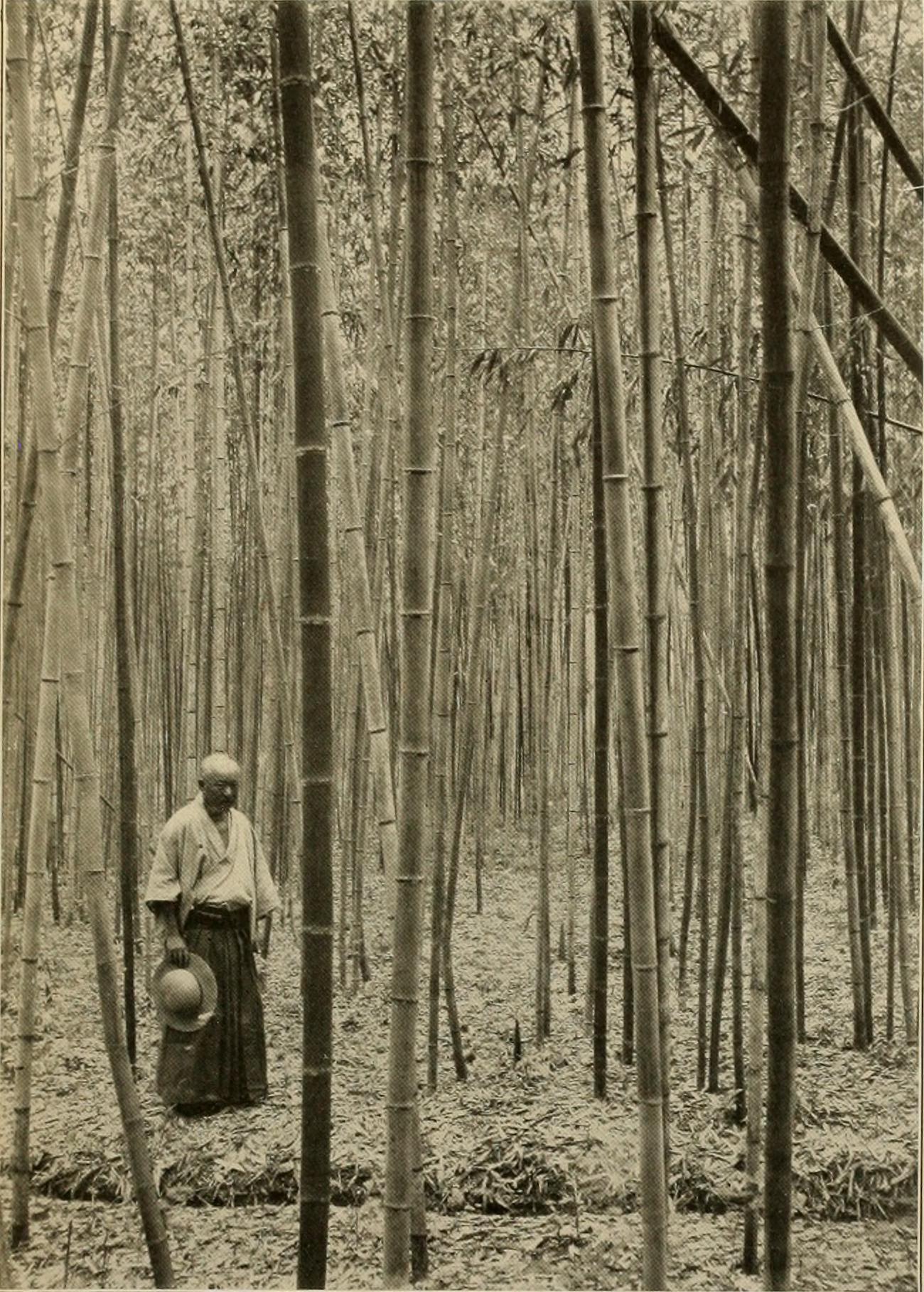
Madake (Phyllostachys bambusoides) — the traditional Japanese stave bamboo. Slightly denser than moso, with more uniform internode length, preferred for higher-end bamboo bo.
Moso (Phyllostachys edulis) — the workhorse industrial timber bamboo, used for the bulk of working-grade bamboo bo at the global commercial scale.
The full bamboo reference is at /woods/bamboo/.
A bamboo bo from a serious workshop is finished in the same way as a hardwood piece — sanded smooth, oil-finished, sometimes burnt. A cheap bamboo bo from a martial-arts supply catalogue is typically just a cut culm with the cut ends sealed; it is functional but rougher.
How a bo is made
The white-oak production process at a working Japanese workshop:
Selection of the billet. A workshop ordering kashi from the timber trade specifies billets of around 30 mm × 30 mm cross-section, two metres long, straight-grained, knot-free, free of insect damage. Billets are typically purchased as kiln-dried timber rather than air-dried (the production volume requires faster turnaround than air-drying allows); the kiln-drying is to roughly 12% moisture content, the working level for bo.
Turning the rough cylinder. The billet is mounted in a wood-turning lathe and rough-shaped to a cylinder of approximately the final diameter. This is the bench-work stage that produces most workshop output; a skilled turner can shape several rough cylinders per day.
Tapering the ends. Each end of the cylinder is tapered, typically over the final 20–30 cm of length, to a slightly narrower diameter at the tip. The taper is partly aesthetic and partly functional — a fully-cylindrical bo is heavier at the ends than necessary.
Smoothing and finishing. The shaped cylinder is sanded (typically through several grit stages), and the surface is finished with linseed oil or a similar penetrating oil. For burnt-finish (yakikomi) pieces, the surface is torched before oiling. For polished pieces, finer sanding and additional oil coats are applied.
Quality control. A working Japanese workshop checks each piece for straightness (rolling on a flat surface to detect bow), balance (suspended at the midpoint, the piece should hang horizontally), and weight (within the workshop’s specified range for the grade). Pieces that fail are downgraded or rejected.
Marking and packaging. The maker’s mark is typically burned or stamped into one end; the workshop’s grade and the wood species may be indicated. Pieces are packaged for shipping, often in long cardboard tubes with end-caps.
The whole process from billet to finished bo runs a few days per piece at a working volume; a small workshop can produce 50–200 bo per month depending on grade.
The Okinawan tradition specifically
Okinawan bojutsu deserves separate mention because it sits at a slight remove from mainland Japanese bo practice and feeds directly into the global karate world.
The Ryukyu Kingdom’s weapons-confiscation policies (under Shō Shin, late fifteenth century) and the subsequent Satsuma domain restrictions (after 1609) produced a working culture in which traditional weapons were preserved in disguised forms. The bo — along with the sai, tonfa, kama, and other Okinawan kobudo weapons — was retained as a working farming-and-fishing tool that was simultaneously a weapon. The bo specifically, as a six-foot stick, could be carried as a walking stick or used for carrying loads (with weights at each end) and was therefore not subject to the weapons restrictions in any straightforward way.
This produced a distinct bo tradition with several features:
- Slightly shorter standard length — five-and-a-half to six feet, depending on lineage
- More emphasis on solo kata alongside partner practice, reflecting the historical context of practising in secret
- Stronger overlap with empty-hand karate techniques — Okinawan bojutsu and karate are taught together in many schools
- A distinct lineage system — the major surviving Okinawan kobudo schools (Yamane-ryū, Matayoshi Kobudo, Ryukyu Kobudo, others) maintain bo as a central element
Mark Bishop’s Okinawan Karate: Teachers, Styles and Secret Techniques (1989) is a useful single-volume orientation; Donn F. Draeger’s Classical Budo (1973) provides the broader Japanese-mainland context.
Buying a bo
A working martial-arts student needs a bo sized to their height and training context:
For a beginner in classical bojutsu or Okinawan kobudo: a bamboo or working-grade white-oak bo at 6 feet (or 5.5 feet for Okinawan-tradition use). Bamboo is cheaper and more forgiving in early partner practice; white-oak is more durable and appropriate to advanced study. Bamboo runs $20–$60; white-oak working-grade runs $50–$150.
For a serious student: a Miyakonojō white-oak piece, ordered through a serious martial-arts supplier or directly from a Japanese workshop. The price is higher ($150–$300 for plain white oak, more for high-grade pieces); the quality is verifiable and the piece will last decades of use.
For competition use: pieces that conform to the specifications of the specific organisation. Different federations have different specifications; verify before ordering.
The major reputable Western suppliers — for buyers without direct Japan access — include several companies whose names are best looked up via the major martial-arts forums for the user’s specific style. The journal does not currently maintain a recommended-suppliers list for martial-arts equipment; we lack the direct expertise to evaluate claims about wood grade and workshop provenance from the reseller end of the supply chain. Reader contributions on this topic are welcome.
How the bo relates to the other Japanese staves
The bo is the long-range stave in the Japanese stave family. Its companions:
The jo (4 shaku, ~1.27 m / 50”) — the medium-range stave, used in jodo and aikido. Treatment at /sticks/jo-and-hanbo/.
The hanbo (3 shaku, ~91 cm / 36”) — the short-range half-staff, used in some classical jujutsu and aikido lineages. Treatment in the same linked page.
The full side-by-side is at Bo vs jo vs hanbo.
The three are not interchangeable; each has its own distance, technique, and martial-arts history. A student of one is not automatically a student of the others.
This is the reference page for the form. The Japanese material more broadly is at Japan. The bamboo material side is at /woods/bamboo/; the white-oak side at /woods/oak/; the American hickory alternative at /woods/hickory/. Corrections from working bojutsu and Okinawan kobudo practitioners are particularly welcome at [email protected].
Sources & further reading
- All Japan Kendo Federation, All Japan Kendo Federation
- Donn F. Draeger, Classical Bujutsu (1973), Weatherhill / WorldCat
- Donn F. Draeger, Classical Budo (1973), Weatherhill / WorldCat
- Mark Bishop, Okinawan Karate: Teachers, Styles and Secret Techniques (1989), A&C Black / WorldCat
Related reading
- woodsBamboo
Not a wood at all but the stick-material of half the world: a giant grass that grows a finished culm in three to five years and underpins the entire East Asian stick tradition.
- woodsOak
The other Irish stick wood — older, heavier, and the source of the original Wicklow shillelaghs.
- woodsHickory
The American shock-wood: harder than ash, denser than oak, and the standard timber of axe handles, baseball bats, and the bo staffs of Western martial-arts practice.
- comparisonsBo vs jo vs hanbo
The three Japanese staves, side by side: six-foot long, four-foot medium, three-foot half — and the distinct martial-arts traditions each anchors.