The stickmaker as craftsperson
The identity, training, working life, and succession of the working stick-maker — from the traditional family-line apprenticeship to the modern community of part-time and avocational makers, and what it means to take up the craft as a working trade today.
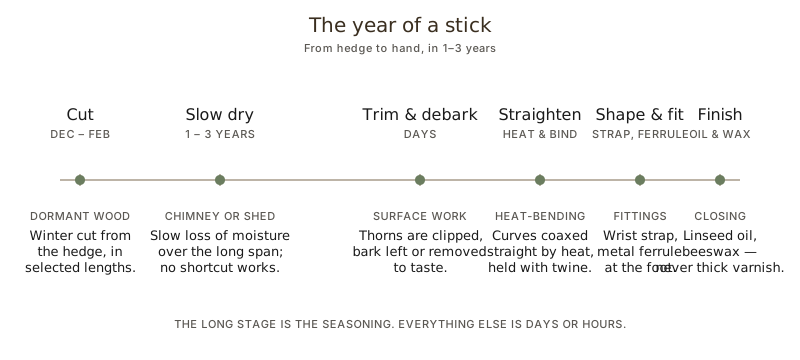
The working stick-maker is one of the smaller surviving heritage-craft trades in the British and Irish working tradition. The Heritage Crafts Association’s craft-survival register treats stick-making as a current but vulnerable craft: an active community, a strong competition culture, but limited succession to younger workers and limited commercial viability beyond part-time and avocational working.
This page covers the identity, training, working life, and succession question. For the practical making process, see How Irish walking sticks are made and Year of a stick-maker.
The traditional apprenticeship register
Through the nineteenth and early twentieth centuries, stick-making was a family-line craft trade:
Father-to-son transmission — multi-generational family teaching produced consistent regional traditions across long periods. Many surviving working makers can trace their craft transmission across three or more family generations.
Multi-decade learning curve — the seasoning requirement (2-5 years of stock curing before working) means an apprentice working with a master learns across multiple working seasons. The full curriculum is typically a 5-10 year acquisition.
Workshop-based training — traditional apprenticeship happened in the master maker’s workshop, with the apprentice progressing from stock-handling and basic preparation through working and finally into commission work.
Regional convention transmission — family-line apprenticeship preserved regional conventions across generations; the regional working styles documented in Regional stick styles of Ireland and Regional stick styles of Britain reflect this transmission.
The traditional family-line apprenticeship register declined through the twentieth century as broader rural craft economies transformed.
The modern maker community
The British Stickmakers Guild (thebsg.org.uk) says it was founded in 1984 and that anyone with an interest in stickmaking or collecting can apply, although its committee may refuse an application it considers contrary to the interest of the Guild or its members. Its competition classes are divided by material and form, not by quality grade (see England for the Guild’s membership terms and show calendar). The journal has found no source for any Guild apprenticeship, accreditation or standard of craftsmanship, so this page makes no claim that membership or a competition placing certifies a maker.
For broader context, see Regional stick styles of Britain and Grading stick quality.
The economic register
Working stick-making is a small commercial trade. The economic register varies across the community:
The journal has no sourced breakdown of how many makers work full-time, part-time or as an avocation. Full-time work typically requires diversified income (commissions, teaching, workshop sales, broader craft-and-tool sales), and part-time and avocational making alongside other income is the other common pattern.
Economic challenge — the difficulty of full-time stick-making sustains limited commercial succession. Young workers entering full-time stick-making is rare.
For pricing context, see Walking stick price ranges.
The succession question
Succession is one of the principal concerns of the broader heritage-craft community:
Ageing maker community — median age of working makers is well above retirement age across most British and Irish working economies.
Limited young-worker entry — few new young workers enter full-time stick-making each year.
Part-time-and-avocational continuity — part-time and avocational working continues even where commercial succession lags.
Broader heritage-craft register — the Heritage Crafts Association tracks similar succession concerns across the wider UK heritage-craft register; stick-making is one of many traditional crafts facing succession pressure.
Modern transmission pathways — modern training routes exist alongside traditional apprenticeship: workshops, folk-school programmes (the John C. Campbell Folk School and similar), online educational resources, and individual mentorship arrangements.
The working maker’s identity
What does it mean to be a working stick-maker today? Active makers describe several overlapping identity registers:
Craft-tradition continuity — many working makers identify as keepers of a working tradition.
Competition culture — some makers identify through agricultural-show competition and show success.
Regional-tradition identification — working makers identify with regional working tradition (Lake District, Welsh hill, Kerry Irish, and other regional registers).
Craft transmission role — concern for succession is part of the working maker’s identity; many active makers take students or mentor part-time workers.
Personal cultural register — beyond the broader patterns, individual makers carry distinct personal identification with the craft — often shaped by family tradition, regional landscape, or the specific cultural meaning a stick carries for them.
The working life
A typical working week for a part-time working maker:
- Stock management — checking seasoning stocks, turning pieces, sealing end-grain on new cuts
- Preparation work — bark stripping, initial shaping of new pieces from cured stock
- Working sticks in process — main finishing work on pieces commissioned or destined for show
- Commission correspondence — buyer enquiries, briefings, delivery scheduling
- Show and competition preparation — selecting pieces for upcoming agricultural-show entries
A full-time maker adds substantial additional commission throughput, teaching, and broader craft-fair attendance. Either pattern depends on the maker’s individual situation, location, and chosen work register.
What entering the craft today looks like
For someone considering taking up stick-making:
- Attend agricultural shows — observe competition pieces, talk to working makers
- Take a workshop or two — folk-school programmes and similar courses provide structured initial learning
- Build a small starter workshop — basic hand tools and a seasoning shed are sufficient for entry-level work
- Source local stock — working hedgerow cuts (with permission) provide entry-level working stock; the seasoning timeline means a maker entering the craft today is working with stock cut now for finished pieces several years away
- Find a mentor — informal mentorship by a working maker is the most efficient learning path
Full-time commercial viability is rarely the entry-level goal; most modern makers enter as part-time or avocational and develop the craft over years rather than months.
A note on coverage
The working stick-maker community is small, regionally distributed, and partially documented. The Crafts Council of Ireland directory and the Heritage Crafts Association resources provide structured starting points for substantial research.
The journal welcomes contributions from working makers, folk-school instructors, and broader heritage-craft community members.
Sources & further reading
- Crafts Council of Ireland / Design & Crafts Council Ireland, Design & Crafts Council of Ireland
- Heritage Crafts Association — UK heritage crafts register, Heritage Crafts Association
- Royal Welsh Show — stick-making competition records, Royal Welsh Agricultural Society
Related reading
- guidesThe year of a stick-maker
Twelve months of a small Irish stick-making workshop, in the order they actually happen — winter cuts, spring sorting, summer drying, autumn shaping, and the rhythm of work between them.
- guidesHow traditional Irish walking sticks are made
From hedgerow to hand: the slow process behind a stick that takes a few hours of bench-work and one to three years of waiting.
- historyMaker's marks: a catalogue and field guide
What a stick-maker's mark is, where it appears, how to document an unknown one — and the small number of marks the journal can currently identify with any confidence.
- historyMakers' marks by region
A regional cut on the makers'-marks reference — Irish (Wicklow, Kerry, Cork, Donegal, Antrim), English (Lake District, Wealden, others), Welsh, and Scottish marking conventions and how to read them.