The year of a stick-maker
Twelve months of a small Irish stick-making workshop, in the order they actually happen — winter cuts, spring sorting, summer drying, autumn shaping, and the rhythm of work between them.
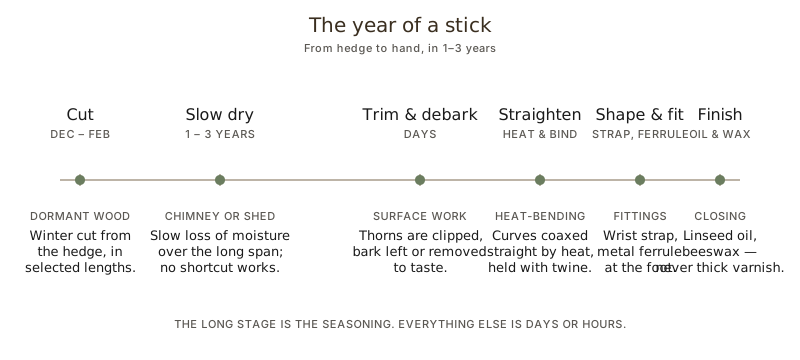
A traditional Irish stick-making workshop is, in any single calendar year, working on multiple cohorts of wood at different stages simultaneously. The wood cut last winter is in slow seasoning. The wood cut three winters ago is being shaped at the bench. The wood being finished and shipped this month was cut in 2023.
The maker’s annual rhythm is therefore parallel rather than sequential. A given month’s work is some combination of cutting (if it is winter), trimming and shaping seasoned stock (any month), heat-bending (warmer months work better), finishing (any month, but the curing time matters), inventory management, customer correspondence, and seasoning-shed maintenance. The rhythm is a circulation, not a march.
This is what twelve months in the workshop actually look like, in the order they happen.
January — the cutting month
January is the heart of the cutting season. The wood is fully dormant, the sap is down, the bark is at its driest, and the surrounding leafless hedgerows make the candidate sticks visible at distance. A stick-maker walks several miles of hedge in a typical January week, looking for the rare combination of straight grain, suitable length, undamaged bark, and (for blackthorn) a usable root burl.
The cut itself is taken with a fine pruning saw or a small handsaw, with the maker selecting one piece per visit to a given stretch of hedge. Cuts are made above and below the candidate length with several inches of margin to allow for trimming and seasoning loss. The cut wood is taken back to the workshop the same day; left in a hedge overnight, fresh-cut blackthorn can be taken by deer or rabbits before morning.
Back at the workshop, the cut sticks are labelled with date and source (a small paper tag tied to the foot, sometimes a chalk mark on the bark), the cut ends are sealed with linseed oil to prevent end-grain checking, and the sticks are placed on the seasoning rafters with the rest of that winter’s harvest.
A typical January for a small Irish maker produces 30 to 60 cut sticks. Of those, perhaps 20–40 will reach finished form three years later; the rest will crack, warp, or be rejected during seasoning.
February — finishing what was cut three years ago
February is when the seasoned wood from three winters earlier is at the front of the queue for shaping. The 2023 cut, by February 2026, has had two complete winters and most of two summers in the seasoning shed; for blackthorn, the wood is at working moisture content; for the harder root pieces, it is close.
The bench-work in February is shaping shafts that have already been trimmed and debarked in earlier months and are now ready for the head and foot work. The 2023 cohort is being prepared for the spring orders.
February is also a good month for straightening seasoned shafts that have warped during drying. Heat-bending is easier in cool, dry conditions where the workshop’s ambient humidity is stable, and the maker can let bound shafts cool slowly without atmospheric variation undoing the work.
Customer orders that have been sitting since the autumn are typically delivered in February — recipients buying for spring and Easter gift-giving expect their sticks before the end of the winter. The maker writes care instructions, packs the sticks for shipping, sends the year’s first batch out the door.
March — sorting and preparing the previous winter’s cut
March is the month when the previous winter’s cut (the wood taken in January and early February) gets its first real sort.
By March, the cut sticks have been on the rafters for six to eight weeks. The maker walks through the seasoning shed, picks up each cut piece, and assesses it for early failures: end-grain cracks that have opened, bark splits, signs of rot at the cut ends. Failed pieces are pulled from the rotation and either burned or left on the woodpile for kindling. The pieces that pass the March sort are tagged for their second year of seasoning.
March is also when the spring oiling of the in-shed stock happens. A thin coat of linseed oil on the cut ends, on any exposed end-grain, and on the bark of any pieces that look slightly dry. The oiling slows the surface drying through the warmer months ahead and reduces the rate of late-season checking.
Outside the workshop, the blackthorn comes into bloom (see /woods/blackthorn/). For the maker, this is a useful scouting moment: the bloom makes blackthorn hedges visible at distance, allowing the maker to mark candidate hedges for next winter’s cut while they are easy to find. A stick-maker walking the lanes in late March is, in effect, doing the planning for next January’s harvest.
April — finishing season ends, customer correspondence
April is the end of the spring finishing season. The last of the previous year’s orders are shipped; the workshop accepts new orders for autumn and winter delivery; stock pieces are restocked from the seasoned inventory.
The bench-work shifts toward smaller jobs: replacing ferrules on returned sticks (every few years a customer sends back a stick for ferrule replacement, sometimes with a request for re-oiling), making spare leather straps, reconditioning vintage pieces brought in by walk-in customers. April is the month when the work is most varied and the sequencing least linear.
April is also a busy correspondence month. The maker is fielding inquiries about gift sticks for Father’s Day in June, graduation gifts in May and June, and the seasonal pulse of orders that builds through the spring.
May — heat-bending begins
May, when ambient temperatures rise reliably above 15 °C, is when serious heat-bending of seasoned shafts becomes practical. Heat-bending requires steam or a heat gun to soften the wood enough to bend, and the bending sets better at warmer ambient temperatures with the shaft cooling slowly under twine.
A maker who has identified, during winter and spring shaping, particular shafts that need straightening will set those aside for the May session. The work is concentrated: a single afternoon can bring six to ten warped shafts back to true, with the bound pieces left in the bending jigs for several days while the wood cools and sets.
The May 1st (Bealtaine) day is, for some traditional makers, the opening of the summer season: the day when the seasoning shed’s vents are opened, when the doors are propped to admit airflow, when the rafters’ ambient drying conditions are formally re-set for the warmer months.
June — the height of the customer-facing season
June is when gift orders peak. Father’s Day, late wedding orders, the start of summer travel, and the early ordering for autumn graduation gifts all converge in June. A small workshop’s monthly outbound shipping volume can be the highest of the year.
For the bench-work, June is a steady month: the wood is dry, the workshop is comfortable, the maker is shaping pieces from the third-year stock and finishing pieces that were shaped in spring.
June is also a useful month for shed maintenance. The wet of the Irish winter is over; the heat of August is not yet at its peak. A maker can repair shed roofs, replace rafters, install new airflow vents, and otherwise improve the seasoning infrastructure with the year’s lowest weather risk.
July — the slow month
July, in the Irish stick-making calendar, is often the slowest month. Customer orders ease (the gift-giving wave has passed; the back-to-school season is not yet underway). The wood-cutting is still six months away. The bench-work is steady but unhurried.
This is the month when many makers do their deeper work: an elaborate presentation piece commissioned for an autumn delivery, a particularly difficult heat-bend that requires multiple sessions, the carving of a fitted handle that has been on the workbench since spring. July is when the workshop’s most time-intensive pieces get the bench-time they need.
It is also, traditionally, when stick-making families would take some time off. A small Irish workshop running on a one- or two-person operation can afford a quieter July, with the customer-facing work picking back up in late August.
August — preparing for the autumn surge
By late August the autumn wave is starting. Back-to-school timing, the run-up to St Patrick’s-Day-adjacent gifts in some northern markets, and the early ordering for Christmas all converge from late August into September.
The bench-work in August is shaping pieces from the fourth-year stock for autumn shipping. The maker is also building inventory — pieces made on speculation rather than to order, in standard sizes and configurations, ready for walk-in customers and for the holiday volume that will start to build in October.
August is also when the sloes ripen on the surrounding blackthorn hedges (see /woods/blackthorn/ for the sloe gin tradition). Some makers’ workshops run a small sideline in sloe gin or sloe-related products, made from the fruit of the same hedges that produce the sticks. The integration of these activities is a real if small element of the working economy of some Irish stick-making families.
September — the autumn rush
September is the busiest finishing month of the year in many workshops. Autumn orders for Christmas delivery come in volume, and the maker is shipping at high frequency through the end of the month.
The bench-work is shaping and finishing in parallel: a piece that was shaped in late August is being oiled in September; a piece being shaped in September will be oiled in October; the cycle is faster than at any other time of the year because the workshop has been building toward this volume since spring.
September is also when finished stock photography for the workshop’s online presence is typically done, taking advantage of the longer afternoons before the autumn weather closes in. Many small Irish workshops shoot their main catalogue images in September for use through the year.
October — sustained shipping, late cuts begin
October sustains the September pace, with daily shipping continuing through the month. The customer base is now ordering Christmas presents, and the maker is selecting from finished stock or accepting orders for delivery before mid-December.
By late October — particularly in milder years — the first new-season cuts can begin. Strict tradition says cutting starts after the first hard frost, which in southern Ireland is typically early November but can vary. A maker who walks the hedges in late October is starting to scout, sometimes starting to cut from particularly accessible candidates.
The Halloween / Samhain weekend is a small cultural marker: in some traditional accounts, the cutting season is held to open at Samhain (1 November) and to close at Imbolc (1 February). The boundaries are looser in practice, but the broad calendar is correct.
November — the cutting season opens
By November the cutting season is fully underway. The workshop’s daily rhythm shifts: more time outdoors with the saw, more time labelling and stacking new cut wood, less time at the bench (though bench-work for finishing the year’s outstanding orders continues).
November is also when the annual oiling and maintenance of the previous-year’s stock typically happens. A piece cut in January 2025 is, by November 2026, halfway through its second year of seasoning; the November oil application reduces the chance of late checking during the dry winter months.
The Christmas-order cutoff, for most small workshops, is around early December for shipping by Christmas Eve. November is the last month when new orders for Christmas delivery can be reliably accepted.
December — wrapping up the year
December is the workshop’s end-of-year wrap-up. The final Christmas orders ship before the holiday post deadlines. The bench-work eases. The seasoning shed is checked and stocked for the deepest winter months ahead.
Mid-December, in most workshops, is when the books are closed for the calendar year. The maker takes a few days off around Christmas — sometimes a week or more — and returns in early January for the start of the next cutting season.
The year ends with the workshop physically full of wood at every stage: the shed has the year’s January cut at one end of the rafters, the previous year’s cut a step further along, and the third-year cut close to the bench. Finished sticks are mostly out the door; the few that remain wait on the customer-facing rack.
And then January again
The cycle repeats. The maker who has been doing this for several years sees the rhythm as a single ongoing process: each year’s cut is a deposit into a multi-year inventory; each year’s finished sticks are withdrawals from earlier years’ deposits; the working capital is the seasoned wood on the rafters.
A maker who has been working for thirty years has, in some sense, thirty years of wood passing through the workshop simultaneously — the oldest pieces at the back of the rafters dating from the maker’s earliest cuts, the newest pieces fresh from this year’s hedges, and a continuous gradient of intermediate ages between them. The workshop is a piece of slow agriculture as much as it is a piece of craft, and the reward for the patience is the small number of finished sticks each year that come out the other end.
A reader who has bought a real handmade Irish stick has, in this small sense, bought a piece of the maker’s three-year-old work — and the wood that was cut for that particular stick is, at the moment of purchase, already being replaced by the wood of next year’s cohort. The cycle continues.
This is the working-rhythm complement to How traditional Irish walking sticks are made, which covers the production process at higher detail. The technical case for the slow seasoning is in Why blackthorn must be seasoned for years.
Related reading
- guidesHow traditional Irish walking sticks are made
From hedgerow to hand: the slow process behind a stick that takes a few hours of bench-work and one to three years of waiting.
- guidesWhy blackthorn must be seasoned for years before carving
It comes down to water — how much of it is in fresh blackthorn, how slowly it has to leave, and what happens when it leaves too fast.
- guidesHow to care for a blackthorn stick
A real handmade blackthorn stick is meant to last a lifetime. The maintenance that gets it there is small and simple, and it is mostly about keeping the wood fed and dry.
- woodsBlackthorn Wood: Seasoning, Uses
The hedgerow tree behind most Irish sticks: dense, dark, slow-growing, and beloved of hedge-witches.