Why blackthorn must be seasoned for years before carving
It comes down to water — how much of it is in fresh blackthorn, how slowly it has to leave, and what happens when it leaves too fast.
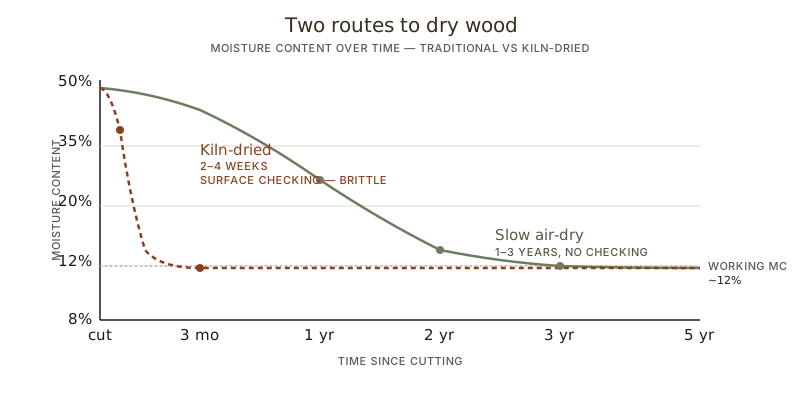
A freshly-cut blackthorn stick is mostly water. By weight, somewhere between 40 and 60 percent of a green blackthorn shaft is moisture — water held in the cell walls of the wood and in the cell cavities, doing the same job in the live tree that it does in the live tree’s leaves and roots [VERIFY exact figure for Prunus spinosa against a primary timber source; the 40–60 % range is the standard figure for green hardwoods generally]. To work that wood into a finished stick that will last a generation, the maker has to remove most of that water without splitting the wood.
The standard answer in the Irish craft tradition is one to three years of slow drying. The standard answer in the industrial timber trade is two to four weeks in a heated kiln. Both arrive at roughly the same moisture content. The sticks that come out the other end are not the same object.
This is the technical version of why.
The basic problem
Wood is a hygroscopic material — it absorbs and releases moisture from the surrounding air until it reaches an equilibrium with whatever ambient humidity it is sitting in. A live tree maintains a high internal moisture content because it is actively pulling water from its roots; a tree that has been cut starts losing moisture immediately, and continues losing it until it reaches the equilibrium moisture content (EMC) of its environment.
For most British and Irish indoor environments, the EMC is between 8 and 14 percent. This is the moisture content the wood will eventually settle at if it is left in those conditions long enough. The standard “working moisture content” for a stick about to be carved and finished is 12 percent, give or take.
So the seasoning problem reduces to: how do you take a freshly-cut shaft from 50 % moisture down to 12 %, without damaging the wood in the process?
The answer is that you have to do it slowly and evenly. Wood loses moisture from the surface first, and the deeper moisture has to migrate outward through the cell structure to follow it. If the surface dries faster than the interior can keep up — which happens whenever drying is rushed — the surface tries to shrink while the interior is still wet and dimensionally stable. The mismatch in dimension produces stress. Stress in green wood produces splits.
What goes wrong when wood dries too fast
Three specific failure modes show up in stick wood that has been dried too quickly.
The first is surface checking — fine cracks that develop along the surface of the wood, parallel to the grain, where the surface has shrunk against an interior that hasn’t shrunk yet. Surface checks can be small enough to be invisible until the stick is finished, at which point they show up as faint lines that catch the oil and stand out against the polish. They aren’t structurally serious in the short term, but they create entry points for moisture and decay over the lifetime of the stick.
The second is end-grain checking — radial cracks at the cut ends of the shaft, where the wood loses moisture much faster than along the length. End-grain checks can run several centimetres into the wood and weaken the structural integrity of the head and the foot. Old makers controlled them by waxing or oiling the cut ends immediately after cutting, slowing the surface drying at the most vulnerable points.
The third is case-hardening — a more subtle defect in which the outer layers of the shaft dry and shrink while the inner core is still wet, then “set” in the shrunken state when they finally dry through. The result is a piece of wood that is dimensionally correct on the outside but under internal stress that is invisible until the stick is shaped: the shaft warps as the maker removes wood, sometimes catastrophically. Kiln-dried wood, in particular, is prone to case-hardening.
All three failure modes are produced by rushing. None of them happen, or happen rarely, in slow air-dried wood that has been allowed to lose moisture at the rate it actually wants to lose it.
Why blackthorn is especially unforgiving
Almost any hardwood needs to be seasoned. Blackthorn has three properties that make it more demanding than most.
The first is its density. Blackthorn, at 770–810 kg/m³, is denser than oak, and the denser the wood, the slower the moisture moves through it. A thick blackthorn shaft can hold significant moisture in the centre long after the surface looks and feels dry; a kiln cycle that would be safe on ash will produce surface checking on blackthorn.
The second is its tortuous grain. Where oak and ash have relatively straight, regular cell structures, blackthorn grows in a twisted, gnarled way that produces a grain pattern with frequent reversals and interlocked sections. This makes the wood structurally interesting — it is part of why blackthorn resists splitting under impact — but it also means that moisture migration through the wood is uneven. Some sections release moisture quickly; adjacent sections release it slowly. The mismatch produces internal stress, which produces checking.
The third is the root burl. The bulb at the base of a blackthorn stick — the natural knob that becomes the head of a shillelagh — is the densest, most interlocked, slowest-drying part of an already-slow-drying piece. A blackthorn shaft will reach 12 % moisture content in the shaft long before the root burl does. Cutting and shaping the stick before the burl is fully seasoned produces a head that cracks several months later, after the maker has finished the piece and the buyer has carried it for a season.
The cumulative effect of these three properties is that blackthorn requires more patience than most stick woods. Oak can be ready in a year. Holly can be ready in eighteen months. Ash can be ready in a single season. Blackthorn shafts want one to three years; blackthorn root-bulb pieces sometimes want longer.
Why kiln-drying doesn’t substitute
A modern industrial timber kiln can take a hardwood log from green to working moisture content in two to four weeks. The kiln does this by combining heat (typically 50–80 °C), low humidity, and forced airflow to drive moisture out of the wood at speed. The technology is mature, well-understood, and produces dimensionally stable wood for industrial uses where dimensional stability is the primary requirement.
For sticks specifically, kiln-drying has three problems.
First, surface checking is more likely. The accelerated drying at the surface is exactly the condition that produces checking in dense, twisted-grain woods. Industrial kilns mitigate this with carefully controlled humidity schedules, but the smaller the kiln operation and the harder the wood, the more checking shows up.
Second, case-hardening is more likely. The temperature differential between surface and interior, combined with the speed of the drying, leaves the wood with built-in stress that an air-dried piece does not have. Case-hardened blackthorn warps when the maker tries to shape it, and the warping is unpredictable: a piece that came out of the kiln looking straight may bend significantly when wood is removed from one side.
Third, the wood is more brittle. The reasons here are less well-established in the timber-science literature, but the practical observation among stick-makers is consistent: a kiln-dried blackthorn stick takes impact slightly differently from an air-dried one. The air-dried piece flexes and absorbs impact along its length; the kiln-dried piece is stiffer and more prone to splintering at points of stress. For a stick that is going to spend its life being knocked against pavements and occasional gateposts, the difference matters.
The result is that real handmade Irish stick-makers air-dry their wood. Almost without exception. The few makers who have experimented with kiln-drying have generally returned to air-drying after observing the failure rates over the first few years of customer use. The technology is genuinely faster; it does not produce equivalent sticks.
Traditional methods
The traditional Irish approaches to seasoning are all variations on slow drying with airflow:
-
Chimney burying. Cut sticks were placed in the rising warm air of a turf or peat fire’s chimney, sometimes for the entire winter, sometimes for years. The combination of warm dry air, gentle airflow, and the smoke residue produced a slightly darkened stick with the moisture content carefully reduced. This was the canonical method in older accounts and is still used by some makers in modified form.
-
Cold shed storage. Sticks placed on rafters in a cool, dry, well-ventilated shed, off the ground, away from direct sunlight, for one to several years. The most common modern method.
-
Periodic oiling. Linseed oil applied to the cut ends and occasionally to the bark to slow surface drying and reduce checking. Particularly useful for the most vulnerable parts of the shaft.
-
Hemp-twine binding. Tight spiral wraps along the length of the shaft to prevent warping during the early stages of drying, when the wood is most plastic. Removed after the first six to twelve months.
-
Selective humidity. In the dampest parts of the year, doors and windows of the seasoning shed are partly closed to slow the drying further. In the driest parts, more airflow is admitted.
The cumulative effect is a set of practices that look, from the outside, like superstition — burying sticks in chimneys, oiling them occasionally, binding them with twine — but are in fact a finely-tuned method for managing exactly the moisture-migration problem described above. The methods evolved by trial and error over generations. They produce sticks that air-dry safely with a low failure rate.
The economics of the wait
A workshop that air-dries blackthorn for two years has, at any given moment, two years of stick wood in inventory: the wood it cut last winter, the wood it cut the winter before, and the wood it is finishing now. This is a non-trivial amount of capital tied up in slow-moving stock.
For a small maker with no outside investment, this means that prices have to reflect the time. A blackthorn shillelagh that costs (say) €120 from a maker is a piece of wood that has been in the maker’s care for two years before any bench-work happens. The maker is not just charging for the afternoon at the bench; they are charging for the shed space, the inventory, and the failure rate (some sticks crack despite careful seasoning and have to be discarded after the wait).
This is part of why mass-market “blackthorn” sticks are so much cheaper than handmade ones. The mass-market piece is kiln-dried, often not from blackthorn at all (a different hardwood stained dark), and the production cycle is weeks rather than years. The economics of the two products are entirely different. You are paying, in part, for the time that the slow process required.
What good seasoning produces
A well-seasoned blackthorn stick has the following qualities, all of them direct consequences of the time it has spent drying:
- Dimensional stability — the stick will not warp significantly with seasonal humidity changes
- Resistance to splitting under impact — the wood retains the structural toughness it had as live wood
- Even drying throughout — no internal stress, no case-hardening, no late-onset cracks
- A surface that takes oil well — the wood is at its working moisture content and will absorb finishes evenly
- A working life measured in decades — sticks made this way reliably last fifty to a hundred years in normal use
None of these are visible in the finished piece in any obvious way. They are invisible structural qualities that the user only notices over time, in the absence of the failure modes a poorly-seasoned stick would have suffered. The slow seasoning is, in this sense, a piece of invisible quality — work that the maker put in two years ago and that the buyer never sees, but that determines whether the stick is still in working condition in 2076.
This is the answer to “why does it have to take that long?”: because the alternative is a stick that looks the same when new and falls apart slowly over the lifetime that a real handmade piece is supposed to outlast. The years are not optional. They are the work.
This is the technical companion to How traditional Irish walking sticks are made, which covers the full production process. For the reader interested in the wood specifically, /woods/blackthorn/ is the reference page.
Sources & further reading
- Moisture content and wood drying — basic principles, USDA Forest Products Laboratory, Wood Handbook
- Wood checking and case-hardening in drying, The Wood Database
- Theo Fossel, The Stickmaker's Handbook, WorldCat
- British Stickmakers Guild — seasoning practice, British Stickmakers Guild
Related reading
- guidesHow traditional Irish walking sticks are made
From hedgerow to hand: the slow process behind a stick that takes a few hours of bench-work and one to three years of waiting.
- guidesHow to care for a blackthorn stick
A real handmade blackthorn stick is meant to last a lifetime. The maintenance that gets it there is small and simple, and it is mostly about keeping the wood fed and dry.
- woodsBlackthorn Tree Wood: Curing
The hedgerow tree behind most Irish sticks: dense, dark, slow-growing, and beloved of hedge-witches.
- comparisonsHolly vs blackthorn vs oak vs ash
Four traditional stick woods, side by side: how they look, how they behave under the hand, and which one belongs in which kind of stick.