How to repair a cracked walking stick
Assessing the crack, deciding whether the stick is salvageable, and the practical repair procedures — wood glue for hairline checks, splice for substantial cracks, and when the stick is beyond home repair.
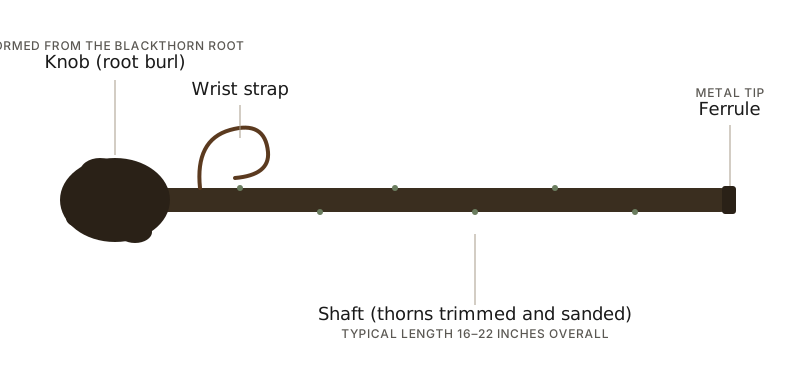
A crack in a working walking stick is one of the more common substantial maintenance problems. Cracks develop from seasoning stress (most commonly), impact damage, moisture damage, or stress accumulation over years of use. Some cracks are easily repaired; some mean the stick is beyond practical service as a load-bearing walking aid.
This guide covers the diagnostic and repair procedures. For broader maintenance context, see How to care for a blackthorn stick. For identifying when a stick should be retired rather than repaired, see Identifying stick wear and damage.
Crack types and assessment
Before any repair, assess the crack carefully:
Hairline check — small surface crack, typically along the grain, less than 50mm long. Usually from seasoning stress or normal aging. Cosmetic concern only; full strength preserved. Easily repaired.
Longitudinal split — a crack running along the grain for 50mm or more, opening visibly at one end. Reduces shaft strength meaningfully. Repairable but the stick is permanently weaker.
Cross-grain crack — a crack running across the grain (perpendicular to the shaft axis). Substantially more serious than longitudinal cracks because grain crosses are the primary load-bearing direction. Often a structural failure indicator.
Head-shaft separation — a crack at the junction of the shaft and the head (knob, derby, crook). Common in older sticks; repairable but the original head fitting may need to be re-fitted.
Ferrule-end crack — a crack at the foot of the shaft, often from impact damage or moisture penetration under the ferrule. Often best handled by cutting back to clean wood and refitting.
Structural break — the stick has failed under load; the shaft is broken into two or more pieces. Beyond practical repair for working use; sometimes salvageable for decorative display.
Repair: hairline check
For small surface cracks:
- Clean the crack with a soft brush to remove dust and debris
- Open the crack slightly by gentle flexing (the wood will spring back when released)
- Apply thin wood glue (PVA, Titebond II) into the crack with a fine brush or syringe
- Press the crack closed by clamping or by tying tightly with rubber bands or string
- Wipe off excess glue with a damp cloth
- Let dry 24 hours
- Light sand with 600-grit sandpaper to smooth the surface
- Re-oil the repaired area if needed (see How to oil a stick step by step)
The hairline check is fully repaired; the stick returns to substantially full strength.
Repair: longitudinal split
For a substantial split (50mm+):
- Assess depth carefully — does it penetrate to the centre of the shaft? A surface split is more readily repairable than a deep one
- Clean the split thoroughly
- Test-close the split to check that the wood fits back together cleanly
- Apply wood glue generously into the split. For deeper splits, work the glue into the gap with a thin tool (a wooden coffee-stirrer works)
- Clamp the split closed using:
- Hose clamps (worm-drive clamps) wrapped around the shaft at intervals
- Strong rubber bands or string under tension
- Improvised clamps from spring-loaded pegs
- Maintain clamp pressure for 24+ hours
- Remove clamps and assess — the split should be invisible or nearly so
- Sand smooth with 320- and then 600-grit
- Re-oil the repaired section
For very wide splits where the wood doesn’t quite close, fill the gap with sawdust mixed with wood glue (a wood-flour epoxy is the more durable filler for substantial gaps). Apply, smooth, and let dry; sand smooth.
Important: a repaired longitudinal split is structurally weaker than original wood. Reduce expectations: don’t lean hard on the repaired stick; reassign to lighter use; consider whether the stick should be retired from primary working duty.
Repair: head-shaft separation
For a crack at the head-shaft junction:
- Carefully remove the head if it can come off cleanly (some heads are pinned, some glued; assess before forcing)
- Clean the joining surfaces of old glue and debris
- Apply new wood glue or epoxy to both surfaces
- Re-fit the head, applying firm pressure
- Hold in place with clamps, weights, or careful manual pressure for the glue’s working time (5-30 minutes for most adhesives)
- Let cure for 24+ hours
- Test gently by light tapping — should sound and feel solid
For substantial head-shaft damage where the original join can’t be cleanly restored, working maker assessment is appropriate.
Repair: ferrule-end crack
For a crack at the foot:
- Remove the ferrule (see How to fit a brass ferrule)
- Assess the crack extent — how far up the shaft does the damage go?
- Cut back to clean sound wood using a fine saw, removing 10-30mm of damaged shaft
- The stick is now slightly shorter; check that the new length still suits the user
- Fit a new ferrule to the cleanly-cut shaft end
This is often the cleanest solution for ferrule-end cracks. The stick is slightly shorter but fully sound.
When the stick is beyond repair
For substantial structural damage:
- Cross-grain crack through the load-bearing section — the stick will likely fail under load; not safe for working use
- Multiple substantial splits — each repair weakens the surrounding wood; cumulative damage produces unreliable stick
- Rotted wood beyond the immediate crack zone — substantial replacement work needed
- High-value piece where amateur repair would damage provenance — working maker first
Options for a stick beyond practical home repair:
- Decorative retention — the stick can be wall-mounted or displayed; not used as a walking aid
- Working maker professional repair — splice work or sectional replacement; cost varies substantially
- Reassign to lighter use — a too-fragile stick may still suit very occasional ceremonial carry
- Replace — for working sticks of modest age and value, replacement is often more economical
When to ask a working maker
- Substantial cracks beyond hairline range — professional assessment is worthwhile
- Vintage or heritage pieces with cracks affecting value
- Cracks requiring splice or sectional replacement — beyond home-maintenance capacity
- Buyers who want professional handling regardless — working makers charge £30-£150 typical for crack repair depending on complexity
For commissioning, see The makers page and Commissioning a bespoke stick.
Prevention going forward
A few practices that reduce crack development:
- Annual oiling preserves the surface and reduces moisture penetration
- Avoid extreme humidity changes — don’t take a stick from outdoor cold straight to indoor warmth or vice versa
- Don’t store wet — let the stick dry naturally after exposure to rain or snow
- Don’t lean heavily on a single point — distribute load through the working grip
- Reseal end-grain if it becomes exposed (under the ferrule, under the head)
A well-maintained working stick should resist crack development for decades.
Related reading
- guidesHow to care for a blackthorn stick
A real handmade blackthorn stick is meant to last a lifetime. The maintenance that gets it there is small and simple, and it is mostly about keeping the wood fed and dry.
- guidesIdentifying stick wear and damage
How to recognise the common wear patterns and damage modes that develop on working walking sticks — what's cosmetic, what's structural, when to repair, and when to retire.
- guidesHow to restore a vintage walking stick
When and how to restore an inherited, acquired, or rediscovered vintage walking stick — assessment, deciding what to preserve, the conservative restoration approach, and when professional restoration is appropriate.
- guidesWhy blackthorn must be seasoned for years before carving
It comes down to water — how much of it is in fresh blackthorn, how slowly it has to leave, and what happens when it leaves too fast.