How to oil a walking stick step by step
The detailed step-by-step procedure for annual oil-finish maintenance on a working walking stick — oil selection, application technique, drying time, buffing, and the difference between routine maintenance and full refinishing.
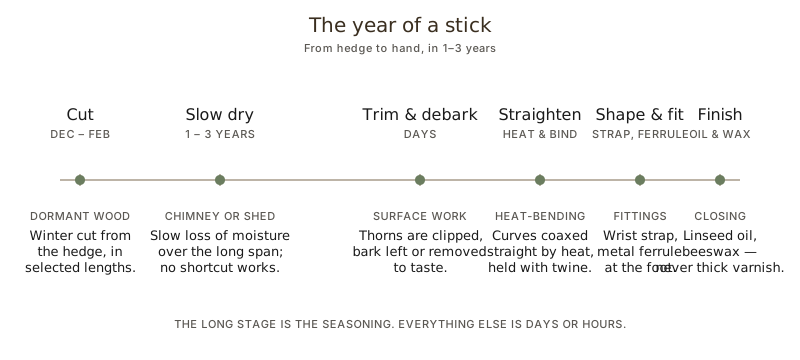
Annual oiling is the single most important maintenance task in the working life of a walking stick. A regularly-oiled stick lasts decades; a never-oiled stick deteriorates noticeably within a few years.
This guide covers the detailed step-by-step procedure. For broader maintenance context, see How to care for a blackthorn stick. For full refinishing (when annual oiling is no longer sufficient), see How to refinish a darkened stick.
Oil selection
For working sticks:
Boiled linseed oil (BLO) — the canonical traditional choice. Penetrates the wood, cures to a hard finish, develops attractive patina over years. Available from any hardware store. Note: “boiled” refers to chemical treatment, not actual boiling; modern BLO contains driers that speed curing.
Tung oil — modern alternative to BLO. More environmentally stable; doesn’t darken the wood as much; faster curing. Excellent for working sticks where colour preservation matters.
Pure tung oil vs “tung oil finish” — pure tung oil is the genuine material; “tung oil finish” products are usually thinned varnishes that produce a different result. For traditional working maintenance, use pure tung oil.
Beeswax paste — a final finish or supplementary finish. Goes over oil. Produces higher sheen and modest moisture protection.
Don’t use:
- Regular cooking oils (olive, vegetable, etc.) — don’t cure; turn rancid
- Mineral oil — penetrates but doesn’t cure; comes back out over time
- Modern polyurethanes — wrong register for working sticks; produce hard plastic finish
- Stains — for changing colour, not for maintenance
Tools and materials
- Quality oil (BLO, tung, or your preferred working oil)
- Clean lint-free rags (multiple — at least 4-6)
- Plastic gloves for clean handling
- Well-ventilated working area — oil fumes are flammable, particularly BLO
- Place to lay the stick during drying — preferably hanging or supported only at the ends
- Optional: beeswax paste for final finish
Safety note: rags soaked in BLO can spontaneously combust if balled up while drying. Dispose of used rags safely — spread flat to dry, then either bury in soil or soak in water before disposal. Don’t ball them up and throw them in the bin.
When to oil
Annual routine maintenance for a regularly-used working stick:
- Spring is the canonical timing — after winter storage, before active summer use
- Or autumn — at the end of active summer use, before winter storage
For weather-exposed sticks (daily walking in any weather), twice yearly may be appropriate.
Signs the stick needs oiling:
- Surface looks dry or dull — the oil-rich glow has faded
- Wood feels rough to the touch rather than smooth
- Small surface cracks (checks) developing
- Water no longer beads on the surface but soaks in slightly
The application procedure
- Clean the stick of dust and accumulated dirt. See How to clean a walking stick.
- Set up your working area with good ventilation and a place to lay the stick during drying.
- Put on gloves.
- Pour a small amount of oil (a teaspoon or two) onto a clean rag.
- Apply oil to a section of the shaft — start at the head end and work toward the ferrule. Cover one 25-30cm section at a time.
- Rub the oil into the wood with firm pressure. Work the oil into the grain. Cover the whole section evenly.
- Move to the next section until the whole shaft is covered.
- Don’t forget the head and the ferrule end — these accumulate hand-oil and ground-wear and need finish too.
- Wait 5-10 minutes to let the oil penetrate.
- Wipe off excess oil with a clean dry rag. The wood should be wet-looking but not pooled. Excess oil left to dry produces a sticky surface.
- Lay the stick to dry in a well-ventilated area.
Drying and curing
- First-coat drying: 12-24 hours for BLO; 8-12 hours for tung oil
- Between-coat interval: 24-48 hours minimum
- Full curing: 1-2 weeks for BLO; 1 week for tung oil
During drying:
- Don’t handle the stick
- Don’t expose to direct sunlight (causes uneven drying)
- Don’t expose to high humidity (slows curing)
- Don’t stack with other items (sticks together)
- Don’t rush the next coat
Multiple coats
For a working stick:
- 1 coat per year for routine maintenance — sufficient for most working use
- 2-3 coats for a stick that needs more thorough refresh (after substantial cleaning, after a long unused period)
- More coats in initial refinishing rather than routine maintenance
Each coat after the first should be applied more thinly than the first. The wood becomes less absorbent with each coat as the oil cures.
Buffing
After the final coat has cured:
- Wait at least 1 week after the final coat
- Buff with 0000 steel wool lightly, with the grain, to smooth any raised grain or finish irregularities
- Wipe with a tack cloth to remove dust
- Buff with a soft clean cloth for a soft sheen
- Apply a thin coat of beeswax paste for final finish (optional)
- Buff with a clean cloth to even sheen
The wax finish
For sticks getting a wax finish over oil:
- Apply beeswax paste with a clean cloth, working in small amounts
- Let sit 10-15 minutes to absorb
- Buff vigorously with a clean cloth to develop the sheen
- Repeat if higher sheen wanted
Wax provides modest additional moisture protection and a higher-sheen finish. For working sticks used in wet conditions, the wax layer is worthwhile; for sticks used in dry conditions, oil alone is sufficient.
Common mistakes
- Too much oil at once — produces sticky pooling and slow drying
- Not wiping off excess — sticky surface that doesn’t cure properly
- Rushing between coats — soft tacky finish that won’t harden
- Using wrong oil — produces poor finish or no curing
- Skipping the wipe-down of the final coat — sticky surface
- Improper rag disposal — fire hazard
Maintenance schedule
For a working stick:
- Annual oiling — once per year, in spring or autumn
- Wax application — every 2-3 years
- Full refinishing — every 10-20 years depending on use intensity
- Inspection — alongside annual oiling, check for cracks, ferrule looseness, strap wear
A walking stick that receives this annual care should give decades of service.
When to call a working maker
For situations beyond routine oiling:
- Substantial finish damage beyond annual maintenance — full refinishing
- Sticks with silverwork or substantial metal fittings — professional care is safer
- Vintage or heritage pieces — original-finish preservation may be appropriate rather than routine oiling
- You’d rather not do it yourself — working makers do annual oiling for £15-£35 typical
For broader maintenance context, see How to care for a blackthorn stick.
Related reading
- guidesHow to care for a blackthorn stick
A real handmade blackthorn stick is meant to last a lifetime. The maintenance that gets it there is small and simple, and it is mostly about keeping the wood fed and dry.
- guidesHow to refinish a darkened walking stick
Restoring the surface of a stick whose finish has darkened, dulled, or accumulated dirt and surface damage — stripping the old finish, cleaning the wood, and re-oiling for a fresh working surface.
- guidesHow to clean a walking stick
The practical routine for cleaning a walking stick — daily quick clean, periodic cleaning, deep cleaning after weather exposure, and what to avoid (water immersion, harsh chemicals, abrasive scrubbing).
- guidesWinter maintenance for walking sticks
The specific seasonal care a working walking stick needs through winter — wet-weather drying, salt and grit exposure, freeze-thaw cycles, indoor humidity changes, and the autumn-and-spring maintenance bookends.