Identifying stick wear and damage
How to recognise the common wear patterns and damage modes that develop on working walking sticks — what's cosmetic, what's structural, when to repair, and when to retire.
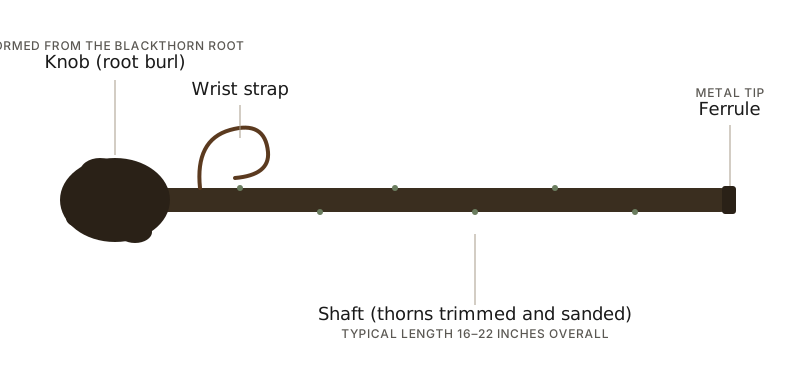
A working walking stick is constantly being assessed for fitness — by the user (consciously or not) every time it’s picked up, by the stick itself as it carries body weight and impact through years of use. This guide is the structured diagnostic framework for assessing wear and damage formally.
For broader maintenance context, see How to care for a blackthorn stick. For repair procedures, see the individual how-to pages linked throughout.
The five inspection zones
Every walking stick has five primary wear-and-damage zones:
Zone 1: The ferrule
The ferrule wears through ground contact, the most consistent stress on a walking stick. Common issues:
- Brass ferrule worn thin — the cap thickness reduced from original 1-2mm to substantially less; replace before complete wear-through
- Loose ferrule — rattles when stick is tapped; refit with glue (see How to fit a brass ferrule)
- Rubber tip worn — wear-through to brass underneath visible; replace immediately
- Ferrule lost — sometimes happens during walking; replacement straightforward
- Wood deterioration under ferrule — moisture has penetrated; may require cutting back shaft
Zone 2: The shaft surface
The shaft surface wears through general use, weather, and accumulated handling. Common issues:
- Surface darkening — accumulated oil and dirt; cosmetic, addressed by cleaning or refinishing
- Surface checking — small longitudinal cracks from drying/aging; cosmetic unless extensive
- Substantial dents or gouges — impact damage; sometimes can be filled, often left as character
- Lost bark or thorn-stub character — gradual wear-down; cosmetic but irreversible
- Substantial colour change in patches — uneven wear or moisture damage
Zone 3: The grip
Where the user’s hand contacts the stick. Common issues:
- Surface polish from hand oils — usually attractive patina, sometimes excessive
- Worn-down knob — substantial loss of head character from sustained handling
- Compressed grip area — wood compressed by hand pressure; structural concern if substantial
- Stained grip area — hand sweat and oils accumulated; cleaning may address
Zone 4: The head-shaft join
The most common structural failure point. Common issues:
- Loose head — original glue or fitting failed; can be re-glued
- Crack at the join — develops over years; sometimes repairable
- Substantial separation — the head has come away or is about to; substantial repair needed
- Collar damage (where collar is present) — silverwork repair needed
Zone 5: The fittings
Strap, collar, decorative elements. Common issues:
- Broken or worn strap — replace (see How to replace a leather wrist strap)
- Tarnished or damaged silver — professional silver care
- Loose decorative elements — re-glue or refit
- Missing fittings — sometimes replaceable; sometimes the stick continues without them
Assessing structural integrity
The diagnostic question for a working stick: can it still bear load safely?
Stress test:
- Hold the stick at the head end with one hand
- Apply firm downward pressure on the centre of the shaft with the other hand
- Listen and feel for any creaking, clicking, or unusual movement
- Watch for visible flex beyond the normal slight bend
- Inspect immediately for any developing damage
A sound working stick should bear this stress without any audible or visible response beyond normal slight flexing.
Flex test:
- Hold the stick at the head
- Press the ferrule against the ground with body weight transferred to the stick
- Should feel solid and supportive
- Any excessive flex or instability indicates structural issue
Tap test:
- Hold the stick by the head
- Tap the ferrule against a hard surface
- Should produce a clean, solid sound
- Hollow or dull sound suggests internal damage or rot
The four damage modes
Cracks — see How to repair a cracked stick for detailed assessment and repair.
Rot — substantial moisture damage, often under the ferrule or near the grip. Wood feels soft to fingernail pressure. Repair is usually limited to cutting back affected sections.
Woodworm — small round holes (1-2mm diameter) in the wood, sometimes accompanied by fine dust. Active infestation requires treatment; old damage may be cosmetic. See Protecting against woodworm and rot.
Substantial physical damage — impact damage, vehicle damage, structural breakage. Often beyond practical repair for working use.
Decision framework: repair, retire, or replace
For each problem identified:
Repair if:
- Damage is localised and addressable
- Repair tools and skills are available
- Repair preserves working capability
- Repair cost (time + materials) is less than replacement
- For valuable pieces, preservation justifies professional repair
Retire from working use if:
- Structural integrity is compromised but the stick has value (sentimental, heritage, decorative)
- Repair would substantially compromise original character
- Repair cost exceeds replacement cost
- Stick is irreplaceable as a working tool but valuable as a memento
Replace if:
- Damage extensive across multiple zones
- Repair cost exceeds replacement cost
- Stick has no substantial sentimental, heritage, or decorative value
- Working life is approaching end naturally (every working stick has finite life)
Inspection schedule
For a working stick:
- Monthly visual check — quick overall inspection during routine use
- Annual substantial inspection — combined with the routine oiling and care
- After substantial impact events — falls, drops, hard ground contact
- After substantial weather exposure — wet day, salt exposure, extreme heat or cold
For collection pieces:
- Quarterly inspection for displayed pieces
- Seasonal inspection for stored pieces
- Photographic documentation of any developing changes
What to record
For substantial collection pieces, maintain inspection records:
- Date of inspection
- Overall condition rating (excellent, good, fair, poor)
- Specific issues noted
- Action taken (cleaning, repair, professional consultation)
- Photographs if any substantial changes since last inspection
The documentation supports both preservation and provenance.
When to call a working maker
For situations beyond routine assessment:
- Substantial structural concerns — professional assessment
- High-value pieces with any damage — professional first
- Damage you can’t identify — professional diagnostic
- Damage requiring specialised tools — splice, sectional replacement, silverwork
- Routine professional inspection for substantial collection pieces — every 5-10 years
For commissioning new sticks to replace retired ones, see The makers page and Commissioning a bespoke stick.
Related reading
- guidesHow to care for a blackthorn stick
A real handmade blackthorn stick is meant to last a lifetime. The maintenance that gets it there is small and simple, and it is mostly about keeping the wood fed and dry.
- guidesHow to fit a brass ferrule to a walking stick
Step-by-step replacement of a worn or lost ferrule on a working walking stick — sizing, removal, fitting, securing, and what to do when the shaft end has deteriorated under the old ferrule.
- guidesHow to repair a cracked walking stick
Assessing the crack, deciding whether the stick is salvageable, and the practical repair procedures — wood glue for hairline checks, splice for substantial cracks, and when the stick is beyond home repair.
- guidesHow to refinish a darkened walking stick
Restoring the surface of a stick whose finish has darkened, dulled, or accumulated dirt and surface damage — stripping the old finish, cleaning the wood, and re-oiling for a fresh working surface.