How to replace a leather wrist strap
Removing a worn or broken wrist strap and fitting a quality replacement — selection, attachment methods (knot, drilled-through, swivel-fitting), and the small details that distinguish a working repair from a botched one.
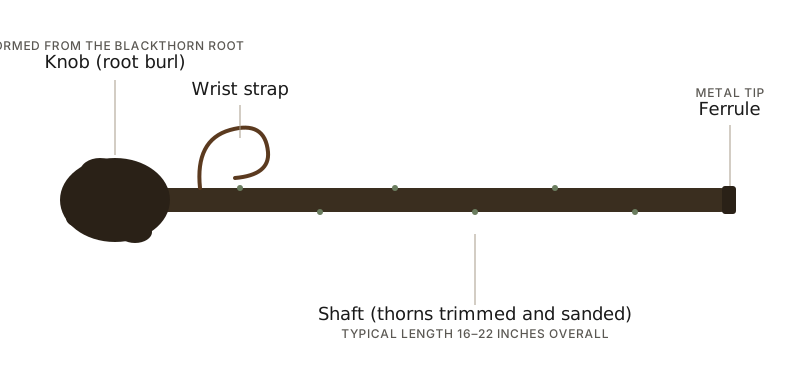
The wrist strap on a walking stick is one of the more visible wear points. Leather doesn’t last forever — typical life is 5-15 years of regular use before the strap stretches, cracks, or breaks at the attachment point. Replacement is well within home-maintenance capacity with basic leather-craft tools.
This guide covers the practical procedure. For broader maintenance context, see How to care for a blackthorn stick.
Tools and materials
For a typical strap replacement:
- Quality leather — saddle leather or oak-tanned shoe leather, 3-4mm thick, 12-20mm wide, 35-50cm length (one piece is sufficient for most attachment methods)
- Sharp craft knife or leather punch
- Small drill with 3-5mm bit (only needed for drilled-through attachment)
- Leather conditioning oil (neatsfoot oil or similar) for finishing the new strap
- Soft cloth for clean-up
Total cost: typically £8-£20 for the leather plus £5-£10 for any tools not already on hand.
Selecting the leather
The single most important decision is leather quality:
Saddle leather (premium choice) — heavy oak-tanned bridle or saddle leather, 3-4mm thick. Lasts decades; develops attractive patina with use; suits the working register of a quality stick. Available from saddleries and leather-craft suppliers; sometimes can be cut from an old leather belt of suitable thickness.
Oak-tanned shoe leather (good alternative) — similar in character to saddle leather but typically thinner (2-3mm); fine for lighter sticks or where the saddle leather is unobtainable.
Bridle leather (excellent) — pre-conditioned saddle leather with oil and wax already worked into the surface. Less common but exceptional.
Avoid:
- Fashion leather (chrome-tanned, often dyed brightly) — won’t last under working stress
- Suede — no wear surface; cracks at attachment points
- Split leather (the under-layer of leather, sold cheap) — delaminates with stress
- Synthetic leather — looks like leather initially but ages badly
The three attachment methods
There are three common ways to attach a wrist strap to a working stick. Each has its register.
Method 1: Knot-through-shaft (most common working method)
A single hole drilled through the shaft; the strap passes through and is knotted on both sides.
Procedure:
- Mark the strap position on the shaft (50-80mm below the head, depending on stick proportions)
- Drill a small hole (4-6mm diameter) through the shaft at the marked position. Drill straight through perpendicular to the shaft axis.
- Pass one end of the strap through the hole
- Tie a secure knot on each side of the shaft (overhand knot, figure-of-eight knot, or stopper knot)
- Trim excess strap to ~5mm beyond the knot
- Sometimes the knot is then dipped in clear glue or shellac to prevent loosening
Pros: secure, traditional, easy to renew when the strap wears.
Cons: the through-shaft hole slightly weakens the shaft at that point (cosmetic only for working sticks).
Method 2: Drilled-through with leather pin
The strap passes through the drilled hole and is held in place by a small piece of leather (a “pin”) inserted through a slit in the strap on each side of the shaft.
Procedure:
- Drill the hole as above
- Pass the strap through
- Cut a small slit in the strap on each side of the shaft, just outside the hole
- Insert a small piece of folded leather (the pin) through the slit, perpendicular to the strap
- The pin can be glued or further-fastened for security
Pros: cleaner-looking than visible knots; preserves the strap material if it needs to be removed.
Cons: slightly more complex; less common in modern working tradition.
Method 3: Brass swivel fitting
A small brass loop or eye is fitted to the shaft; the strap attaches to the brass.
Procedure:
- Fit a small brass screw-eye into the shaft at the strap position
- Attach the strap to the brass eye with a small leather loop or buckle
- The brass fitting allows the strap to swivel freely as the user’s hand rotates
Pros: looks refined; suits Victorian-era pieces and presentation sticks; allows free strap rotation.
Cons: more complex; less robust for working use; less traditional in Irish working register.
For working sticks, Method 1 (knot-through-shaft) is the standard. Method 2 suits buyers wanting cleaner aesthetics. Method 3 suits presentation and Victorian-era restoration.
Removing the old strap
The procedure depends on the old attachment method:
Knot-through-shaft — cut the strap close to one knot; pull the remainder through the hole. The knot may be tight; a steady pull usually works.
Pinned attachment — remove the pin from one side; pull the strap through.
Swivel fitting — open the strap loop at the brass eye; remove the strap. If the brass eye also needs replacing, unscrew or pry it out carefully.
Once the old strap is off, inspect the hole or attachment point for damage. Small enlargement is normal; substantial damage may require filling and re-drilling.
Fitting the new strap
For Method 1 (knot-through-shaft):
- Cut the new strap to length — typically 35-50cm depending on the wrist size and the desired loop length
- Optionally condition the leather with neatsfoot oil before fitting (makes it more pliable for knot-tying)
- Pass one end through the shaft hole
- Tie an overhand knot on one side, snug against the shaft
- Form the wrist loop on the other side by routing the strap through the wrist position and back through any necessary loop construction
- Tie the second knot, leaving the wrist loop at the desired length
- Trim excess and seal the knot ends with clear glue or shellac
For best results, fit and test the strap on the user’s wrist before final knotting. The loop should slip on and off the wrist comfortably but not slip off accidentally during walking.
Sizing the wrist loop
The wrist loop should:
- Slip on and off the user’s wrist with modest manipulation
- Not slip off accidentally during normal walking
- Allow the user to twist the stick in the hand without the strap binding
- Sit comfortably when the user is gripping the stick — neither pulling on the wrist nor flapping loosely
A typical adult wrist needs ~30-35cm of strap loop circumference. Larger wrists need correspondingly more. The user should test the new strap before final knot-securing.
Common mistakes
A few mistakes that produce botched repairs:
- Wrong leather grade — produces a strap that fails within months
- Hole drilled at wrong position — too high (above the natural grip) is uncomfortable; too low looks wrong
- Loop too tight — uncomfortable on the wrist; can cause skin irritation
- Loop too loose — falls off the wrist during walking
- Knot loose — pulls through the hole over time
- Mismatched leather colour to the stick aesthetic — dark stick with bright tan strap looks wrong
- No leather conditioning — new leather is stiff and uncomfortable; a brief application of neatsfoot oil softens it appropriately
Maintenance going forward
Once the new strap is fitted:
- Annual conditioning with neatsfoot oil or saddle soap to prevent the leather drying out
- Inspect at the attachment points annually for wear or cracking
- Replace expectation — quality saddle leather should last 10-20 years; lower-grade leather may need replacement more frequently
- Watch for shrinkage — wet leather shrinks as it dries; if the strap gets wet, work it through the wrist a few times while drying to keep the loop size correct
A walking stick with a well-fitted, well-maintained strap is more secure on the wrist and substantially more comfortable in extended carrying.
When to ask a working maker
For situations beyond home-maintenance:
- Vintage or heritage pieces where original-material preservation matters
- Brass swivel fittings that need repair or replacement
- Substantial shaft damage at the attachment point requiring filling or splicing
- Buyers who simply prefer not to do it themselves — working makers fit replacement straps for £15-£30 typical
For commissioning, see The makers page and Commissioning a bespoke stick.
Related reading
- guidesHow to care for a blackthorn stick
A real handmade blackthorn stick is meant to last a lifetime. The maintenance that gets it there is small and simple, and it is mostly about keeping the wood fed and dry.
- guidesHow to fit a brass ferrule to a walking stick
Step-by-step replacement of a worn or lost ferrule on a working walking stick — sizing, removal, fitting, securing, and what to do when the shaft end has deteriorated under the old ferrule.
- guidesIdentifying stick wear and damage
How to recognise the common wear patterns and damage modes that develop on working walking sticks — what's cosmetic, what's structural, when to repair, and when to retire.
- guidesHow to restore a vintage walking stick
When and how to restore an inherited, acquired, or rediscovered vintage walking stick — assessment, deciding what to preserve, the conservative restoration approach, and when professional restoration is appropriate.