Olive
The Mediterranean stick wood: gnarled, dense, golden-figured, and the inheritor of three thousand years of continuous cultivation.
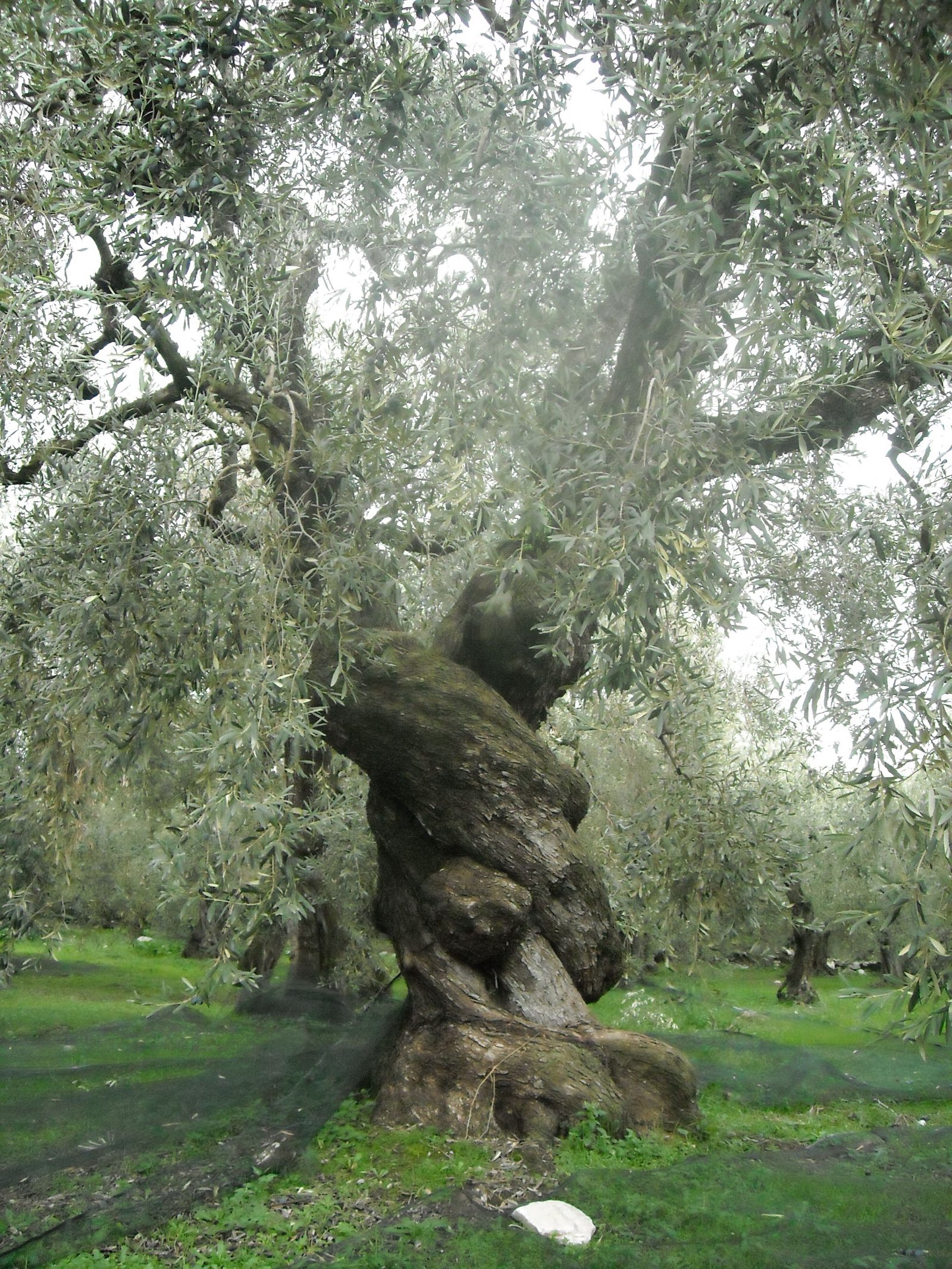
Olive is the Mediterranean stick wood. It is the timber of a tree that has been cultivated for at least six thousand years across the Mediterranean basin — Olea europaea, the common olive — and that lives long enough, in the older groves, that any individual trunk in current use may have been growing when the Roman Republic was a young state. The wood that comes out of a fallen or pruned olive trunk is dense, golden-figured, exceptionally hard, and visually unmistakable; nothing else in commercial commerce produces the cathedral grain of polished olive heartwood.
For a publication oriented toward the British and Irish hedgerow stick tradition, olive opens onto an entirely different working culture — a Mediterranean tradition rooted in the agricultural cycle of an oil-producing tree rather than in the small-batch craft economy of the temperate hedgerow. Olive sticks are made from pruned branches and felled or storm-broken trunks of trees whose primary economic purpose is fruit production for olive oil. The wood is, in this sense, a by-product of a different industry — but the tradition of working it into walking sticks, canes, and shepherd’s tools is continuous from the classical period to the present, particularly in Greece, Crete, Spain, and the Levant.
This is what the journal can tell a reader about it.
Quick reference
| Common names | Olive, common olive, elia (Greek), aceituna (Spanish), olivo (Italian), zaytoun (Arabic) |
| Binomial | Olea europaea L. |
| Family | Oleaceae (olive family — same as ash) |
| Native range | Mediterranean basin; eastern Mediterranean coast of Africa, into the Levant; cultivated globally in Mediterranean-climate regions |
| Habit | Evergreen tree, 5–15 m at maturity; very long-lived (hundreds to thousands of years); trunk twists and hollows with age |
| Bark | Smooth and grey on young growth; fissured, irregular, often hollowing on mature trees |
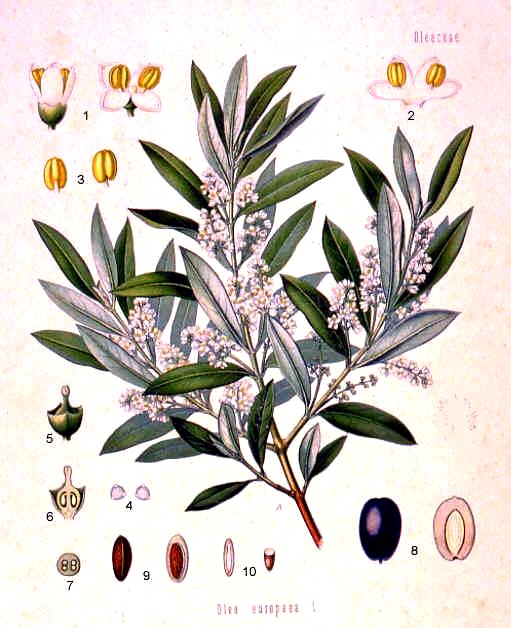
| Leaves | Opposite, simple, lance-shaped, leathery, 4–10 cm; silvery underneath, dark grey-green above; evergreen |
| Flowers | Small, white, in panicles; April–May |
| Fruit | The drupe (olive), green ripening to black; the basis of olive oil and table-olive industries |
| Wood density | ~890–950 kg/m³ — among the densest commercial European hardwoods [VERIFY] |
| Janka hardness | ~7,200 N — exceptionally hard, comparable to or above European hornbeam |
The plant
Olea europaea belongs to the Oleaceae — the same family as ash, lilac, and privet. The connection is structurally relevant: ash and olive share a common ancestor, similar wood-grain patterns at the cellular level, and (in the case of ash) the same vulnerability to ring-porous fungal pathogens. But olive is otherwise its own thing — an evergreen, slow-growing, drought-tolerant tree that has co-evolved with Mediterranean climate cycles over millions of years.
Three features identify olive in the field:
The silvery-undersided leaves. Olive leaves are dark grey-green on the upper surface and silvery-white on the underside, a colour scheme that produces the characteristic shimmering effect when wind passes through an olive grove. The shape — narrow, lance-shaped, leathery — is unlike any northern European tree and is unmistakable in the Mediterranean countryside.
The gnarled trunk. Mature olive trees develop deeply furrowed, twisted, often-hollowed trunks. The trunk profile of an olive at 200 years is distinct from any other commercial tree species in Europe; the older the tree, the more characteristic the gnarling. Some Mediterranean olives in current production have estimated ages of 1,000–2,000 years (with documented ages above 1,500 years on a few exceptional specimens) [VERIFY against carbon-14 and dendrochronology studies].
The fruit. Olive trees in production grow flowers in panicles in spring and fruit through summer and autumn; the green olives become black-purple as they ripen, and the fruit drops or is harvested between October and February depending on whether the destination is table olives (earlier) or oil (later).
In its growth pattern, olive is unusual. The tree can be coppiced — cut to the ground and regenerated from the stool — and a coppiced olive can produce a viable new trunk in 10–20 years, with full nut production resuming in 30–40 years. This is part of why olive groves can survive for thousands of years: individual trunks die or are removed, but the genetic identity of the grove continues through coppice regrowth from the original root system.

The Mediterranean working context
Olive cultivation is, in the Mediterranean basin, the agricultural foundation of the rural economy — and has been continuously since at least the Bronze Age. Estimated eleven million hectares are under olive cultivation globally as of the mid-2020s, with the vast majority in Spain, Italy, Greece, Tunisia, Portugal, Morocco, and Turkey [VERIFY current FAO figures]. Annual production runs to roughly three million tonnes of olive oil plus a comparable volume of table olives.
Olive trees are pruned annually, typically in winter, to maintain fruit production. The pruning produces an annual flow of small-diameter branches — typically 2–8 cm in diameter at the base — that are partly burned, partly used as firewood, and partly worked into stick-grade pieces by craftspeople adjacent to the orchard. Larger pieces come from felled trees (when an old grove is cleared for replanting) and from storm-broken trunks.
This means olive stick-making is, more than any of the British and Irish stick traditions, a secondary craft dependent on a primary agricultural cycle. A working olive stick-maker in Crete, Andalusia, or Apulia is typically a person with a day-job — often in the olive industry itself — who works sticks from pruning by-products as a side trade. The economics are different from the small-batch hedgerow stick-cutter; the supply is more abundant; the cultural register more practical.
The major regional traditions:
Crete — the Cretan walking stick (katsouna) is a recognised regional craft, with several active workshops producing carved-handle olive sticks for the tourist trade and for traditional shepherds. The form is often a Y-fork at the head (similar to a thumb-stick) or a carved knob.
Mainland Greece — particularly Pelion, the Peloponnese, and the western mountains. Olive sticks here trend toward simpler forms, less carved than the Cretan tradition, with strong emphasis on the natural grain figure of the wood.
Spain (Andalusia) — extensive working tradition; olive shepherd’s sticks and walking sticks are produced in volume across the southern Spanish countryside. The Spanish form is closer to the British walking stick than the Cretan crook, often with a fitted handle.
Italy (especially Apulia and Tuscany) — primarily walking sticks rather than crooks; high-end olive-wood gentleman’s canes for the tourist trade exist alongside working farm sticks. The Italian olive-wood handicraft tradition extends into kitchen ware, decorative bowls, and the small-furniture trade.
The Levant (Palestine, Lebanon, Syria, Israel) — olive walking sticks and shepherd’s sticks have been produced in this region since the classical period. The work survives but is heavily disrupted by the political and economic conditions of the late twentieth and early twenty-first centuries.
The wood
Olive is exceptionally hard, with Janka hardness around 7,200 N [VERIFY] — well above oak (~5,000 N), comparable to or above European holly, and approaching the hardness of hop hornbeam. Density runs around 890–950 kg/m³ at 12% moisture content, putting olive among the densest commercial European hardwoods.
The colour and figure are the wood’s defining features. The sapwood is pale cream, sometimes nearly white. The heartwood is a golden-honey or amber, often with strong streaks of darker brown and occasional near-black markings — the figure that has made olive a prized wood for cabinetwork, decorative turnery, and high-end gift items for centuries. The figure is irregular, sometimes called “lightning-strike” or cathedral grain, and is at its most striking on radial-cut faces.
The grain is interlocked in old-growth pieces, which is the consequence of the trunk’s tendency to twist as it grows. This makes olive harder to work than ash or oak — a hand-tool catches the interlocked grain unpredictably — but produces, when finished, a surface of striking visual depth that no straight-grained wood can match.
For walking-stick purposes, olive produces a stick that is:
- Heavy in the hand, denser even than hawthorn or blackthorn
- Visually striking, with the gold-and-brown figure visible through any oil finish
- Limited in length — the gnarled, twisted trunk character means clean straight pieces over three feet are uncommon, and most olive walking sticks are under four feet
- Resistant to wear, with the dense surface holding up well against everyday handling
- Distinctive in cultural register — an olive stick reads as Mediterranean in a way that is impossible to mistake
The visual signature that says olive specifically: the irregular gold-and-brown grain figure, often with strong dark streaks; a polished surface that reads as glassy under low-angle light; and (often) a slightly twisted natural form preserved from the source branch.
Cutting and seasoning
Olive seasoning is, in some respects, slower than blackthorn and, in others, faster. The wood:
- Cracks easily during seasoning if dried too quickly, particularly through the irregular knots and twists of older-growth pieces — surface checking and end-grain cracks are the standard failure modes
- Holds dimensional stability once seasoned, with low shrinkage compared to most temperate hardwoods
- Requires careful storage — the wood is dense enough that internal moisture moves slowly, and pieces dried in a hurry often case-harden (develop dry surfaces over still-wet cores)
Traditional Mediterranean seasoning runs two to four years for stick-grade pieces, with the larger pieces left longer. The wood is cut from pruning by-products (small diameter, available annually) or from felled trunks (larger diameter, seasoned slowly in controlled conditions).
After seasoning, olive is often debarked — the bark is rough and irregular and rarely contributes to the visual character of the finished stick. The wood is then shaped (often retaining the natural curve of the source branch), polished, oiled, and fitted with a handle and ferrule as needed.
Finishing is traditionally olive oil. The wood absorbs olive oil deeply, the figure deepens visibly, and the grain pattern emerges as the oil penetrates. The traditional Greek and Cretan finishing oils are sometimes scented with herbs (rigani — wild marjoram — is a common addition) for cultural reasons that are partly ritual and partly practical (the volatile oils may have some surface-protective effect). Beeswax over the cured oil is the standard final finish.
From cut to stick
The forms olive most often takes:
The Cretan katsouna (κατσούνα) — a curved-handle walking stick or shepherd’s stick, often with the curve preserved from the natural growth of the source branch. Length typically 80–100 cm. The handle is often carved with simple decorative motifs (geometric patterns, religious symbols, the user’s initials). The katsouna is a piece of working Cretan material culture, made by named craftspeople in active workshops, and is a recognised tourist-souvenir item alongside its actual everyday use.
The Spanish olive walking stick — typically straighter than the Cretan form, with a fitted carved-wood or horn handle, often longer (90–110 cm). The Spanish tradition is more closely aligned with the British walking-stick form than the Cretan one.
The high-end gentleman’s cane — Italian and Spanish craftsmen produce olive-wood canes with metal (silver, brass) or carved wood handles, sized for urban dress use, in the Mediterranean upmarket craft trade.
The shepherd’s stick — a longer form (150–180 cm), often with a Y-fork at the head, used by working shepherds across the Greek and Spanish countryside. The shepherd’s stick form has overlapping conventions with the British shepherd’s crook (see /sticks/shepherds-crook/, in preparation), but the olive material gives it a distinctly Mediterranean visual register.
Beyond sticks
Olive’s primary economic role is, of course, fruit production for olive oil and table olives. Wood is a substantial side product. The non-stick uses include:
Cabinetwork and turnery — olive wood is one of the more prized European cabinet woods, particularly for small decorative turning (bowls, salt cellars, knife handles). Italian and Greek workshops produce high-end olive-wood kitchen and gift wares for export at substantial scale.
Cooking utensils — wooden spoons, spatulas, salad servers in olive wood are a standard Mediterranean export. The wood does not absorb cooking oils significantly and resists staining from acidic foods better than most kitchen woods.
Crucifixes and devotional objects — olive wood from the Holy Land has a long ecclesiastical-craft tradition. Olive-wood crucifixes from Bethlehem and Nazareth are produced in volume for the religious-tourism trade and have a continuous documented history reaching to the medieval pilgrim period.
Charcoal and firewood — olive prunings are a major source of rural firewood across the Mediterranean. The wood burns hot and slow.
Veneer — high-figure pieces are sliced into veneer for furniture and decorative surfaces, particularly in Italy and Spain.
The cumulative effect is that olive is one of the more commercially diverse wood products of the European temperate-and-Mediterranean zone, with stick-making representing a tiny fraction of total economic use.
Olive vs the British and Irish stick woods
The summary, for a reader trying to place olive in the broader stick world:
Density: olive is denser than blackthorn, far denser than oak or ash. Hand-for-hand, an olive stick is the heaviest of the common stick woods.
Visual register: olive’s gold-and-brown figured grain is unmistakable; no other commercial stick wood looks like it.
Cultural register: an olive stick reads as Mediterranean. A hawthorn or blackthorn stick reads as British and Irish. They are not interchangeable in the way that blackthorn and oak are within the Irish tradition; olive belongs to a different working culture.
Form: olive sticks tend to be shorter than equivalent British walking sticks, often with a preserved natural curve from the source branch. The Cretan katsouna and the Spanish carved-handle stick are recognisably different forms from the British walking stick or the Irish shillelagh.
Availability outside the Mediterranean: olive sticks are commercially available globally through the tourist and craft-export trade, but a working olive-stick maker outside the Mediterranean is uncommon. The wood’s character is part of its cultural-geographic specificity, and a transplanted olive-stick craft tradition would lose something important about its source.
For a buyer who wants a Mediterranean stick from the actual Mediterranean tradition, the most direct route is Cretan, Greek, or Spanish workshops via the tourist-craft trade. The journal does not currently maintain a recommended-makers list for olive sticks; if you know of a maker who should be considered, please write to the editor.
This is a reference page on olive as a stick wood. The Mediterranean stick traditions deserve fuller individual treatment — Crete, Andalusia, the Levant — and dedicated regional pieces are in preparation. Corrections from working makers in the Mediterranean tradition are particularly welcome at [email protected].
Sources & further reading
- Olea europaea L. — Plants of the World Online, Plants of the World Online, Royal Botanic Gardens, Kew
- International Olive Council, International Olive Council
- Olive — wood properties, The Wood Database
- Mort Rosenblum, Olives: The Life and Lore of a Noble Fruit (1996), North Point Press / WorldCat
- FAO Olive cultivation reports, Food and Agriculture Organization of the United Nations
Related reading
- woodsOak
The other Irish stick wood — older, heavier, and the source of the original Wicklow shillelaghs.
- woodsBlackthorn Tree Wood: Curing
The hedgerow tree behind most Irish sticks: dense, dark, slow-growing, and beloved of hedge-witches.
- woodsAsh
The springy, impact-resistant wood of staves, tool handles, and the Irish hurling stick — and the species now in the middle of a Europe-wide health crisis.
- comparisonsHolly vs blackthorn vs oak vs ash
Four traditional stick woods, side by side: how they look, how they behave under the hand, and which one belongs in which kind of stick.