Shillelagh vs walking stick vs blackthorn stick
Three terms that are used interchangeably in tourist shops but mean different things in the workshop. Here's what each one actually refers to.

The three terms are not interchangeable, even though they almost always are in casual use, in tourist shops, and on the websites of mass-market gift retailers. Each one means something specific in the workshop, and a maker who knows the work will use the terms with care.
This is the short version of what each one refers to.
The three forms
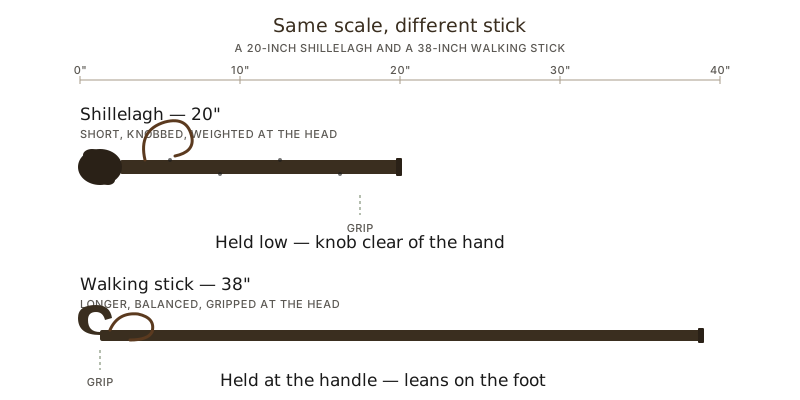
A shillelagh is a short, weighted, knobbed wooden club, traditionally from Ireland. The defining features are the short length (16–22 inches is typical), the heavy head (formed from the natural root burl of the tree), the leather wrist strap, and the historical role as a fighting club rather than a walking aid. A shillelagh is held low on the shaft, near the foot, with the knob clear of the hand for striking. It is, in form and function, a club.
A walking stick is a longer, balanced stick designed to take weight on flat ground or hill walking, gripped at the top by a handle, a knob, or a fork. Typical length is 32–43 inches, sized to the user’s height. The walking stick distributes the user’s weight through the wrist and arm to the foot of the stick; it is engineered, in the working sense, to be leaned on. A walking stick is much longer than a shillelagh, more even in balance, and gripped at the head rather than the shaft.
A blackthorn stick is any stick made of blackthorn (Prunus spinosa), regardless of length, form, or function. The phrase says something about the wood; it does not, by itself, say anything about whether the stick is a shillelagh, a walking stick, or some third thing. A long blackthorn stick is a walking stick made of blackthorn. A short one is a shillelagh. A piece of blackthorn intended for tool-handle stock is none of the above.
The difference is straightforward and consequential. Tourist-shop catalogues that label a 36-inch walking stick as a “shillelagh” are doing something wrong, even if the wood is genuine blackthorn. The shillelagh is short; the walking stick is long; and the wood is a separate question from both.
The historical reason
The conflation has a partly forgivable explanation. For most of the period when these objects were in everyday Irish use, the same person carried both — and often the same tree had been cut to make both. A nineteenth-century countryman might own a long blackthorn walking stick for the road and a short blackthorn shillelagh for the fair; the wood was the same and the maker was the same and the social context was the same. The two forms shaded into each other in a way that the more rigid modern terminology obscures.
Where the terminology came apart was in the emigration to the United States. The shillelagh became a souvenir of Irish identity in the American diaspora — bought as a gift, hung on a wall, paraded on St Patrick’s Day — at a scale that the longer walking stick never matched. American gift-shop English absorbed shillelagh as a generic term for any Irish wooden stick, and the modern confusion is largely the result of that semantic broadening, fed back into Irish tourism by a hundred years of returning visitors. The term is now used in two registers — the precise workshop register and the broad consumer register — that mostly do not overlap.
How to tell them apart visually
The simplest test is length.
- Less than 24 inches: a shillelagh.
- More than 30 inches: a walking stick.
- 24 to 30 inches: a transitional piece, sometimes called a swagger stick in military usage, sometimes a cane; the maker’s intention determines the form.
The second test is the head.
- A shillelagh’s head is the root burl — a swollen, irregular, dense bulb formed from the junction of the trunk with the root. It is part of the stick, not a separate piece. It is rough; it is heavy; it is the striking surface.
- A walking stick’s head is a handle — a curve, a fork, a knob, sometimes a horn or stag-antler fitting, designed to be gripped by the hand. It may be carved, fitted, or natural, but it is meant to be held, not swung.
The third test is the strap.
- A shillelagh has a wrist strap through a hole drilled below the head. The strap loops over the wrist when the stick is in the low fighting grip, securing it during a swing.
- A walking stick may or may not have a wrist strap. When it does, the strap is at the handle end rather than below the head, and it is for hanging the stick or for keeping it close at hand on a slope, not for retention during a strike.
If a piece has a long shaft, a fitted handle, and a wrist strap at the handle end, it is a walking stick — even if it is made of blackthorn and even if it is being sold as a shillelagh.
How to tell a real one from a fake
This is a separate question from the form question, but it comes up often enough that it belongs here. The mass-market “blackthorn shillelagh” — sold cheaply, mostly through the American Irish-gift trade — is typically a turned dowel of a different wood, stained dark, with a separate wooden ball glued onto the head and a thin synthetic strap looped through. The form is approximately right; the wood is not blackthorn; the head is not a root burl; and the price is not what a real piece costs.
Three fast tests:
- Look at the head. A real root burl flows out of the shaft as a continuous piece of wood, with grain running through both. A glued knob has a clear seam where it joins the shaft, often visible under finish.
- Look at the surface of the shaft. A real blackthorn shaft shows the trimmed nubs where the live thorns once stood — small raised marks at irregular intervals. A turned dowel has a smooth, regular surface.
- Pick it up. A real piece is heavier than its dimensions suggest, because the wood is dense (770–810 kg/m³ for blackthorn; in line with oak or higher). A turned softwood dowel is light.
A real shillelagh from a careful maker is irregular, heavy, and slightly rough in surface character. The cheap version is regular, light, and glassy-smooth. The wood gives it away before any other test does.
What to ask for
If you are buying from an honest maker, the language to use is straightforward:
- A 19-inch blackthorn shillelagh, with leather strap and natural ferrule is unambiguous. The maker knows what you mean.
- A 38-inch oak walking stick, with horn handle is also unambiguous.
- A blackthorn stick without specifying length will get you a question back from the maker about what you have in mind.
If a seller cannot answer the length question — or cannot tell you what wood the piece is — they probably are not the maker. The piece may still be fine; it may equally be the manufactured kind. Ask.
For the longer treatment of what a shillelagh actually is, see What is a shillelagh?. For the wood specifically, see Blackthorn. For the side-by-side of the four traditional stick woods, see Holly vs blackthorn vs oak vs ash.
The terminology question is more current than it should be — the journal continues to receive corrections from readers about how these terms are used regionally and in particular makers’ workshops. If your usage differs from what’s described here, please write in.
Sources & further reading
- shillelagh, n., Oxford English Dictionary
- walking-stick, n., Oxford English Dictionary
- British Stickmakers Guild — types of stick, British Stickmakers Guild
Related reading
- guidesShillelagh: Meaning, History & How to Spot a Real One
An Irish blackthorn club, a contested word, and a heritage object that has outlived its job description.
- woodsBlackthorn Tree Wood: Curing
The hedgerow tree behind most Irish sticks: dense, dark, slow-growing, and beloved of hedge-witches.
- comparisonsHolly vs blackthorn vs oak vs ash
Four traditional stick woods, side by side: how they look, how they behave under the hand, and which one belongs in which kind of stick.
- guidesA short history of the Irish walking stick
Three centuries of an everyday object — from faction-fight weapon to emigrant gift to the heritage piece a small handful of makers still cut by hand.